







‘Trump Route’ no threat to strong Iran: Expert
US pursues political goal in South Caucasus
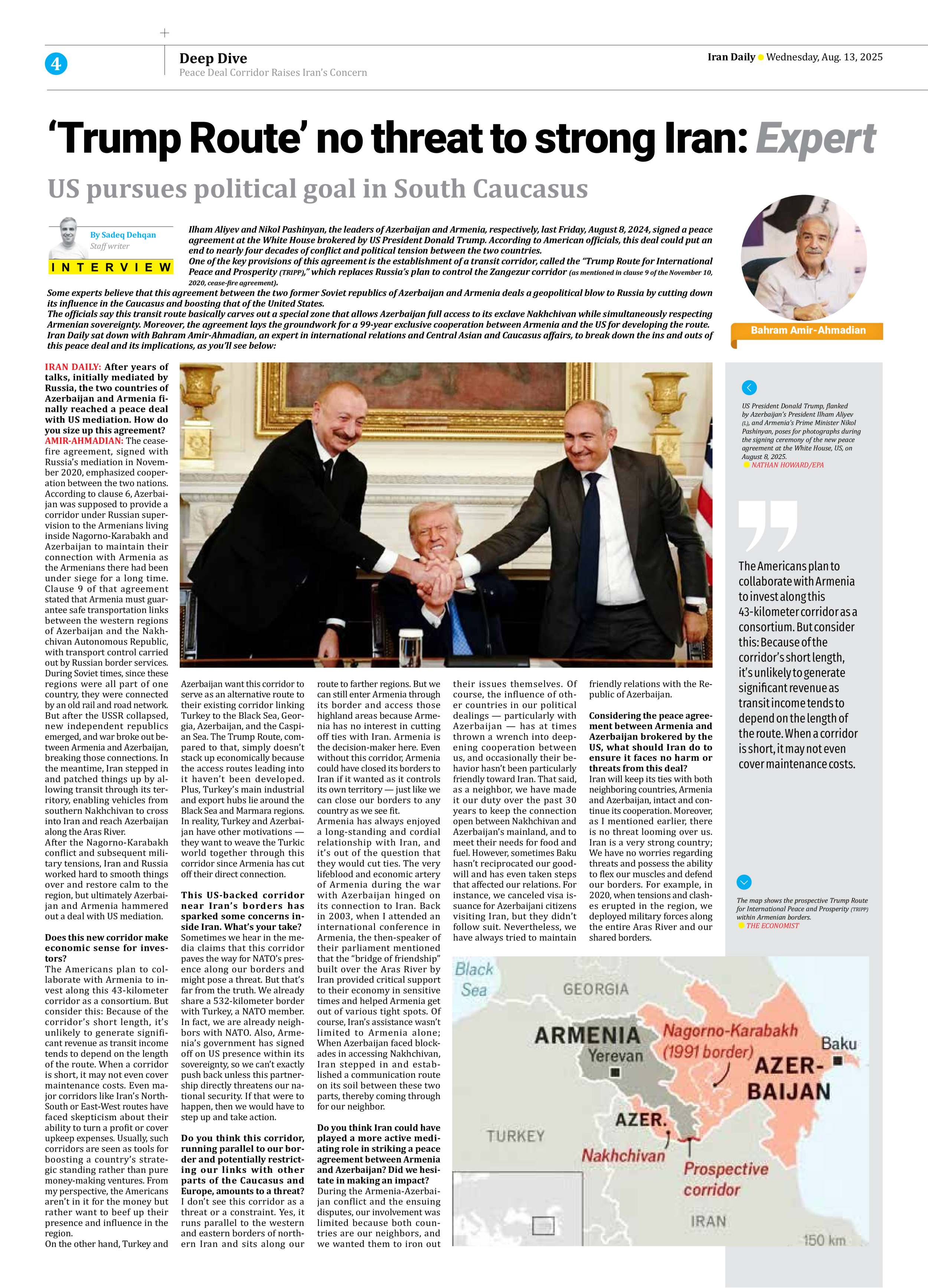
Ilham Aliyev and Nikol Pashinyan, the leaders of Azerbaijan and Armenia, respectively, last Friday, August 8, 2024, signed a peace agreement at the White House brokered by US President Donald Trump. According to American officials, this deal could put an end to nearly four decades of conflict and political tension between the two countries. One of the key provisions of this agreement is the establishment of a transit corridor, called the “Trump Route for International Peace and Prosperity (TRIPP),” which replaces Russia’s plan to control the Zangezur corridor (as mentioned in clause 9 of the November 10, 2020, cease-fire agreement). Some experts believe that this agreement between the two former Soviet republics of Azerbaijan and Armenia deals a geopolitical blow to Russia by cutting down its influence in the Caucasus and boosting that of the United States. The officials say this transit route basically carves out a special zone that allows Azerbaijan full access to its exclave Nakhchivan while simultaneously respecting Armenian sovereignty. Moreover, the agreement lays the groundwork for a 99-year exclusive cooperation between Armenia and the US for developing the route. Iran Daily sat down with Bahram Amir-Ahmadian, an expert in international relations and Central Asian and Caucasus affairs, to break down the ins and outs of this peace deal and its implications, as you’ll see below:
By Sadeq Dehqan
Staff writer
IRAN DAILY: After years of talks, initially mediated by Russia, the two countries of Azerbaijan and Armenia finally reached a peace deal with US mediation. How do you size up this agreement?
AMIR-AHMADIAN: The cease-fire agreement, signed with Russia’s mediation in November 2020, emphasized cooperation between the two nations. According to clause 6, Azerbaijan was supposed to provide a corridor under Russian supervision to the Armenians living inside Nagorno-Karabakh and Azerbaijan to maintain their connection with Armenia as the Armenians there had been under siege for a long time. Clause 9 of that agreement stated that Armenia must guarantee safe transportation links between the western regions of Azerbaijan and the Nakhchivan Autonomous Republic, with transport control carried out by Russian border services.
During Soviet times, since these regions were all part of one country, they were connected by an old rail and road network. But after the USSR collapsed, new independent republics emerged, and war broke out between Armenia and Azerbaijan, breaking those connections. In the meantime, Iran stepped in and patched things up by allowing transit through its territory, enabling vehicles from southern Nakhchivan to cross into Iran and reach Azerbaijan along the Aras River.
After the Nagorno-Karabakh conflict and subsequent military tensions, Iran and Russia worked hard to smooth things over and restore calm to the region, but ultimately Azerbaijan and Armenia hammered out a deal with US mediation.
Does this new corridor make economic sense for investors?
The Americans plan to collaborate with Armenia to invest along this 43-kilometer corridor as a consortium. But consider this: Because of the corridor’s short length, it’s unlikely to generate significant revenue as transit income tends to depend on the length of the route. When a corridor is short, it may not even cover maintenance costs. Even major corridors like Iran’s North-South or East-West routes have faced skepticism about their ability to turn a profit or cover upkeep expenses. Usually, such corridors are seen as tools for boosting a country’s strategic standing rather than pure money-making ventures. From my perspective, the Americans aren’t in it for the money but rather want to beef up their presence and influence in the region.
On the other hand, Turkey and Azerbaijan want this corridor to serve as an alternative route to their existing corridor linking Turkey to the Black Sea, Georgia, Azerbaijan, and the Caspian Sea. The Trump Route, compared to that, simply doesn’t stack up economically because the access routes leading into it haven’t been developed. Plus, Turkey’s main industrial and export hubs lie around the Black Sea and Marmara regions. In reality, Turkey and Azerbaijan have other motivations — they want to weave the Turkic world together through this corridor since Armenia has cut off their direct connection.
This US-backed corridor near Iran’s borders has sparked some concerns inside Iran. What’s your take?
Sometimes we hear in the media claims that this corridor paves the way for NATO’s presence along our borders and might pose a threat. But that’s far from the truth. We already share a 532-kilometer border with Turkey, a NATO member. In fact, we are already neighbors with NATO. Also, Armenia’s government has signed off on US presence within its sovereignty, so we can’t exactly push back unless this partnership directly threatens our national security. If that were to happen, then we would have to step up and take action.
Do you think this corridor, running parallel to our border and potentially restricting our links with other parts of the Caucasus and Europe, amounts to a threat?
I don’t see this corridor as a threat or a constraint. Yes, it runs parallel to the western and eastern borders of northern Iran and sits along our route to farther regions. But we can still enter Armenia through its border and access those highland areas because Armenia has no interest in cutting off ties with Iran. Armenia is the decision-maker here. Even without this corridor, Armenia could have closed its borders to Iran if it wanted as it controls its own territory — just like we can close our borders to any country as we see fit.
Armenia has always enjoyed a long-standing and cordial relationship with Iran, and it’s out of the question that they would cut ties. The very lifeblood and economic artery of Armenia during the war with Azerbaijan hinged on its connection to Iran. Back in 2003, when I attended an international conference in Armenia, the then-speaker of their parliament mentioned that the “bridge of friendship” built over the Aras River by Iran provided critical support to their economy in sensitive times and helped Armenia get out of various tight spots. Of course, Iran’s assistance wasn’t limited to Armenia alone; When Azerbaijan faced blockades in accessing Nakhchivan, Iran stepped in and established a communication route on its soil between these two parts, thereby coming through for our neighbor.
Do you think Iran could have played a more active mediating role in striking a peace agreement between Armenia and Azerbaijan? Did we hesitate in making an impact?
During the Armenia-Azerbaijan conflict and the ensuing disputes, our involvement was limited because both countries are our neighbors, and we wanted them to iron out their issues themselves. Of course, the influence of other countries in our political dealings — particularly with Azerbaijan — has at times thrown a wrench into deepening cooperation between us, and occasionally their behavior hasn’t been particularly friendly toward Iran. That said, as a neighbor, we have made it our duty over the past 30 years to keep the connection open between Nakhchivan and Azerbaijan’s mainland, and to meet their needs for food and fuel. However, sometimes Baku hasn’t reciprocated our goodwill and has even taken steps that affected our relations. For instance, we canceled visa issuance for Azerbaijani citizens visiting Iran, but they didn’t follow suit. Nevertheless, we have always tried to maintain friendly relations with the Republic of Azerbaijan.
Considering the peace agreement between Armenia and Azerbaijan brokered by the US, what should Iran do to ensure it faces no harm or threats from this deal?
Iran will keep its ties with both neighboring countries, Armenia and Azerbaijan, intact and continue its cooperation. Moreover, as I mentioned earlier, there is no threat looming over us. Iran is a very strong country; We have no worries regarding threats and possess the ability to flex our muscles and defend our borders. For example, in 2020, when tensions and clashes erupted in the region, we deployed military forces along the entire Aras River and our shared borders.