







Negotiations need clear subject, fairness: Former spokesman
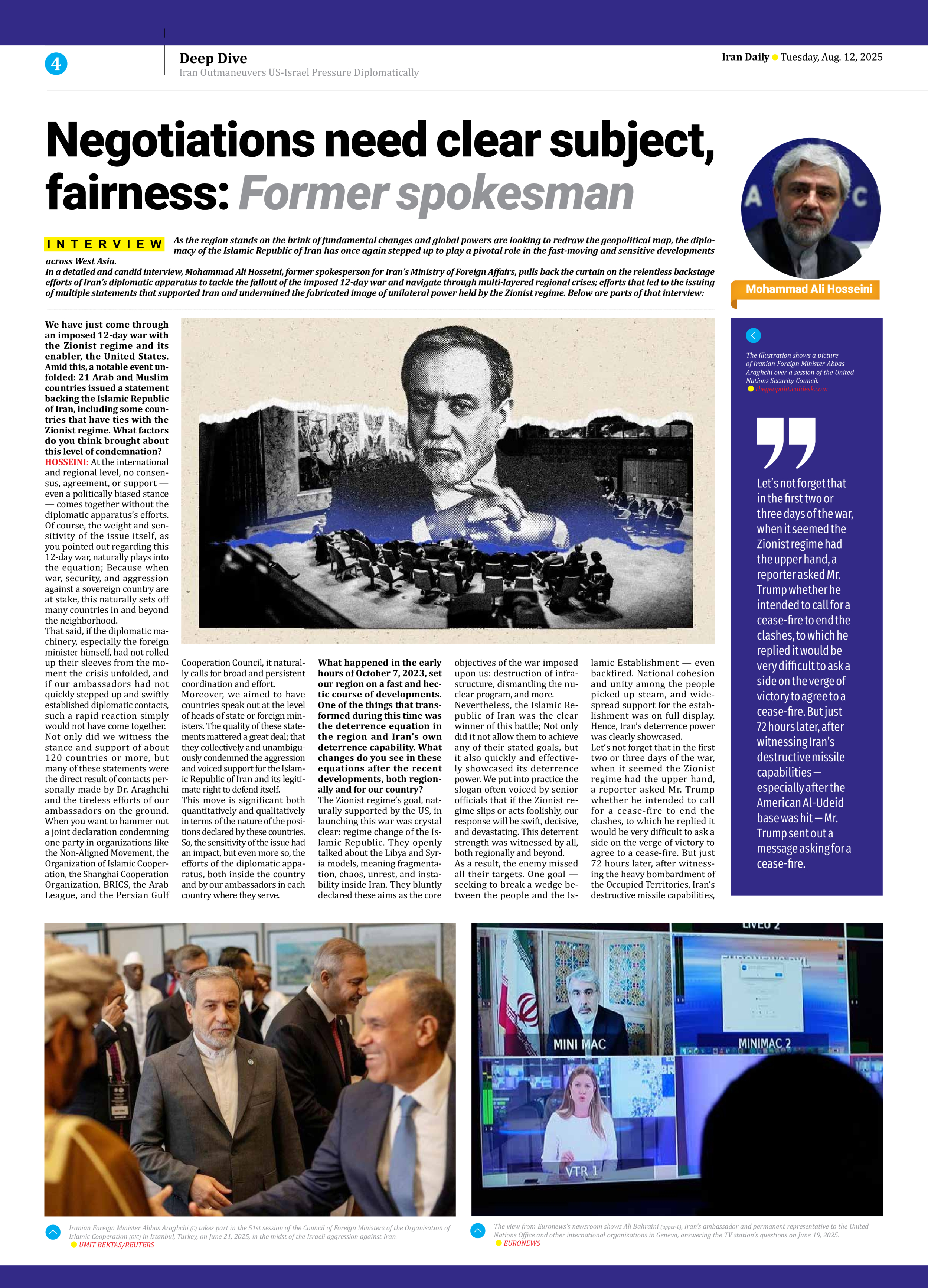
As the region stands on the brink of fundamental changes and global powers are looking to redraw the geopolitical map, the diplomacy of the Islamic Republic of Iran has once again stepped up to play a pivotal role in the fast-moving and sensitive developments across West Asia. In a detailed and candid interview, Mohammad Ali Hosseini, former spokesperson for Iran’s Ministry of Foreign Affairs, pulls back the curtain on the relentless backstage efforts of Iran’s diplomatic apparatus to tackle the fallout of the imposed 12-day war and navigate through multi-layered regional crises; efforts that led to the issuing of multiple statements that supported Iran and undermined the fabricated image of unilateral power held by the Zionist regime. Below are parts of that interview:
We have just come through an imposed 12-day war with the Zionist regime and its enabler, the United States. Amid this, a notable event unfolded: 21 Arab and Muslim countries issued a statement backing the Islamic Republic of Iran, including some countries that have ties with the Zionist regime. What factors do you think brought about this level of condemnation?
HOSSEINI: At the international and regional level, no consensus, agreement, or support — even a politically biased stance — comes together without the diplomatic apparatus’s efforts. Of course, the weight and sensitivity of the issue itself, as you pointed out regarding this 12-day war, naturally plays into the equation; Because when war, security, and aggression against a sovereign country are at stake, this naturally sets off many countries in and beyond the neighborhood.
That said, if the diplomatic machinery, especially the foreign minister himself, had not rolled up their sleeves from the moment the crisis unfolded, and if our ambassadors had not quickly stepped up and swiftly established diplomatic contacts, such a rapid reaction simply would not have come together.
Not only did we witness the stance and support of about 120 countries or more, but many of these statements were the direct result of contacts personally made by Dr. Araghchi and the tireless efforts of our ambassadors on the ground. When you want to hammer out a joint declaration condemning one party in organizations like the Non-Aligned Movement, the Organization of Islamic Cooperation, the Shanghai Cooperation Organization, BRICS, the Arab League, and the Persian Gulf Cooperation Council, it naturally calls for broad and persistent coordination and effort.
Moreover, we aimed to have countries speak out at the level of heads of state or foreign ministers. The quality of these statements mattered a great deal; that they collectively and unambiguously condemned the aggression and voiced support for the Islamic Republic of Iran and its legitimate right to defend itself.
This move is significant both quantitatively and qualitatively in terms of the nature of the positions declared by these countries. So, the sensitivity of the issue had an impact, but even more so, the efforts of the diplomatic apparatus, both inside the country and by our ambassadors in each country where they serve.
What happened in the early hours of October 7, 2023, set our region on a fast and hectic course of developments. One of the things that transformed during this time was the deterrence equation in the region and Iran’s own deterrence capability. What changes do you see in these equations after the recent developments, both regionally and for our country?
The Zionist regime’s goal, naturally supported by the US, in launching this war was crystal clear: regime change of the Islamic Republic. They openly talked about the Libya and Syria models, meaning fragmentation, chaos, unrest, and instability inside Iran. They bluntly declared these aims as the core objectives of the war imposed upon us: destruction of infrastructure, dismantling the nuclear program, and more.
Nevertheless, the Islamic Republic of Iran was the clear winner of this battle; Not only did it not allow them to achieve any of their stated goals, but it also quickly and effectively showcased its deterrence power. We put into practice the slogan often voiced by senior officials that if the Zionist regime slips or acts foolishly, our response will be swift, decisive, and devastating. This deterrent strength was witnessed by all, both regionally and beyond.
As a result, the enemy missed all their targets. One goal — seeking to break a wedge between the people and the Islamic Establishment — even backfired. National cohesion and unity among the people picked up steam, and widespread support for the establishment was on full display. Hence, Iran’s deterrence power was clearly showcased.
Let’s not forget that in the first two or three days of the war, when it seemed the Zionist regime had the upper hand, a reporter asked Mr. Trump whether he intended to call for a cease-fire to end the clashes, to which he replied it would be very difficult to ask a side on the verge of victory to agree to a cease-fire. But just 72 hours later, after witnessing the heavy bombardment of the Occupied Territories, Iran’s destructive missile capabilities, and its defensive and deterrent power — especially after the American Al-Udeid base was hit — Mr. Trump sent out a message asking for a cease-fire.
The Islamic Republic demonstrated its deterrence clearly, and when that power is openly displayed, you will see shifts and new equations taking shape in the region and beyond. Of course, to reach definite and tangible deterrence strength, we must cover up and make up for our weaknesses while simultaneously building on our strengths — so firmly that not even the thought crosses the mind of any enemy that they can threaten Iran’s security. God willing, with national unity and the strong support our armed forces enjoy today, this deterrence must be reinforced and consolidated in every dimension.
One reaction to the Zionist regime and the United States’ aggression against Iran that caught many Western media off guard was the stance taken by the European troika and the European Union. Numerous articles were even published highlighting how Europe, once a self-proclaimed defender of human rights, has reached a point where it not only refuses to condemn the aggression but actually comes down on the side of the aggressor. How did Europe and its three main countries get to this point? What has unfolded in Iran-Europe relations?
Unfortunately, the European countries have stuck to the course they set out on during the imposed 12-day war. Especially the three key players — France, the UK, and Germany — who hold significant sway in the EU’s decision-making, have gone down a path that has led to the decline of Europe’s credibility and influence in the region, on the global stage, and even bilaterally with the Islamic Republic of Iran.
The approach European countries have adopted toward Iran has effectively knocked the wind out of the sails of Iran-Europe relationship supporters. Many analysts and political experts — even those who have consistently championed the expansion of ties with Europe — admitted they never thought Europe would double down on such negative stances or turn a blind eye to the blatant crimes of the Zionist regime.
At the G7, meeting where these three European countries were present, a statement was issued that was truly shameful. The statement laid out two deeply troubling points: First, the so-called right of “legitimate defense” was granted to a regime that openly engaged in aggression, terrorism, destruction, and mass killing. Second, the Islamic Republic of Iran was painted as the center of insecurity, instability, and terrorism in the region.
Furthermore, the German chancellor’s remark was highly notable. He said the aggression was the “dirty work Israel is doing for all of us”. What does this statement imply? If your nation — that is, your sovereignty, territorial integrity, people, scientists, and military commanders — gets subjected to aggression, invasion, and terrorism, would you consider that legitimate? This phrase essentially means that if it were within their power, they themselves would have carried out these actions, but lacking such capability, the Zionist regime — which has become fully exposed as America’s and the West’s proxy in the region — is doing it for them.
Europe not only refused to condemn the attack on Iran’s nuclear facilities but also completely backed away from the bare minimum of ethical and legal standards in international relations. This is while these same countries had negotiated with us for years on the nuclear issue and formally recognized Iran’s enrichment program within the framework of the agreement.
But today, they talk of “zero enrichment” and “complete dismantlement” of Iran’s nuclear program; a series of demands and positions that have caused Europe’s standing among the Iranian nation, regional peoples, and even on the world stage to further deteriorate. Europeans need to face up to the fact that the cause of this decline lies precisely in these irresponsible, two-faced approaches and actions. Even the United States, their closest ally, no longer holds Europe in any special regard.
What’s the way forward? If Europeans are truly serious about mending fences with the Islamic Republic, they must recognize Iran’s legitimate, obvious, and lawful rights — both regarding the nuclear issue and other matters. The Islamic Republic has never asked for more than its rightful rights in negotiations but expects that when it holds up its end of the bargain faithfully, its rights will be recognized in return.
Since taking office as foreign minister, Foreign Minister Araghchi has put forward an initiative aimed at cooling down tensions in Iran-Europe relations. Amid the recent war, Araghchi held significant talks in Geneva with foreign ministers of the European troika and the EU’s foreign policy chief. Moreover, another round of talks at the deputy level was just held in Istanbul. Can we hold out hope that Iran-Europe relations might come to fruition, especially given the unofficial, artificial deadline Europe has lined up for snapback activation?
This snapback issue is part of the new game Europeans are continuing to play out along the same misguided path they started before. If negotiations are to bear fruit, there’s no way around recognizing Iran’s legitimate, natural, and legal rights. We have no other route.
Currently, the sanctions imposed by the US have been backed up by Europe as well. Before finalizing the nuclear agreement, we had close talks with European parties, and after the JCPOA was inked, the Islamic Republic, as a committed party, held fast to all its obligations. This was confirmed not only by multiple reports from the International Atomic Energy Agency but also by the European countries themselves. Even after the US exit, Iran kept up its commitments for a long time and still continues to engage responsibly.
But here’s the question: On which commitments have the European countries, who were principal parties to the agreement, actually followed through? Aside from aligning with the US, issuing condemnations, or expressing verbal concerns, what concrete steps have been taken to fulfill their commitments? Everyone rightly expects reciprocal action from Europe for Iran’s compliance. Just as they expected Iran to accept practical restrictions, Iran also has the right to see tangible moves to lift sanctions.
Let’s not forget that, after the US departure from the JCPOA, Europeans took on 11 specific commitments, yet not one was carried out. A glaring example of this failure is that Europe didn’t even condemn the brutal Israeli attack on Iran’s nuclear facilities, despite ongoing negotiations and maintained contacts.
Our position is crystal clear: The legitimate rights of the Islamic Republic of Iran must be acknowledged. Iran will never back down from any of its obvious rights, including enrichment, peaceful nuclear activities, and the safeguards set by the Agency. Should Europe change course, Iran’s leadership will undoubtedly make decisions suited to the new circumstances.
In my view, the ongoing talks reflect Iran’s effort to hammer home its lawful, principled, and rational stances. Now, it’s up to the European side to make up its mind: Are they genuinely interested in turning over a new leaf in relations with the Islamic Republic or not? If yes, they must accept and commit in practice to frameworks for constructive interaction based on mutual respect, shared interests, and adherence to dialog principles.
Despite all the realities currently playing out on the political and field scenes, the Islamic Republic of Iran has consistently stressed that it has never walked away from the negotiating table nor shut the door on diplomacy at any point. Is there any prospect for us to return once more to the negotiating table with the United States? Especially under conditions where Donald Trump has recently, in response to our foreign minister’s remarks, threatened to launch new attacks.
Some officials of the Zionist regime and certain American figures continue to wave the threat of renewed attacks. These threats are nothing but a rerun of the “all options are on the table” policy that we have repeatedly heard echo through past years. Amid this, what Araghchi has laid out is that despite all the damages sustained during this period, the Islamic Republic of Iran remains ready to engage in dialogue. But the issue is: Who should answer for these damages? Who should make good on these harms?
When we talk about negotiation, we mean a purposeful and clear dialogue. A negotiation with a well-defined subject. Naturally, topics such as Iran’s peaceful nuclear program, the right of enrichment, territorial integrity, national sovereignty, and scientific achievements — which are the nation’s assets — are red lines that are non-negotiable. This is something considered self-evident even in Western countries.
However, if the goal is to dial down tensions and carve out a path for effective dialogue, the Islamic Republic of Iran has not only never turned its back on negotiation but has consistently kept it going, directly or indirectly. Yet, one must bear in mind that an event has taken place; A 12-day war was forced upon Iran. Now the question arises: Who was the aggressor? What was the cause of this aggression? Why did some countries extend unconditional support to that regime? And now that serious damages have been inflicted — on people, infrastructures, and nuclear programs — who should take responsibility for these losses?
One cannot simply brush aside these developments by saying “let bygones be bygones and now enter into negotiations,” especially over the same issues that sparked the war and where the enemy was defeated. The very side that failed in that war is now shamelessly resurrecting the pre-war demands. This is where the subject, framework, and standards for negotiation and dialogue must be clearly laid out.
We did not back away from the negotiating table; Rather, while we were engaged in talks, our country was targeted by attacks. Therefore, the question arises: Who is responsible for this situation? Who caused the negotiations to break down? It was the United States that walked out of the nuclear deal and tried to drag others along to exit as well. Plus, it was also the instigator of war — and now speaks of negotiation.
As a result, the prior trust — even the minimal trust that existed — is now gone, and that very mistrust was cooked up by them. Negotiation calls for a clear subject, transparent rules, and at least a minimum of trust and fairness. Only within such a framework can common ground be hammered out for talks with either the American or European side.
I emphasize that even during the imposed 12-day war, our foreign minister was in contact with various parties; He was both taking in messages and sending out messages. Thus, the door to negotiation has never been shut tight. But it cannot be ignored that when a side suffers damage from the talks, it must be clearly established who is responsible for that damage and how they should be held accountable. Only in a transparent atmosphere with clear frameworks can the groundwork be set up for fruitful negotiations — negotiations that will at least pay off with benefits for the people of Iran.
The full article first appeared
in Persian on IRNA.