







Trump’s new Middle East
Or revival of Nixon–Kissinger Twin-Pillar Policy
By Edris Khosravi
Guest contributor
The Middle East is a geographical region in Western Asia and is part of Afro-Eurasia, which extends from the Bab el-Mandeb Strait in the southwest to the Dardanelles Strait in the northwest, and from the east to the Himalayas and part of Karachi.
The term Middle East was popularized by Alfred Thayer Mahan, an influential American naval officer and historian, after he used it in his article, titled “The Persian Gulf and International Relations,” published in September 1902 in the National Review.
The Middle East is a strategic region in terms of geography and energy, with 56% of the world’s oil resources located in this region. After its founding in 1776, America turned its attention to the Middle East, but after World War II, it garnered worldwide attention. American foreign policy aimed at preventing Soviet influence in the region during the Cold War saw widespread support in various forms.
Among America’s main priorities in relation to this goal was supporting Israel against its neighboring Arab countries, which were under Soviet protection at the height of the Arab-Israeli conflict. Soon, the United States replaced Britain as the main security sponsor of Saudi Arabia and other Persian Gulf Arab states in the 1960s and ensured a steady flow of Persian Gulf oil.
Nixon-Kissinger’s
Twin-pillar Policy
With the announcement of the British forces’ withdrawal from east of Suez and the Persian Gulf in 1967, the United States, as the Western superpower after World War II, gradually expanded its influence in the Persian Gulf to prevent Soviet influence in the region. With the emergence of a power vacuum and a change in the balance of power in the region, the United States officially announced its new role as the guardian of Western interests in the Persian Gulf.
Given the strategic importance of the Persian Gulf in American foreign policy under the Nixon–Kissinger doctrine, a policy called the Twin Pillars was adopted by US president Richard Nixon while he was in office (1969–1974) to maintain dominance over the region at the expense of local governments. According to the plan, Iran formed the military pillar, and Saudi Arabia was the financial pillar. The Twin-Pillar Policy continued in the region for about 10 years, a successful example of which was the suppression of the Dhofar movement in Oman.
With the 1979 Islamic Revolution in Iran and the loss of Iran as one of the two pillars, the United States’ regional strategy in the Persian Gulf faced failure.
Trump, new Middle East plan
Soon after the events of September 11, 2001, the United States attacked the Middle East under the pretext of confronting Al-Qaeda, and the idea of the Greater Middle East was proposed by President George Bush.
This plan was supposed to move the Middle East toward American modernity centered on Israel, within the framework of a liberal democratic system. Significant steps were taken to implement the Greater Middle East plan, but the Arab Spring in 2010 changed the course of developments. A wave of public awakening took shape instead of the Greater Middle East plan, which never moved beyond Syria — the battleground for competing global and regional powers.
After Donald Trump won the US presidential election in 2016, he demonstrated a willingness to use tricks to achieve his desires and goals without adherence to any specific rules or principles. This still includes personalizing power and willingness to negotiate even with US enemies, demonstrated in his talks with Russian President Vladimir Putin over Ukraine, or ending the Korean Peninsula crisis through relations with the North Korean leader. This indicated that he would also seek to dialogue and compromise with parties in the Middle East.
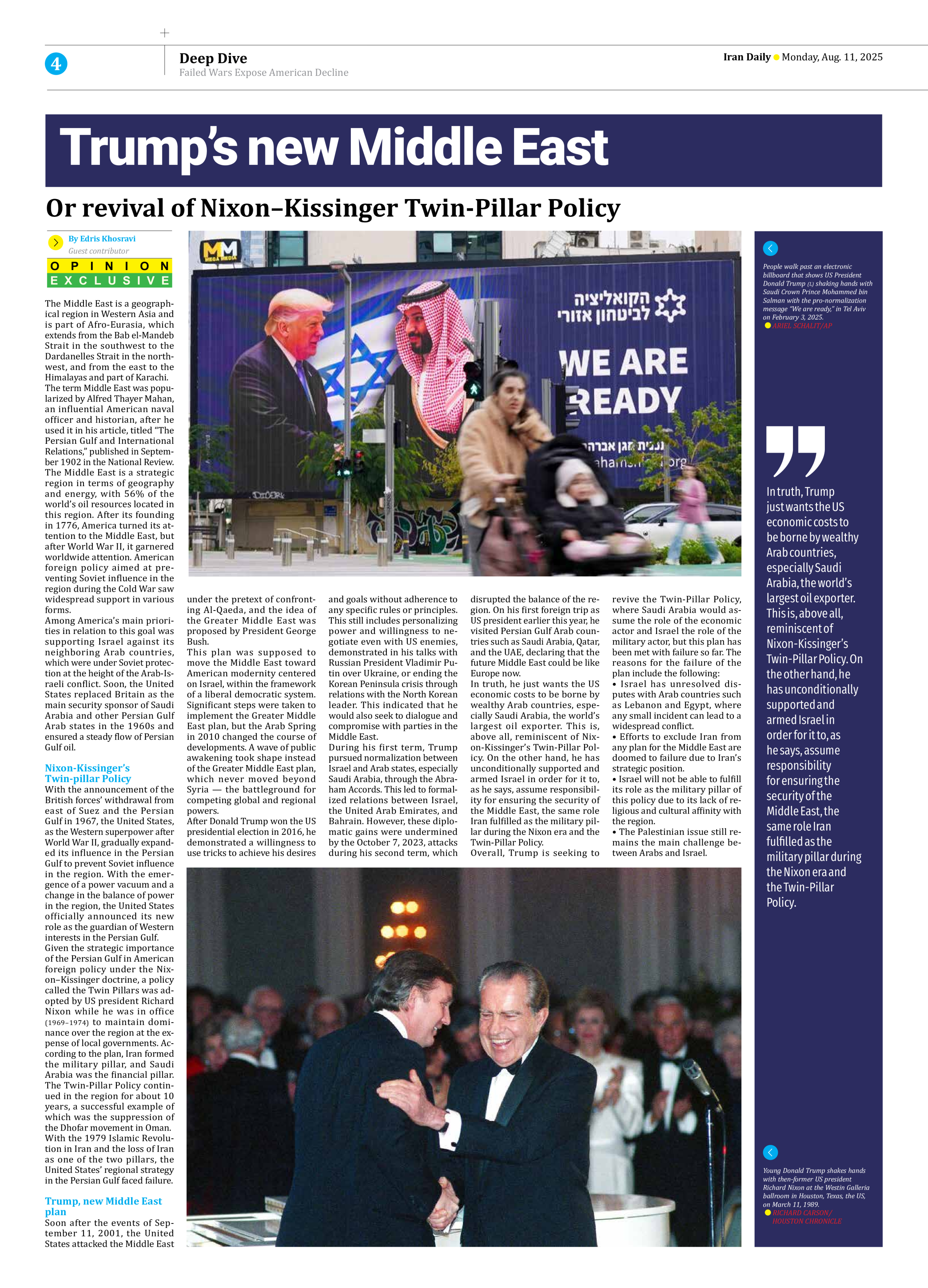
During his first term, Trump pursued normalization between Israel and Arab states, especially Saudi Arabia, through the Abraham Accords. This led to formalized relations between Israel, the United Arab Emirates, and Bahrain. However, these diplomatic gains were undermined by the October 7, 2023, attacks during his second term, which disrupted the balance of the region. On his first foreign trip as US president earlier this year, he visited Persian Gulf Arab countries such as Saudi Arabia, Qatar, and the UAE, declaring that the future Middle East could be like Europe now.
In truth, he just wants the US economic costs to be borne by wealthy Arab countries, especially Saudi Arabia, the world’s largest oil exporter. This is, above all, reminiscent of Nixon-Kissinger’s Twin-Pillar Policy. On the other hand, he has unconditionally supported and armed Israel in order for it to, as he says, assume responsibility for ensuring the security of the Middle East, the same role Iran fulfilled as the military pillar during the Nixon era and the Twin-Pillar Policy.
Overall, Trump is seeking to revive the Twin-Pillar Policy, where Saudi Arabia would assume the role of the economic actor and Israel the role of the military actor, but this plan has been met with failure so far. The reasons for the failure of the plan include the following:
• Israel has unresolved disputes with Arab countries such as Lebanon and Egypt, where any small incident can lead to a widespread conflict.
• Efforts to exclude Iran from any plan for the Middle East are doomed to failure due to Iran’s strategic position.
• Israel will not be able to fulfill its role as the military pillar of this policy due to its lack of religious and cultural affinity with the region.
• The Palestinian issue still remains the main challenge between Arabs and Israel.