





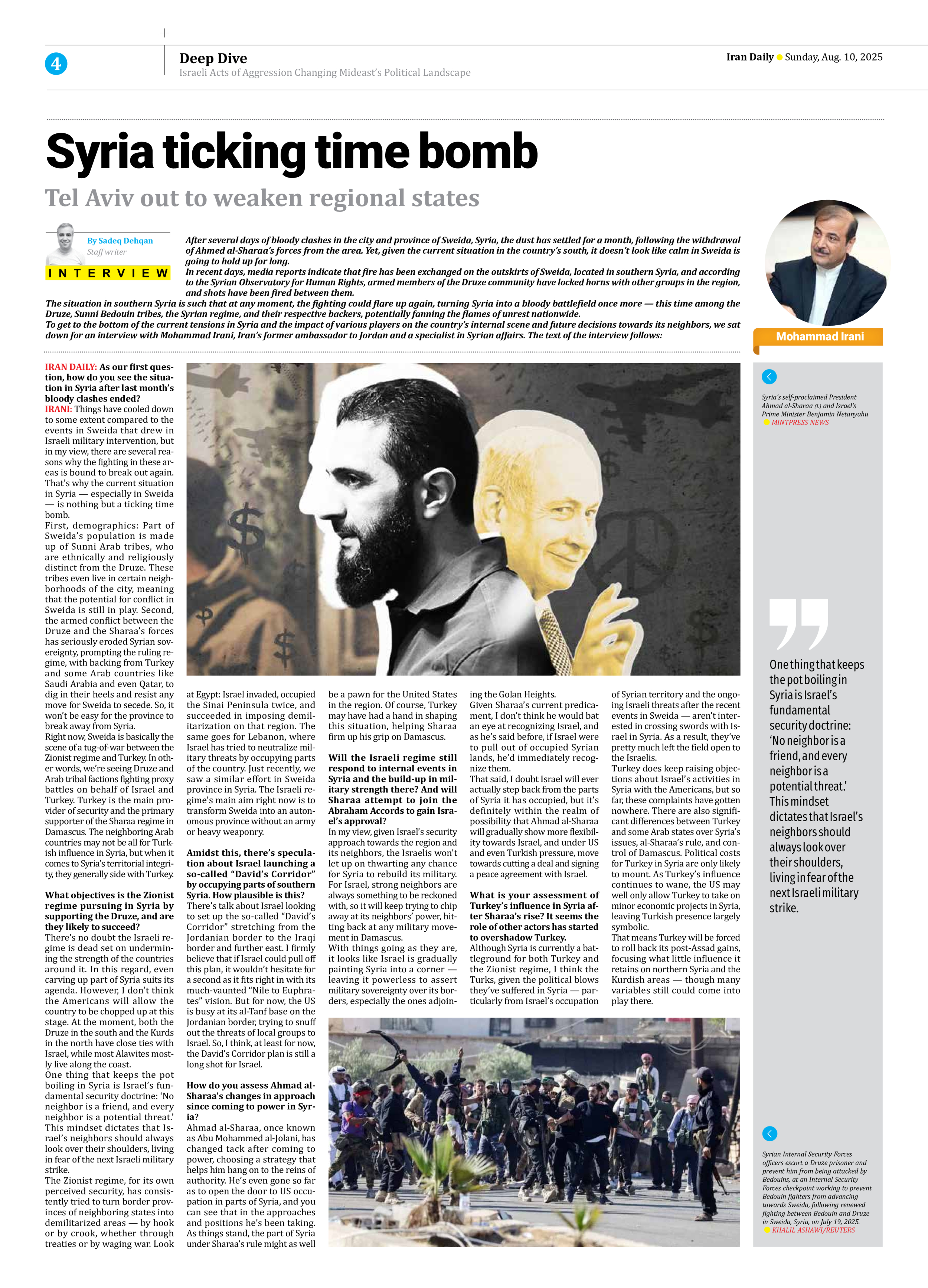


Syria ticking time bomb
Tel Aviv out to weaken regional states
After several days of bloody clashes in the city and province of Sweida, Syria, the dust has settled for a month, following the withdrawal of Ahmed al-Sharaa’s forces from the area. Yet, given the current situation in the country’s south, it doesn’t look like calm in Sweida is going to hold up for long. In recent days, media reports indicate that fire has been exchanged on the outskirts of Sweida, located in southern Syria, and according to the Syrian Observatory for Human Rights, armed members of the Druze community have locked horns with other groups in the region, and shots have been fired between them. The situation in southern Syria is such that at any moment, the fighting could flare up again, turning Syria into a bloody battlefield once more — this time among the Druze, Sunni Bedouin tribes, the Syrian regime, and their respective backers, potentially fanning the flames of unrest nationwide. To get to the bottom of the current tensions in Syria and the impact of various players on the country’s internal scene and future decisions towards its neighbors, we sat down for an interview with Mohammad Irani, Iran’s former ambassador to Jordan and a specialist in Syrian affairs. The text of the interview follows:
By Sadeq Dehqan
Staff writer
IRAN DAILY: As our first question, how do you see the situation in Syria after last month’s bloody clashes ended?
IRANI: Things have cooled down to some extent compared to the events in Sweida that drew in Israeli military intervention, but in my view, there are several reasons why the fighting in these areas is bound to break out again. That’s why the current situation in Syria — especially in Sweida — is nothing but a ticking time bomb.
First, demographics: Part of Sweida’s population is made up of Sunni Arab tribes, who are ethnically and religiously distinct from the Druze. These tribes even live in certain neighborhoods of the city, meaning that the potential for conflict in Sweida is still in play. Second, the armed conflict between the Druze and the Sharaa’s forces has seriously eroded Syrian sovereignty, prompting the ruling regime, with backing from Turkey and some Arab countries like Saudi Arabia and even Qatar, to dig in their heels and resist any move for Sweida to secede. So, it won’t be easy for the province to break away from Syria.
Right now, Sweida is basically the scene of a tug-of-war between the Zionist regime and Turkey. In other words, we’re seeing Druze and Arab tribal factions fighting proxy battles on behalf of Israel and Turkey. Turkey is the main provider of security and the primary supporter of the Sharaa regime in Damascus. The neighboring Arab countries may not be all for Turkish influence in Syria, but when it comes to Syria’s territorial integrity, they generally side with Turkey.
What objectives is the Zionist regime pursuing in Syria by supporting the Druze, and are they likely to succeed?
There’s no doubt the Israeli regime is dead set on undermining the strength of the countries around it. In this regard, even carving up part of Syria suits its agenda. However, I don’t think the Americans will allow the country to be chopped up at this stage. At the moment, both the Druze in the south and the Kurds in the north have close ties with Israel, while most Alawites mostly live along the coast.
One thing that keeps the pot boiling in Syria is Israel’s fundamental security doctrine: ‘No neighbor is a friend, and every neighbor is a potential threat.’ This mindset dictates that Israel’s neighbors should always look over their shoulders, living in fear of the next Israeli military strike.
The Zionist regime, for its own perceived security, has consistently tried to turn border provinces of neighboring states into demilitarized areas — by hook or by crook, whether through treaties or by waging war. Look at Egypt: Israel invaded, occupied the Sinai Peninsula twice, and succeeded in imposing demilitarization on that region. The same goes for Lebanon, where Israel has tried to neutralize military threats by occupying parts of the country. Just recently, we saw a similar effort in Sweida province in Syria. The Israeli regime’s main aim right now is to transform Sweida into an autonomous province without an army or heavy weaponry.
Amidst this, there’s speculation about Israel launching a so-called “David’s Corridor” by occupying parts of southern Syria. How plausible is this?
There’s talk about Israel looking to set up the so-called “David’s Corridor” stretching from the Jordanian border to the Iraqi border and further east. I firmly believe that if Israel could pull off this plan, it wouldn’t hesitate for a second as it fits right in with its much-vaunted “Nile to Euphrates” vision. But for now, the US is busy at its al-Tanf base on the Jordanian border, trying to snuff out the threats of local groups to Israel. So, I think, at least for now, the David’s Corridor plan is still a long shot for Israel.
How do you assess Ahmad al-Sharaa’s changes in approach since coming to power in Syria?
Ahmad al-Sharaa, once known as Abu Mohammed al-Jolani, has changed tack after coming to power, choosing a strategy that helps him hang on to the reins of authority. He’s even gone so far as to open the door to US occupation in parts of Syria, and you can see that in the approaches and positions he’s been taking. As things stand, the part of Syria under Sharaa’s rule might as well be a pawn for the United States in the region. Of course, Turkey may have had a hand in shaping this situation, helping Sharaa firm up his grip on Damascus.
Will the Israeli regime still respond to internal events in Syria and the build-up in military strength there? And will Sharaa attempt to join the Abraham Accords to gain Israel’s approval?
In my view, given Israel’s security approach towards the region and its neighbors, the Israelis won’t let up on thwarting any chance for Syria to rebuild its military. For Israel, strong neighbors are always something to be reckoned with, so it will keep trying to chip away at its neighbors’ power, hitting back at any military movement in Damascus.
With things going as they are, it looks like Israel is gradually painting Syria into a corner — leaving it powerless to assert military sovereignty over its borders, especially the ones adjoining the Golan Heights.
Given Sharaa’s current predicament, I don’t think he would bat an eye at recognizing Israel, and as he’s said before, if Israel were to pull out of occupied Syrian lands, he’d immediately recognize them.
That said, I doubt Israel will ever actually step back from the parts of Syria it has occupied, but it’s definitely within the realm of possibility that Ahmad al-Sharaa will gradually show more flexibility towards Israel, and under US and even Turkish pressure, move towards cutting a deal and signing a peace agreement with Israel.
What is your assessment of Turkey’s influence in Syria after Sharaa’s rise? It seems the role of other actors has started to overshadow Turkey.
Although Syria is currently a battleground for both Turkey and the Zionist regime, I think the Turks, given the political blows they’ve suffered in Syria — particularly from Israel’s occupation of Syrian territory and the ongoing Israeli threats after the recent events in Sweida — aren’t interested in crossing swords with Israel in Syria. As a result, they’ve pretty much left the field open to the Israelis.
Turkey does keep raising objections about Israel’s activities in Syria with the Americans, but so far, these complaints have gotten nowhere. There are also significant differences between Turkey and some Arab states over Syria’s issues, al-Sharaa’s rule, and control of Damascus. Political costs for Turkey in Syria are only likely to mount. As Turkey’s influence continues to wane, the US may well only allow Turkey to take on minor economic projects in Syria, leaving Turkish presence largely symbolic.
That means Turkey will be forced to roll back its post-Assad gains, focusing what little influence it retains on northern Syria and the Kurdish areas — though many variables still could come into play there.