







A look at Iran’s missile development history
Americans never accepted Iran’s missile power
By Shadab Asgari
Researcher, historian
Before the 1979 Iran Revolution, Mohammad Reza Pahlavi had put forward numerous requests to the Americans for the purchase of cruise, mid-range, and even short-range missiles. However, these requests never went through or got the green light from the US government. To find out why, one must look into the behaviors of the American officials and, especially, the statements of their top officials. Various presidents have, to various extents, laid down America’s long-term strategy regarding Iran, which was put into practice. This strategy is remarkable from two perspectives: Firstly, the US is clearly cautious in arms transfers to Iran to prevent it from stepping up as a regional power. Secondly, it has long been feared that Iran leans toward the Eastern Bloc (characterized at one time by the Soviet Union), and that has put a lid on the US’s willingness to assist militarily.
On May 30–31, 1972, when US president Richard Nixon and his national security advisor Henry Kissinger wrapped up their meeting with Soviet leaders in Moscow and signed the SALT treaty, they touched down in Tehran for a brief meeting with the Shah. In Tehran, Nixon unexpectedly paid off the Shah with praise and finally gave in to his demand. He promised that the Shah could buy any kind of non-nuclear weapon he wanted from the US. This promise was a golden opportunity for the Shah, especially since the US Departments of Defense and State were taken off the hook regarding oversight of arms sales to Iran. Meanwhile, Kissinger noted to defense and foreign ministers that henceforth, arms purchases should primarily fall under the Iranian government’s requests.
Given this one-of-a-kind situation and Iran’s multi-billion-dollar arms purchases from the US, it seemed the Shah would no longer run into trouble buying missiles. Yet, what actually came to light told a different story. American officials and military leaders turned down selling missiles — even the ground-to-ground Lance missiles with a 120 km range and rockets with a 60 km range — to the Iranian monarchy. This was despite the Shah’s readiness to sink to new lows to meet his needs, showing no reverence for himself or high-ranking military and government officials. For example, Army Chief of Staff Bahram Aryana and General Hassan Toofanian were sent off to Israel to negotiate arms purchases, where they had to wear Jewish kippahs in synagogues for religious ceremonies.
Missile production project
In this climate, with no faith in domestic expertise and unwilling to give the slightest chance to Iran’s military or civil experts to shine, Mohammad Reza Pahlavi asked Israeli authorities to kick off a secret joint missile production project in Iran, away from American eyes. This project, dubbed “Project Flower,” aimed to extend the effective range of Gabriel anti-ship missiles to 150–200 km.
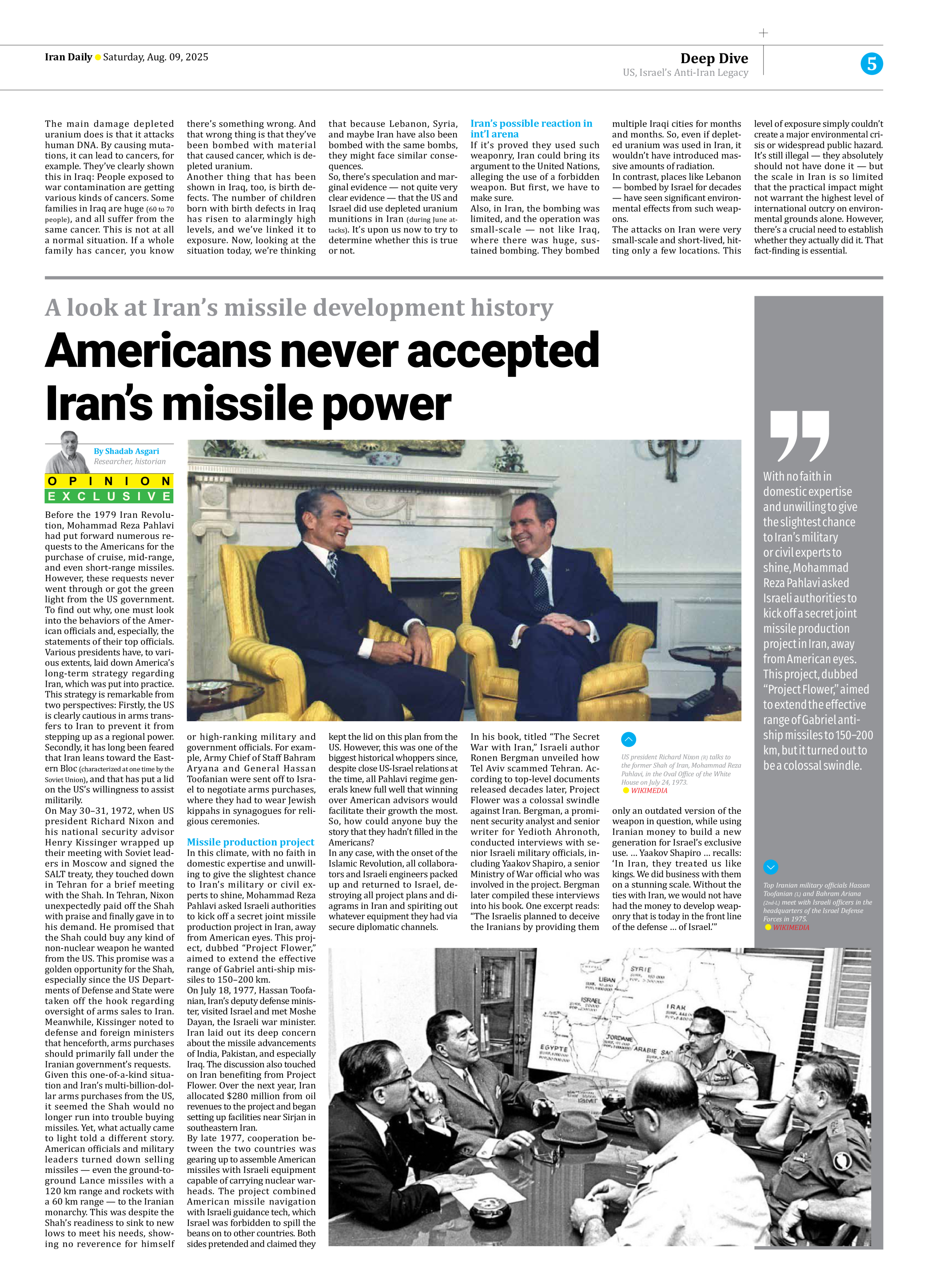
On July 18, 1977, Hassan Toofanian, Iran’s deputy defense minister, visited Israel and met Moshe Dayan, the Israeli war minister. Iran laid out its deep concern about the missile advancements of India, Pakistan, and especially Iraq. The discussion also touched on Iran benefiting from Project Flower. Over the next year, Iran allocated $280 million from oil revenues to the project and began setting up facilities near Sirjan in southeastern Iran.
By late 1977, cooperation between the two countries was gearing up to assemble American missiles with Israeli equipment capable of carrying nuclear warheads. The project combined American missile navigation with Israeli guidance tech, which Israel was forbidden to spill the beans on to other countries. Both sides pretended and claimed they kept the lid on this plan from the US. However, this was one of the biggest historical whoppers since, despite close US-Israel relations at the time, all Pahlavi regime generals knew full well that winning over American advisors would facilitate their growth the most. So, how could anyone buy the story that they hadn’t filled in the Americans?
In any case, with the onset of the Islamic Revolution, all collaborators and Israeli engineers packed up and returned to Israel, destroying all project plans and diagrams in Iran and spiriting out whatever equipment they had via secure diplomatic channels.
In his book, titled “The Secret War with Iran,” Israeli author Ronen Bergman unveiled how Tel Aviv scammed Tehran. According to top-level documents released decades later, Project Flower was a colossal swindle against Iran. Bergman, a prominent security analyst and senior writer for Yedioth Ahronoth, conducted interviews with senior Israeli military officials, including Yaakov Shapiro, a senior Ministry of War official who was involved in the project. Bergman later compiled these interviews into his book. One excerpt reads:
“The Israelis planned to deceive the Iranians by providing them only an outdated version of the weapon in question, while using Iranian money to build a new generation for Israel’s exclusive use. … Yaakov Shapiro … recalls: ‘In Iran, they treated us like kings. We did business with them on a stunning scale. Without the ties with Iran, we would not have had the money to develop weaponry that is today in the front line of the defense … of Israel.’”