







Iran emerges as new anti-colonial icon in Mideast
When Israel launched unprecedented strikes on Iran in June, it escalated a decades-long conflict rooted in what Iranian figures have condemned since 1950 as “Zionist colonialism”. In an exclusive interview with Iran Daily, Dr. Mozhgan Savabieasfahani, an advocate for justice in Palestine, traces Iran’s unwavering resistance to this colonialism throughout history — from prime minister Mosaddegh’s cancellation of recognition of Israel to Dr. Fatemi’s 1950 declaration that Israel would “harm the entire Middle East”. This, she maintains, has led to Iran’s emergence as the region’s undisputed victor. Iran’s recent retaliatory strikes shattered Israel’s myth of invincibility, igniting “satisfaction in the hearts of 450 million people” across the Muslim world, said the assistant professor of Environmental Sciences at the University of Michigan. Today, Iran stands as the hero of the anti-colonial struggle — a symbol of successful resistance that has inspired nations to “fight alongside us to get rid of Zionist colonialism”. As she affirms, “Change will come to the Middle East by the people of the Middle East, and Iran is their role model.” What follows is an edited version of the interview to improve its flow:
By Zohreh Qanadi
Staff writer
It is historically significant for us Iranians to remember that our people have recognized the inherently aggressive nature of the Zionist regime since its founding in 1948 — long before the establishment of the Islamic Republic in 1979. If we go back in history, we can see that Iran’s Prime Minister Mohammad Mosaddegh (1951–1953) and Dr. Hossein Fatemi [a key figure in the government of Mosaddegh] were clear in their minds about what colonialism is and what Israel as a colonial power is doing in the Middle East. In a March 1950 article titled “What’s at the Root of This Rush to Recognize Israel’s Administration?” published in Bakhtar-e Emruz newspaper, Dr. Fatemi asserts that Israel is a colonial power destined to harm not only Palestinians but the entire Middle East. Also, in 1951, recalling Iran's envoy from Israel, prime minister Mossadegh publicly withdrew recognition of the entity. An article published by the Jewish Telegraphic Agency in 1958, titled “Iran Reported Ready to Extend Diplomatic Recognition to Israel”, stated: “Iran recognized Israel after its formation in 1948. However, in 1951, when premier Mohammed Mossadegh nationalized the country’s oil resources and started on a policy of wooing the Arab states, he recalled the Iranian envoy from Israel and stated publicly that he has withdrawn recognition from Israel.”
So, Iranian politicians long ago were quite aware of what Israel is and what its role will be in the Middle East. They could sense that it was going to be an extremely destructive force for all the people of the Middle East, and they had declared their support for the people of Palestine. Although maybe at the time, Dr. Fatemi could not see the scope of the damage that Israel could cause to the Middle East, he had a sense that it was a bad thing for the entire region.
Since the 1950s, this understanding in Iran — that Israel is a destructive force for the entire region — has become clearer as Israel has attacked nearly every country in the Middle East: from Palestine to Syria, Yemen, Iraq, and Lebanon, and has engaged in wars with Egypt as well. The Israelis have conducted wars against all of these countries.
Impact of Iran’s resistance on region
Therefore, one important thing for us to focus on is that Iran has arguably been the most prominent and consistent force against Israel globally; Dare I say, the only country that has clearly stated its anti-Zionist, anti-colonialist slogans against Israel has been Iran. Iran has not only been vocal about this, but it has also actively helped Resistance movements across the Middle East. This stems from Iran’s conviction that it is our duty to support oppressed people who lack representation. By countering Israeli aggression beyond its borders, Iran ultimately aimed to protect its own population from direct conflict.
However, Israel is now flexing its muscles and has dared to attack Iran once.
Image of Iran
So, what is the image of Iran in the whole region right now? Iran has become the icon of success and anti-colonialist struggle. Iran right now is a victor; It’s the hero of this whole fight — the imposed 12-day struggle with Israel and the United States.
What does Iran look like in the minds of the people of the Middle East, who are predominantly Arab? It looks like a nation of formidable capabilities. They look at Iran and see a single country doing everything to help the Palestinians, including retaliating against attacks by Israel and the United States.
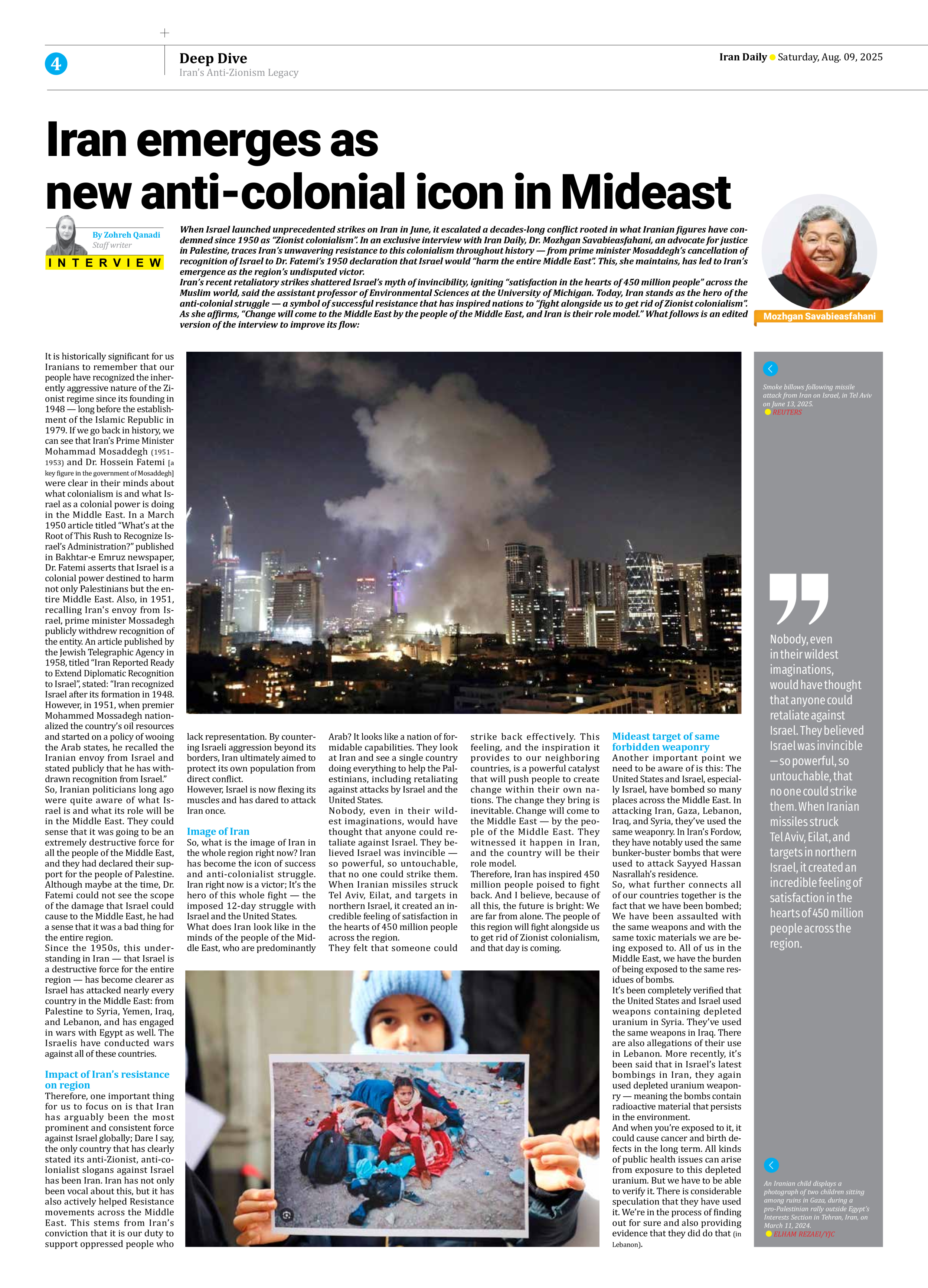
Nobody, even in their wildest imaginations, would have thought that anyone could retaliate against Israel. They believed Israel was invincible — so powerful, so untouchable, that no one could strike them. When Iranian missiles struck Tel Aviv, Eilat, and targets in northern Israel, it created an incredible feeling of satisfaction in the hearts of 450 million people across the region.
They felt that someone could strike back effectively. This feeling, and the inspiration it provides to our neighboring countries, is a powerful catalyst that will push people to create change within their own nations. The change they bring is inevitable. Change will come to the Middle East — by the people of the Middle East. They witnessed it happen in Iran, and the country will be their role model.
Therefore, Iran has inspired 450 million people poised to fight back. And I believe, because of all this, the future is bright: We are far from alone. The people of this region will fight alongside us to get rid of Zionist colonialism, and that day is coming.
Mideast target of same forbidden weaponry
Another important point we need to be aware of is this: The United States and Israel, especially Israel, have bombed so many places across the Middle East. In attacking Iran, Gaza, Lebanon, Iraq, and Syria, they’ve used the same weaponry. In Iran’s Fordow, they have notably used the same bunker-buster bombs that were used to attack Sayyed Hassan Nasrallah’s residence.
So, what further connects all of our countries together is the fact that we have been bombed; We have been assaulted with the same weapons and with the same toxic materials we are being exposed to. All of us in the Middle East, we have the burden of being exposed to the same residues of bombs.
It’s been completely verified that the United States and Israel used weapons containing depleted uranium in Syria. They’ve used the same weapons in Iraq. There are also allegations of their use in Lebanon. More recently, it’s been said that in Israel’s latest bombings in Iran, they again used depleted uranium weaponry — meaning the bombs contain radioactive material that persists in the environment.
And when you’re exposed to it, it could cause cancer and birth defects in the long term. All kinds of public health issues can arise from exposure to this depleted uranium. But we have to be able to verify it. There is considerable speculation that they have used it. We’re in the process of finding out for sure and also providing evidence that they did do that (in Lebanon).
The main damage depleted uranium does is that it attacks human DNA. By causing mutations, it can lead to cancers, for example. They’ve clearly shown this in Iraq: People exposed to war contamination are getting various kinds of cancers. Some families in Iraq are huge (60 to 70 people), and all suffer from the same cancer. This is not at all a normal situation. If a whole family has cancer, you know there’s something wrong. And that wrong thing is that they’ve been bombed with material that caused cancer, which is depleted uranium.
Another thing that has been shown in Iraq, too, is birth defects. The number of children born with birth defects in Iraq has risen to alarmingly high levels, and we’ve linked it to exposure. Now, looking at the situation today, we’re thinking that because Lebanon, Syria, and maybe Iran have also been bombed with the same bombs, they might face similar consequences.
So, there’s speculation and marginal evidence — not quite very clear evidence — that the US and Israel did use depleted uranium munitions in Iran (during June attacks). It’s upon us now to try to determine whether this is true or not.
Iran’s possible reaction in int’l arena
If it’s proved they used such weaponry, Iran could bring its argument to the United Nations, alleging the use of a forbidden weapon. But first, we have to make sure.
Also, in Iran, the bombing was limited, and the operation was small-scale — not like Iraq, where there was huge, sustained bombing. They bombed multiple Iraqi cities for months and months. So, even if depleted uranium was used in Iran, it wouldn’t have introduced massive amounts of radiation.
In contrast, places like Lebanon — bombed by Israel for decades — have seen significant environmental effects from such weapons.
The attacks on Iran were very small-scale and short-lived, hitting only a few locations. This level of exposure simply couldn’t create a major environmental crisis or widespread public hazard. It’s still illegal — they absolutely should not have done it — but the scale in Iran is so limited that the practical impact might not warrant the highest level of international outcry on environmental grounds alone. However, there’s a crucial need to establish whether they actually did it. That fact-finding is essential.