







Joint chamber: Iraq serves as Iran’s gateway to 500m market
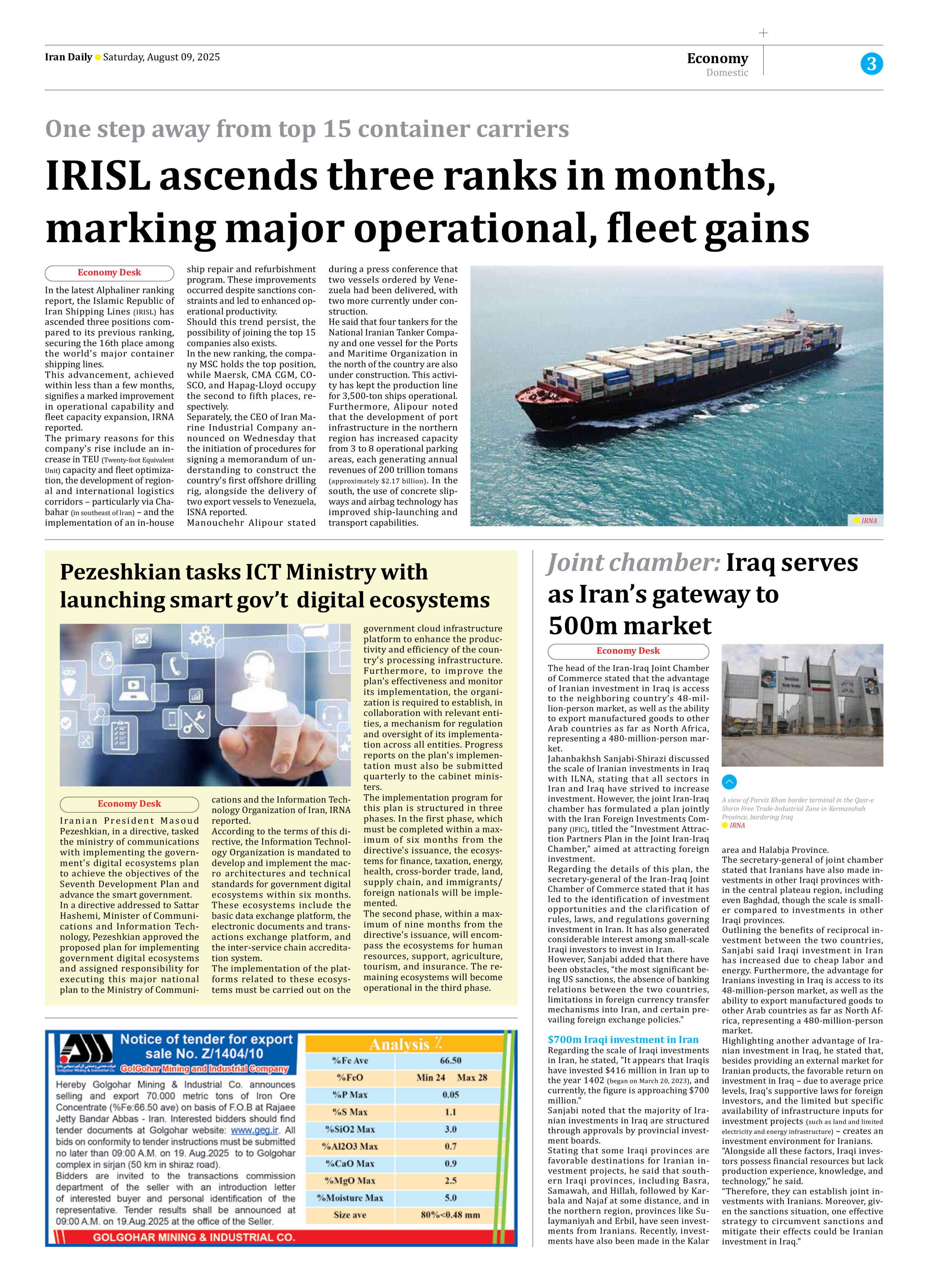
The head of the Iran-Iraq Joint Chamber of Commerce stated that the advantage of Iranian investment in Iraq is access to the neighboring country’s 48-million-person market, as well as the ability to export manufactured goods to other Arab countries as far as North Africa, representing a 480-million-person market.
Jahanbakhsh Sanjabi-Shirazi discussed the scale of Iranian investments in Iraq with ILNA, stating that all sectors in Iran and Iraq have strived to increase investment. However, the joint Iran-Iraq chamber has formulated a plan jointly with the Iran Foreign Investments Company (IFIC), titled the "Investment Attraction Partners Plan in the Joint Iran-Iraq Chamber," aimed at attracting foreign investment.
Regarding the details of this plan, the secretary-general of the Iran-Iraq Joint Chamber of Commerce stated that it has led to the identification of investment opportunities and the clarification of rules, laws, and regulations governing investment in Iran. It has also generated considerable interest among small-scale Iraqi investors to invest in Iran.
However, Sanjabi added that there have been obstacles, “the most significant being US sanctions, the absence of banking relations between the two countries, limitations in foreign currency transfer mechanisms into Iran, and certain prevailing foreign exchange policies."
$700m Iraqi investment in Iran
Regarding the scale of Iraqi investments in Iran, he stated, "It appears that Iraqis have invested $416 million in Iran up to the year 1402 (began on March 20, 2023), and currently, the figure is approaching $700 million."
Sanjabi noted that the majority of Iranian investments in Iraq are structured through approvals by provincial investment boards.
Stating that some Iraqi provinces are favorable destinations for Iranian investment projects, he said that southern Iraqi provinces, including Basra, Samawah, and Hillah, followed by Karbala and Najaf at some distance, and in the northern region, provinces like Sulaymaniyah and Erbil, have seen investments from Iranians. Recently, investments have also been made in the Kalar area and Halabja Province.
The secretary-general of joint chamber stated that Iranians have also made investments in other Iraqi provinces within the central plateau region, including even Baghdad, though the scale is smaller compared to investments in other Iraqi provinces.
Outlining the benefits of reciprocal investment between the two countries, Sanjabi said Iraqi investment in Iran has increased due to cheap labor and energy. Furthermore, the advantage for Iranians investing in Iraq is access to its 48-million-person market, as well as the ability to export manufactured goods to other Arab countries as far as North Africa, representing a 480-million-person market.
Highlighting another advantage of Iranian investment in Iraq, he stated that, besides providing an external market for Iranian products, the favorable return on investment in Iraq – due to average price levels, Iraq's supportive laws for foreign investors, and the limited but specific availability of infrastructure inputs for investment projects (such as land and limited electricity and energy infrastructure) – creates an investment environment for Iranians.
"Alongside all these factors, Iraqi investors possess financial resources but lack production experience, knowledge, and technology,” he said.
“Therefore, they can establish joint investments with Iranians. Moreover, given the sanctions situation, one effective strategy to circumvent sanctions and mitigate their effects could be Iranian investment in Iraq."