







Israel’s role in border terror incidents clear: Former envoy
Terrorism ‘ominous gift’ foreign powers passed on to Pakistan
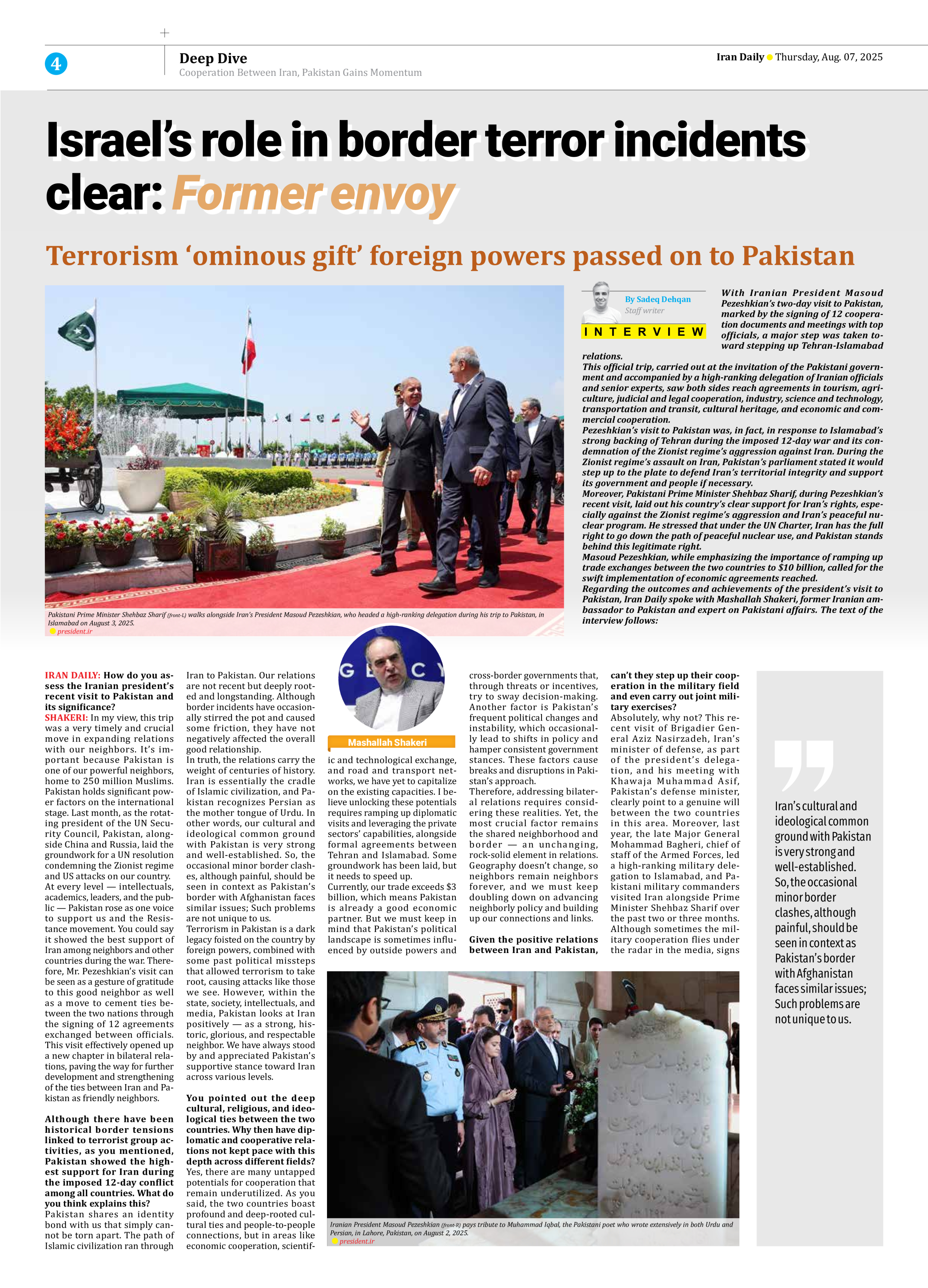
With Iranian President Masoud Pezeshkian’s two-day visit to Pakistan, marked by the signing of 12 cooperation documents and meetings with top officials, a major step was taken toward stepping up Tehran-Islamabad relations. This official trip, carried out at the invitation of the Pakistani government and accompanied by a high-ranking delegation of Iranian officials and senior experts, saw both sides reach agreements in tourism, agriculture, judicial and legal cooperation, industry, science and technology, transportation and transit, cultural heritage, and economic and commercial cooperation. Pezeshkian’s visit to Pakistan was, in fact, in response to Islamabad’s strong backing of Tehran during the imposed 12-day war and its condemnation of the Zionist regime’s aggression against Iran. During the Zionist regime’s assault on Iran, Pakistan’s parliament stated it would step up to the plate to defend Iran’s territorial integrity and support its government and people if necessary. Moreover, Pakistani Prime Minister Shehbaz Sharif, during Pezeshkian’s recent visit, laid out his country’s clear support for Iran’s rights, especially against the Zionist regime’s aggression and Iran’s peaceful nuclear program. He stressed that under the UN Charter, Iran has the full right to go down the path of peaceful nuclear use, and Pakistan stands behind this legitimate right. Masoud Pezeshkian, while emphasizing the importance of ramping up trade exchanges between the two countries to $10 billion, called for the swift implementation of economic agreements reached. Regarding the outcomes and achievements of the president’s visit to Pakistan, Iran Daily spoke with Mashallah Shakeri, former Iranian ambassador to Pakistan and expert on Pakistani affairs. The text of the interview follows:
By Sadeq Dehqan
Staff writer
IRAN DAILY: How do you assess the Iranian president’s recent visit to Pakistan and its significance?
SHAKERI: In my view, this trip was a very timely and crucial move in expanding relations with our neighbors. It’s important because Pakistan is one of our powerful neighbors, home to 250 million Muslims. Pakistan holds significant power factors on the international stage. Last month, as the rotating president of the UN Security Council, Pakistan, alongside China and Russia, laid the groundwork for a UN resolution condemning the Zionist regime and US attacks on our country.
At every level — intellectuals, academics, leaders, and the public — Pakistan rose as one voice to support us and the Resistance movement. You could say it showed the best support of Iran among neighbors and other countries during the war. Therefore, Mr. Pezeshkian’s visit can be seen as a gesture of gratitude to this good neighbor as well as a move to cement ties between the two nations through the signing of 12 agreements exchanged between officials. This visit effectively opened up a new chapter in bilateral relations, paving the way for further development and strengthening of the ties between Iran and Pakistan as friendly neighbors.
Although there have been historical border tensions linked to terrorist group activities, as you mentioned, Pakistan showed the highest support for Iran during the imposed 12-day conflict among all countries. What do you think explains this?
Pakistan shares an identity bond with us that simply cannot be torn apart. The path of Islamic civilization ran through Iran to Pakistan. Our relations are not recent but deeply rooted and longstanding. Although border incidents have occasionally stirred the pot and caused some friction, they have not negatively affected the overall good relationship.
In truth, the relations carry the weight of centuries of history. Iran is essentially the cradle of Islamic civilization, and Pakistan recognizes Persian as the mother tongue of Urdu. In other words, our cultural and ideological common ground with Pakistan is very strong and well-established. So, the occasional minor border clashes, although painful, should be seen in context as Pakistan’s border with Afghanistan faces similar issues; Such problems are not unique to us.
Terrorism in Pakistan is a dark legacy foisted on the country by foreign powers, combined with some past political missteps that allowed terrorism to take root, causing attacks like those we see. However, within the state, society, intellectuals, and media, Pakistan looks at Iran positively — as a strong, historic, glorious, and respectable neighbor. We have always stood by and appreciated Pakistan’s supportive stance toward Iran across various levels.
You pointed out the deep cultural, religious, and ideological ties between the two countries. Why then have diplomatic and cooperative relations not kept pace with this depth across different fields?
Yes, there are many untapped potentials for cooperation that remain underutilized. As you said, the two countries boast profound and deep-rooted cultural ties and people-to-people connections, but in areas like economic cooperation, scientific and technological exchange, and road and transport networks, we have yet to capitalize on the existing capacities. I believe unlocking these potentials requires ramping up diplomatic visits and leveraging the private sectors’ capabilities, alongside formal agreements between Tehran and Islamabad. Some groundwork has been laid, but it needs to speed up.
Currently, our trade exceeds $3 billion, which means Pakistan is already a good economic partner. But we must keep in mind that Pakistan’s political landscape is sometimes influenced by outside powers and cross-border governments that, through threats or incentives, try to sway decision-making. Another factor is Pakistan’s frequent political changes and instability, which occasionally lead to shifts in policy and hamper consistent government stances. These factors cause breaks and disruptions in Pakistan’s approach.
Therefore, addressing bilateral relations requires considering these realities. Yet, the most crucial factor remains the shared neighborhood and border — an unchanging, rock-solid element in relations. Geography doesn’t change, so neighbors remain neighbors forever, and we must keep doubling down on advancing neighborly policy and building up our connections and links.
Given the positive relations between Iran and Pakistan, can’t they step up their cooperation in the military field and even carry out joint military exercises?
Absolutely, why not? This recent visit of Brigadier General Aziz Nasirzadeh, Iran’s minister of defense, as part of the president’s delegation, and his meeting with Khawaja Muhammad Asif, Pakistan’s defense minister, clearly point to a genuine will between the two countries in this area. Moreover, last year, the late Major General Mohammad Bagheri, chief of staff of the Armed Forces, led a high-ranking military delegation to Islamabad, and Pakistani military commanders visited Iran alongside Prime Minister Shehbaz Sharif over the past two or three months. Although sometimes the military cooperation flies under the radar in the media, signs of this intention exist at the military leadership level of both countries. We hope to see these collaborations deepened and taken all the way to practical and operational phases.
Regarding border tensions and problems, is it possible for the two countries to hammer out a solution so that such incidents no longer show up and sour the relations?
I strongly feel that the Zionist regime’s evil hand is behind these incidents. Their agents can sneak into even remote areas of Pakistan, manipulating poverty and ignorance among some misguided elements to set off conspiracies. Problems like these, rooted in Zionist meddling, are not limited to the Iran-Pakistan border but can surface along other borders with neighbors as well. Both countries’ officials have now owned up to this reality and acknowledged the issue. Therefore, the relevant agencies in both countries must step up to the plate and put measures in place to nip this malignant tumor in the bud.
I should also flag another point: Pakistan itself has been hit hard by terrorism in 2024, suffering about 1,600 terrorist operations within its own borders, resulting in over 2,500 deaths. Pakistan is thus a victim of terrorism on its own soil, and its capacity to control self-serving terrorists who operate in its far-flung areas is limited. We must wrap our heads around this fact. Tehran and Islamabad have come to grips with the understanding that terrorism knows no borders. If someone starts a fire in your neighbor’s house, the smoke will affect all the neighboring homes. Therefore, Tehran, Islamabad, and Kabul must join forces to combat terrorism and come up with appropriate plans.
Is the goal of reaching $10 billion in trade exchanges between Iran and Pakistan, mentioned during the president’s recent trip, achievable?
If the necessary political and legal will and support are in place and bilateral efforts keep up the momentum, I believe hitting $10 billion in the next few years is definitely within reach.
Let me just point out one thing: Pakistan has a contract for gas supply via pipeline from Iran that remains intact. They can currently receive up to 30 million cubic meters of gas daily from Iran, and just this one commodity alone could push our trade volume close to that $10 billion target annually. Moreover, expanding other connections such as rail, road links, and maritime exchanges through the two important ports — Chabahar in Iran and Gwadar in Pakistan — could set up massive commercial traffic between the countries. This expansion would benefit bilateral ties as well as the broader region, including China on Pakistan’s eastern flank, which would also cash in on these transport and trade developments.
Do you think the Iran-Pakistan gas pipeline will ultimately be put into operation?
Iran’s commitment to getting this pipeline up and running is clear and unwavering. Iran has shown resolve both in execution and in financing the project. The pipeline has already been laid down up to the vicinity of the Pakistani border. However, Pakistan faces two hurdles on its end: First, financing its segment of the pipeline implementation, which I view as manageable since the necessary funds can be sourced from various places, and second, the looming shadow of threats from powers uneasy about this connection. These actors have put the brakes on Islamabad, intimidating them and holding up progress on the pipeline.