





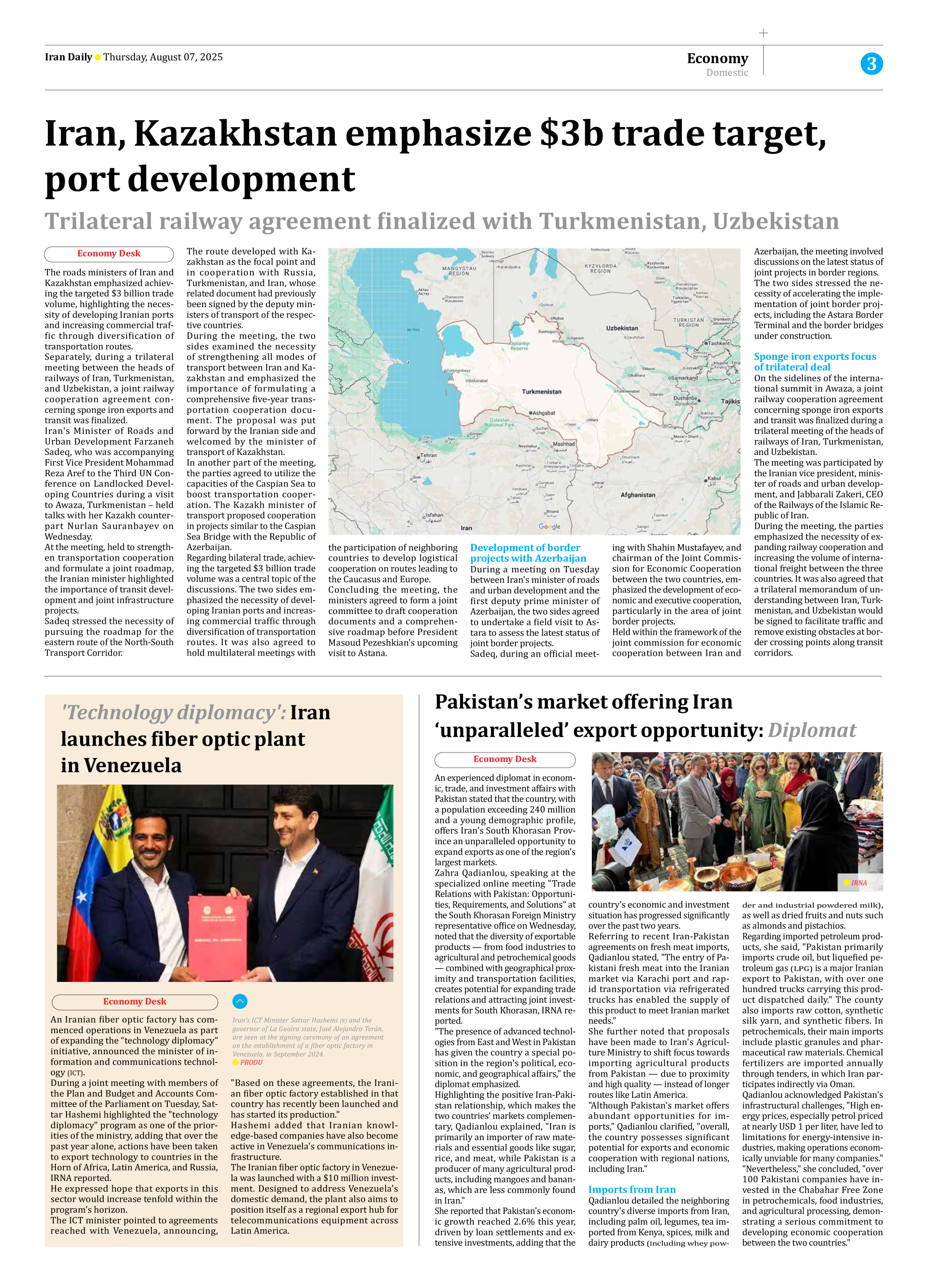


Pakistan’s market offering Iran ‘unparalleled’ export opportunity: Diplomat
An experienced diplomat in economic, trade, and investment affairs with Pakistan stated that the country, with a population exceeding 240 million and a young demographic profile, offers Iran’s South Khorasan Province an unparalleled opportunity to expand exports as one of the region's largest markets.
Zahra Qadianlou, speaking at the specialized online meeting "Trade Relations with Pakistan: Opportunities, Requirements, and Solutions" at the South Khorasan Foreign Ministry representative office on Wednesday, noted that the diversity of exportable products — from food industries to agricultural and petrochemical goods — combined with geographical proximity and transportation facilities, creates potential for expanding trade relations and attracting joint investments for South Khorasan, IRNA reported.
"The presence of advanced technologies from East and West in Pakistan has given the country a special position in the region's political, economic, and geographical affairs," the diplomat emphasized.
Highlighting the positive Iran-Pakistan relationship, which makes the two countries' markets complementary, Qadianlou explained, "Iran is primarily an importer of raw materials and essential goods like sugar, rice, and meat, while Pakistan is a producer of many agricultural products, including mangoes and bananas, which are less commonly found in Iran."
She reported that Pakistan's economic growth reached 2.6% this year, driven by loan settlements and extensive investments, adding that the country's economic and investment situation has progressed significantly over the past two years.
Referring to recent Iran-Pakistan agreements on fresh meat imports, Qadianlou stated, "The entry of Pakistani fresh meat into the Iranian market via Karachi port and rapid transportation via refrigerated trucks has enabled the supply of this product to meet Iranian market needs."
She further noted that proposals have been made to Iran's Agriculture Ministry to shift focus towards importing agricultural products from Pakistan — due to proximity and high quality — instead of longer routes like Latin America.
"Although Pakistan's market offers abundant opportunities for imports," Qadianlou clarified, "overall, the country possesses significant potential for exports and economic cooperation with regional nations, including Iran."
Imports from Iran
Qadianlou detailed the neighboring country's diverse imports from Iran, including palm oil, legumes, tea imported from Kenya, spices, milk and dairy products (including whey powder and industrial powdered milk), as well as dried fruits and nuts such as almonds and pistachios.
Regarding imported petroleum products, she said, "Pakistan primarily imports crude oil, but liquefied petroleum gas (LPG) is a major Iranian export to Pakistan, with over one hundred trucks carrying this product dispatched daily." The county also imports raw cotton, synthetic silk yarn, and synthetic fibers. In petrochemicals, their main imports include plastic granules and pharmaceutical raw materials. Chemical fertilizers are imported annually through tenders, in which Iran participates indirectly via Oman.
Qadianlou acknowledged Pakistan's infrastructural challenges, "High energy prices, especially petrol priced at nearly USD 1 per liter, have led to limitations for energy-intensive industries, making operations economically unviable for many companies."
"Nevertheless," she concluded, "over 100 Pakistani companies have invested in the Chabahar Free Zone in petrochemicals, food industries, and agricultural processing, demonstrating a serious commitment to developing economic cooperation between the two countries."