





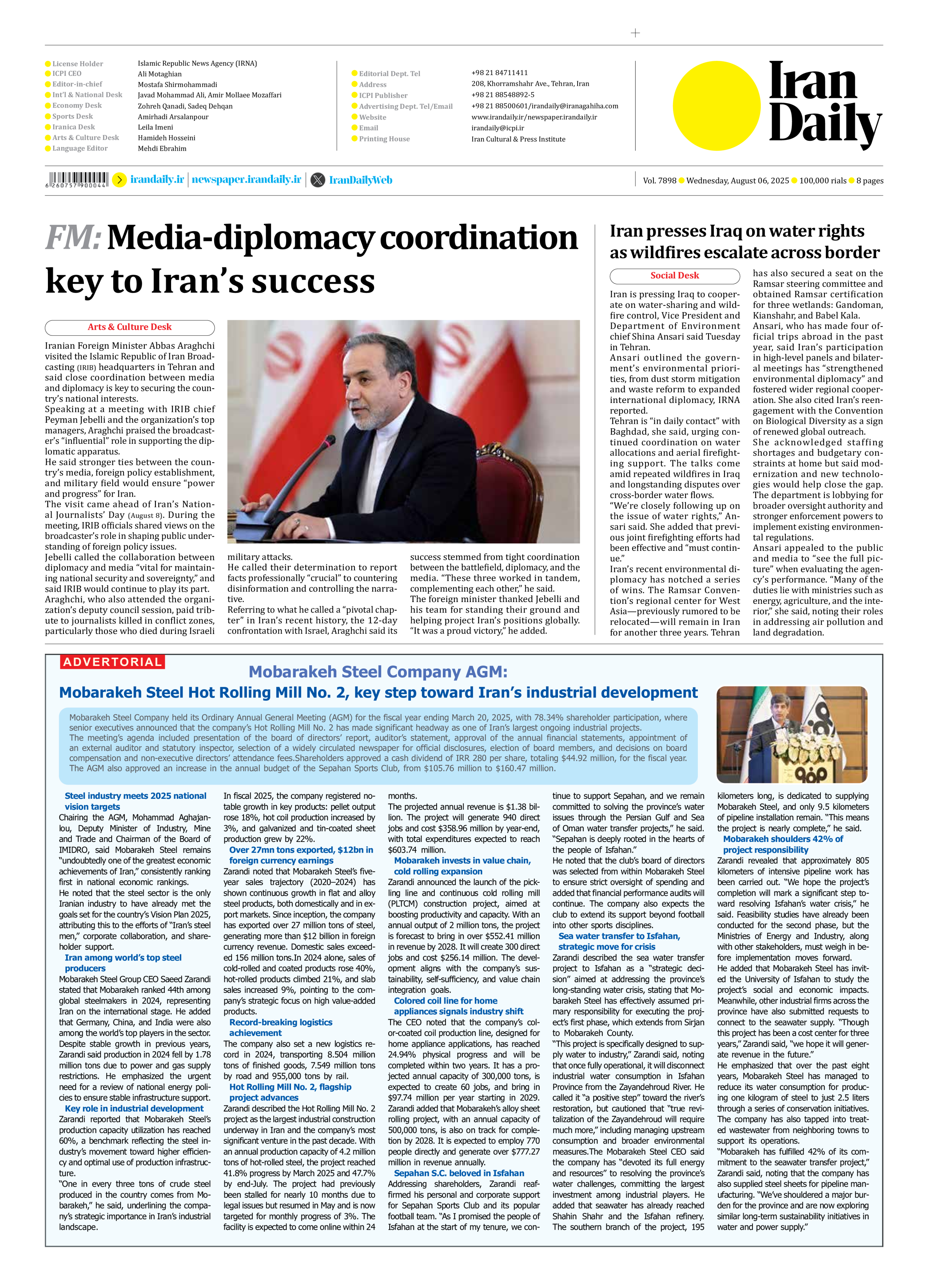


Mobarakeh Steel Company AGM:
Mobarakeh Steel Hot Rolling Mill No. 2, key step toward Iran’s industrial development
Mobarakeh Steel Company held its Ordinary Annual General Meeting (AGM) for the fiscal year ending March 20, 2025, with 78.34% shareholder participation, where senior executives announced that the company’s Hot Rolling Mill No. 2 has made significant headway as one of Iran’s largest ongoing industrial projects. The meeting’s agenda included presentation of the board of directors’ report, auditor’s statement, approval of the annual financial statements, appointment of an external auditor and statutory inspector, selection of a widely circulated newspaper for official disclosures, election of board members, and decisions on board compensation and non-executive directors’ attendance fees.Shareholders approved a cash dividend of IRR 280 per share, totaling $44.92 million, for the fiscal year. The AGM also approved an increase in the annual budget of the Sepahan Sports Club, from $105.76 million to $160.47 million.
Steel industry meets 2025 national vision targets
Chairing the AGM, Mohammad Aghajanlou, Deputy Minister of Industry, Mine and Trade and Chairman of the Board of IMIDRO, said Mobarakeh Steel remains “undoubtedly one of the greatest economic achievements of Iran,” consistently ranking first in national economic rankings.
He noted that the steel sector is the only Iranian industry to have already met the goals set for the country’s Vision Plan 2025, attributing this to the efforts of “Iran’s steel men,” corporate collaboration, and shareholder support.
Iran among world’s top steel producers
Mobarakeh Steel Group CEO Saeed Zarandi stated that Mobarakeh ranked 44th among global steelmakers in 2024, representing Iran on the international stage. He added that Germany, China, and India were also among the world’s top players in the sector.
Despite stable growth in previous years, Zarandi said production in 2024 fell by 1.78 million tons due to power and gas supply restrictions. He emphasized the urgent need for a review of national energy policies to ensure stable infrastructure support.
Key role in industrial development
Zarandi reported that Mobarakeh Steel’s production capacity utilization has reached 60%, a benchmark reflecting the steel industry’s movement toward higher efficiency and optimal use of production infrastructure.
“One in every three tons of crude steel produced in the country comes from Mobarakeh,” he said, underlining the company’s strategic importance in Iran’s industrial landscape.
In fiscal 2025, the company registered notable growth in key products: pellet output rose 18%, hot coil production increased by 3%, and galvanized and tin-coated sheet production grew by 22%.
Over 27mn tons exported, $12bn in foreign currency earnings
Zarandi noted that Mobarakeh Steel’s five-year sales trajectory (2020–2024) has shown continuous growth in flat and alloy steel products, both domestically and in export markets. Since inception, the company has exported over 27 million tons of steel, generating more than $12 billion in foreign currency revenue. Domestic sales exceeded 156 million tons.In 2024 alone, sales of cold-rolled and coated products rose 40%, hot-rolled products climbed 21%, and slab sales increased 9%, pointing to the company’s strategic focus on high value-added products.
Record-breaking logistics achievement
The company also set a new logistics record in 2024, transporting 8.504 million tons of finished goods, 7.549 million tons by road and 955,000 tons by rail.
Hot Rolling Mill No. 2, flagship project advances
Zarandi described the Hot Rolling Mill No. 2 project as the largest industrial construction underway in Iran and the company’s most significant venture in the past decade. With an annual production capacity of 4.2 million tons of hot-rolled steel, the project reached 41.8% progress by March 2025 and 47.7% by end-July. The project had previously been stalled for nearly 10 months due to legal issues but resumed in May and is now targeted for monthly progress of 3%. The facility is expected to come online within 24 months.
The projected annual revenue is $1.38 billion. The project will generate 940 direct jobs and cost $358.96 million by year-end, with total expenditures expected to reach $603.74 million.
Mobarakeh invests in value chain, cold rolling expansion
Zarandi announced the launch of the pickling line and continuous cold rolling mill (PLTCM) construction project, aimed at boosting productivity and capacity. With an annual output of 2 million tons, the project is forecast to bring in over $552.41 million in revenue by 2028. It will create 300 direct jobs and cost $256.14 million. The development aligns with the company’s sustainability, self-sufficiency, and value chain integration goals.
Colored coil line for home appliances signals industry shift
The CEO noted that the company’s color-coated coil production line, designed for home appliance applications, has reached 24.94% physical progress and will be completed within two years. It has a projected annual capacity of 300,000 tons, is expected to create 60 jobs, and bring in $97.74 million per year starting in 2029.
Zarandi added that Mobarakeh’s alloy sheet rolling project, with an annual capacity of 500,000 tons, is also on track for completion by 2028. It is expected to employ 770 people directly and generate over $777.27 million in revenue annually.
Sepahan S.C. beloved in Isfahan
Addressing shareholders, Zarandi reaffirmed his personal and corporate support for Sepahan Sports Club and its popular football team. “As I promised the people of Isfahan at the start of my tenure, we continue to support Sepahan, and we remain committed to solving the province’s water issues through the Persian Gulf and Sea of Oman water transfer projects,” he said. “Sepahan is deeply rooted in the hearts of the people of Isfahan.”
He noted that the club’s board of directors was selected from within Mobarakeh Steel to ensure strict oversight of spending and added that financial performance audits will continue. The company also expects the club to extend its support beyond football into other sports disciplines.
Sea water transfer to Isfahan, strategic move for crisis
Zarandi described the sea water transfer project to Isfahan as a “strategic decision” aimed at addressing the province’s long-standing water crisis, stating that Mobarakeh Steel has effectively assumed primary responsibility for executing the project’s first phase, which extends from Sirjan to Mobarakeh County.
“This project is specifically designed to supply water to industry,” Zarandi said, noting that once fully operational, it will disconnect industrial water consumption in Isfahan Province from the Zayandehroud River. He called it “a positive step” toward the river’s restoration, but cautioned that “true revitalization of the Zayandehroud will require much more,” including managing upstream consumption and broader environmental measures.The Mobarakeh Steel CEO said the company has “devoted its full energy and resources” to resolving the province’s water challenges, committing the largest investment among industrial players. He added that seawater has already reached Shahin Shahr and the Isfahan refinery. The southern branch of the project, 195 kilometers long, is dedicated to supplying Mobarakeh Steel, and only 9.5 kilometers of pipeline installation remain. “This means the project is nearly complete,” he said.
Mobarakeh shoulders 42% of project responsibility
Zarandi revealed that approximately 805 kilometers of intensive pipeline work has been carried out. “We hope the project’s completion will mark a significant step toward resolving Isfahan’s water crisis,” he said. Feasibility studies have already been conducted for the second phase, but the Ministries of Energy and Industry, along with other stakeholders, must weigh in before implementation moves forward.
He added that Mobarakeh Steel has invited the University of Isfahan to study the project’s social and economic impacts. Meanwhile, other industrial firms across the province have also submitted requests to connect to the seawater supply. “Though this project has been a cost center for three years,” Zarandi said, “we hope it will generate revenue in the future.”
He emphasized that over the past eight years, Mobarakeh Steel has managed to reduce its water consumption for producing one kilogram of steel to just 2.5 liters through a series of conservation initiatives. The company has also tapped into treated wastewater from neighboring towns to support its operations.
“Mobarakeh has fulfilled 42% of its commitment to the seawater transfer project,” Zarandi said, noting that the company has also supplied steel sheets for pipeline manufacturing. “We’ve shouldered a major burden for the province and are now exploring similar long-term sustainability initiatives in water and power supply.”