







Lessons from Ismail Haniyeh’s assassination
By Majid
Sajadi Panah
University professor
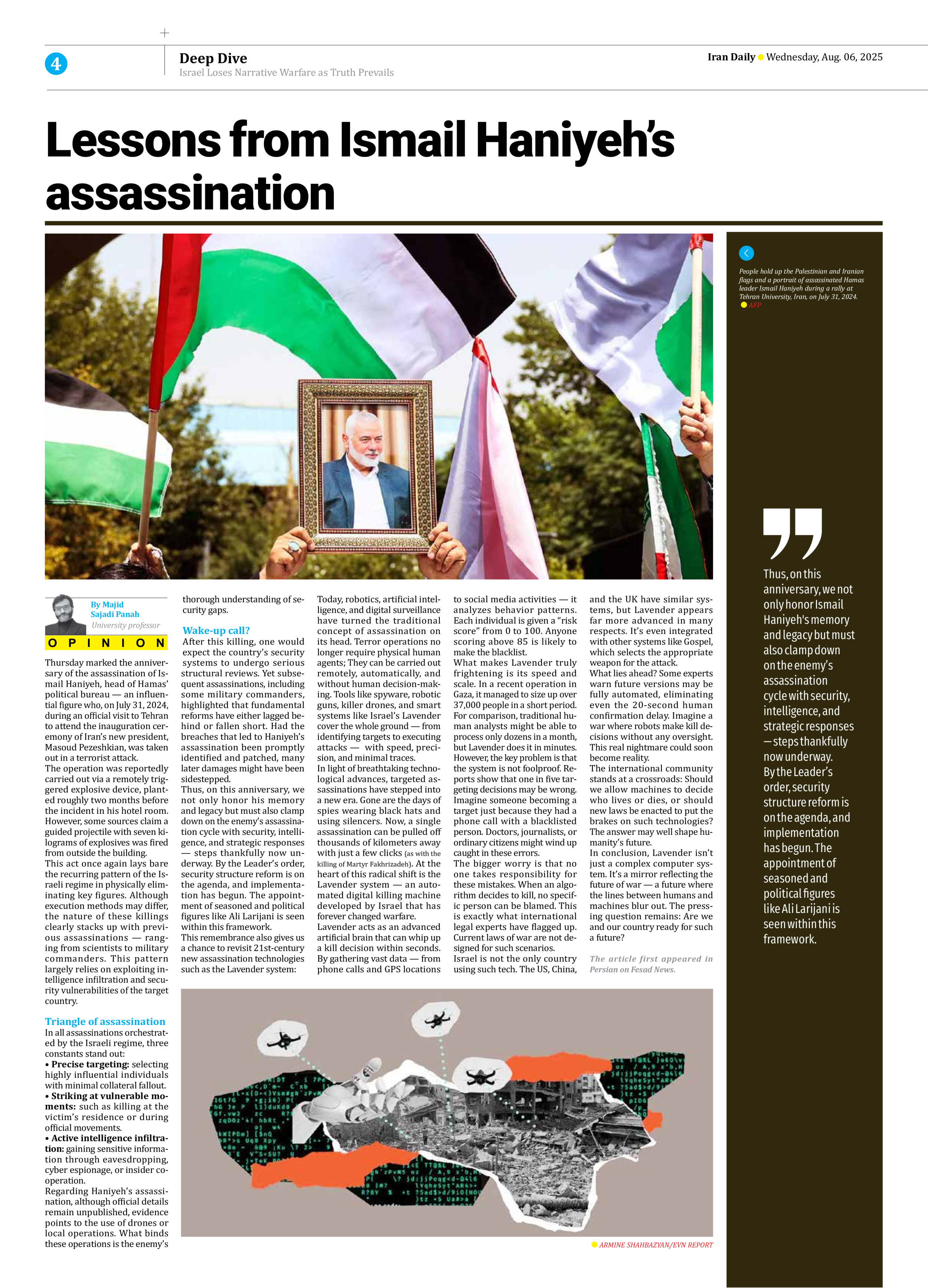
Thursday marked the anniversary of the assassination of Ismail Haniyeh, head of Hamas’ political bureau — an influential figure who, on July 31, 2024, during an official visit to Tehran to attend the inauguration ceremony of Iran’s new president, Masoud Pezeshkian, was taken out in a terrorist attack.
The operation was reportedly carried out via a remotely triggered explosive device, planted roughly two months before the incident in his hotel room. However, some sources claim a guided projectile with seven kilograms of explosives was fired from outside the building.
This act once again lays bare the recurring pattern of the Israeli regime in physically eliminating key figures. Although execution methods may differ, the nature of these killings clearly stacks up with previous assassinations — ranging from scientists to military commanders. This pattern largely relies on exploiting intelligence infiltration and security vulnerabilities of the target country.
Triangle of assassination
In all assassinations orchestrated by the Israeli regime, three constants stand out:
• Precise targeting: selecting highly influential individuals with minimal collateral fallout.
• Striking at vulnerable moments: such as killing at the victim’s residence or during official movements.
• Active intelligence infiltration: gaining sensitive information through eavesdropping, cyber espionage, or insider cooperation.
Regarding Haniyeh’s assassination, although official details remain unpublished, evidence points to the use of drones or local operations. What binds these operations is the enemy’s thorough understanding of security gaps.
Wake-up call?
After this killing, one would expect the country’s security systems to undergo serious structural reviews. Yet subsequent assassinations, including some military commanders, highlighted that fundamental reforms have either lagged behind or fallen short. Had the breaches that led to Haniyeh’s assassination been promptly identified and patched, many later damages might have been sidestepped.
Thus, on this anniversary, we not only honor his memory and legacy but must also clamp down on the enemy’s assassination cycle with security, intelligence, and strategic responses — steps thankfully now underway. By the Leader’s order, security structure reform is on the agenda, and implementation has begun. The appointment of seasoned and political figures like Ali Larijani is seen within this framework.
This remembrance also gives us a chance to revisit 21st-century new assassination technologies such as the Lavender system:
Today, robotics, artificial intelligence, and digital surveillance have turned the traditional concept of assassination on its head. Terror operations no longer require physical human agents; They can be carried out remotely, automatically, and without human decision-making. Tools like spyware, robotic guns, killer drones, and smart systems like Israel’s Lavender cover the whole ground — from identifying targets to executing attacks — with speed, precision, and minimal traces.
In light of breathtaking technological advances, targeted assassinations have stepped into a new era. Gone are the days of spies wearing black hats and using silencers. Now, a single assassination can be pulled off thousands of kilometers away with just a few clicks (as with the killing of Martyr Fakhrizadeh). At the heart of this radical shift is the Lavender system — an automated digital killing machine developed by Israel that has forever changed warfare.
Lavender acts as an advanced artificial brain that can whip up a kill decision within seconds. By gathering vast data — from phone calls and GPS locations to social media activities — it analyzes behavior patterns. Each individual is given a “risk score” from 0 to 100. Anyone scoring above 85 is likely to make the blacklist.
What makes Lavender truly frightening is its speed and scale. In a recent operation in Gaza, it managed to size up over 37,000 people in a short period. For comparison, traditional human analysts might be able to process only dozens in a month, but Lavender does it in minutes.
However, the key problem is that the system is not foolproof. Reports show that one in five targeting decisions may be wrong. Imagine someone becoming a target just because they had a phone call with a blacklisted person. Doctors, journalists, or ordinary citizens might wind up caught in these errors.
The bigger worry is that no one takes responsibility for these mistakes. When an algorithm decides to kill, no specific person can be blamed. This is exactly what international legal experts have flagged up. Current laws of war are not designed for such scenarios.
Israel is not the only country using such tech. The US, China, and the UK have similar systems, but Lavender appears far more advanced in many respects. It’s even integrated with other systems like Gospel, which selects the appropriate weapon for the attack.
What lies ahead? Some experts warn future versions may be fully automated, eliminating even the 20-second human confirmation delay. Imagine a war where robots make kill decisions without any oversight. This real nightmare could soon become reality.
The international community stands at a crossroads: Should we allow machines to decide who lives or dies, or should new laws be enacted to put the brakes on such technologies? The answer may well shape humanity’s future.
In conclusion, Lavender isn’t just a complex computer system. It’s a mirror reflecting the future of war — a future where the lines between humans and machines blur out. The pressing question remains: Are we and our country ready for such a future?
The article first appeared in
Persian on Fesad News.