







VP says Iran’s transit hits record 20m tons via regional cooperation
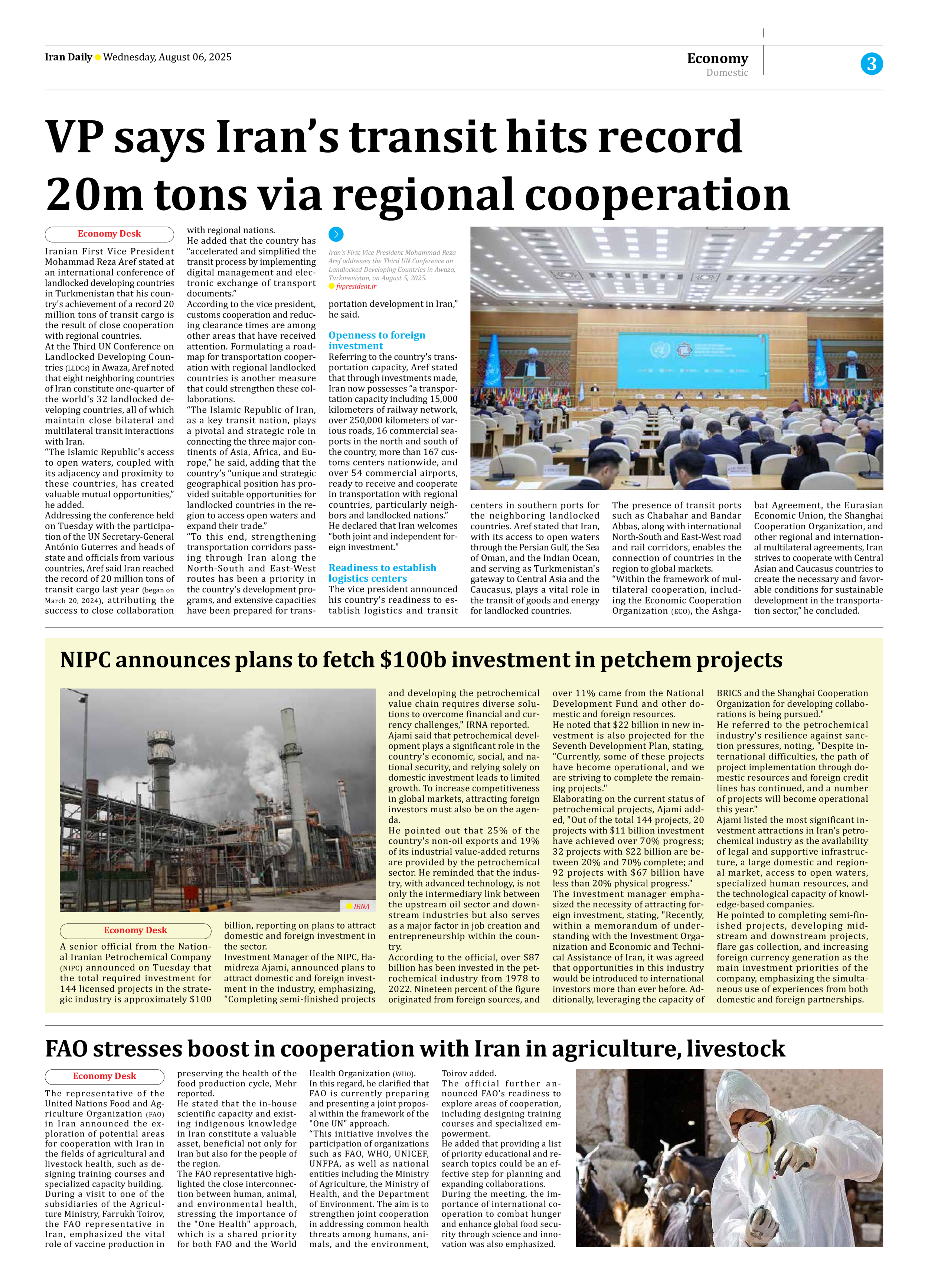
Iranian First Vice President Mohammad Reza Aref stated at an international conference of landlocked developing countries in Turkmenistan that his country's achievement of a record 20 million tons of transit cargo is the result of close cooperation with regional countries.
At the Third UN Conference on Landlocked Developing Countries (LLDCs) in Awaza, Aref noted that eight neighboring countries of Iran constitute one-quarter of the world's 32 landlocked developing countries, all of which maintain close bilateral and multilateral transit interactions with Iran.
“The Islamic Republic's access to open waters, coupled with its adjacency and proximity to these countries, has created valuable mutual opportunities,” he added.
Addressing the conference held on Tuesday with the participation of the UN Secretary-General António Guterres and heads of state and officials from various countries, Aref said Iran reached the record of 20 million tons of transit cargo last year (began on March 20, 2024), attributing the success to close collaboration with regional nations.
He added that the country has “accelerated and simplified the transit process by implementing digital management and electronic exchange of transport documents.”
According to the vice president, customs cooperation and reducing clearance times are among other areas that have received attention. Formulating a roadmap for transportation cooperation with regional landlocked countries is another measure that could strengthen these collaborations.
“The Islamic Republic of Iran, as a key transit nation, plays a pivotal and strategic role in connecting the three major continents of Asia, Africa, and Europe,” he said, adding that the country’s “unique and strategic geographical position has provided suitable opportunities for landlocked countries in the region to access open waters and expand their trade.”
“To this end, strengthening transportation corridors passing through Iran along the North-South and East-West routes has been a priority in the country's development programs, and extensive capacities have been prepared for transportation development in Iran,” he said.
Openness to foreign investment
Referring to the country's transportation capacity, Aref stated that through investments made, Iran now possesses “a transportation capacity including 15,000 kilometers of railway network, over 250,000 kilometers of various roads, 16 commercial seaports in the north and south of the country, more than 167 customs centers nationwide, and over 54 commercial airports, ready to receive and cooperate in transportation with regional countries, particularly neighbors and landlocked nations.”
He declared that Iran welcomes “both joint and independent foreign investment."
Readiness to establish logistics centers
The vice president announced his country's readiness to establish logistics and transit centers in southern ports for the neighboring landlocked countries. Aref stated that Iran, with its access to open waters through the Persian Gulf, the Sea of Oman, and the Indian Ocean, and serving as Turkmenistan's gateway to Central Asia and the Caucasus, plays a vital role in the transit of goods and energy for landlocked countries.
The presence of transit ports such as Chabahar and Bandar Abbas, along with international North-South and East-West road and rail corridors, enables the connection of countries in the region to global markets.
“Within the framework of multilateral cooperation, including the Economic Cooperation Organization (ECO), the Ashgabat Agreement, the Eurasian Economic Union, the Shanghai Cooperation Organization, and other regional and international multilateral agreements, Iran strives to cooperate with Central Asian and Caucasus countries to create the necessary and favorable conditions for sustainable development in the transportation sector,” he concluded.