





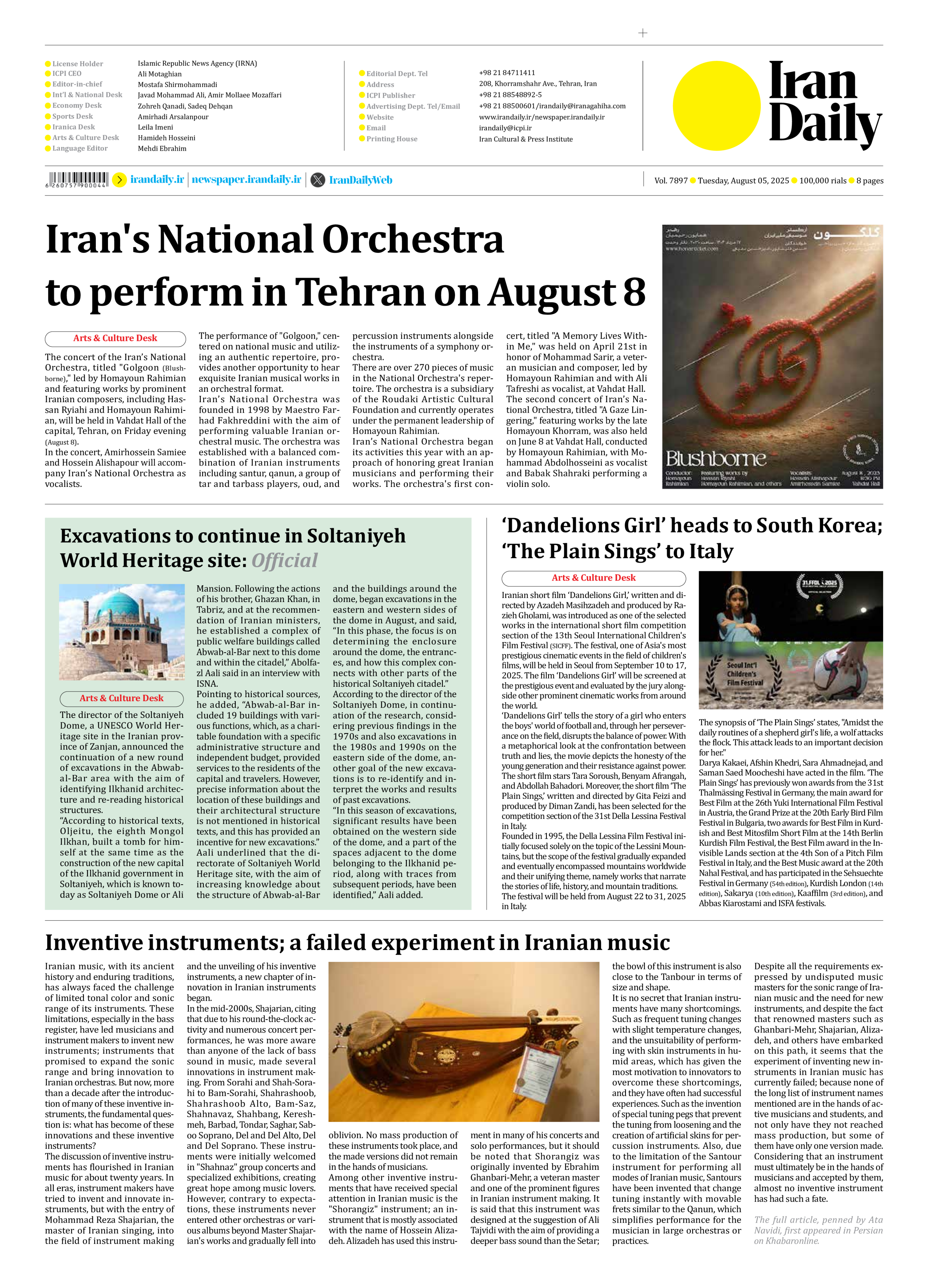


Inventive instruments; a failed experiment in Iranian music
Iranian music, with its ancient history and enduring traditions, has always faced the challenge of limited tonal color and sonic range of its instruments. These limitations, especially in the bass register, have led musicians and instrument makers to invent new instruments; instruments that promised to expand the sonic range and bring innovation to Iranian orchestras. But now, more than a decade after the introduction of many of these inventive instruments, the fundamental question is: what has become of these innovations and these inventive instruments?
The discussion of inventive instruments has flourished in Iranian music for about twenty years. In all eras, instrument makers have tried to invent and innovate instruments, but with the entry of Mohammad Reza Shajarian, the master of Iranian singing, into the field of instrument making and the unveiling of his inventive instruments, a new chapter of innovation in Iranian instruments began.
In the mid-2000s, Shajarian, citing that due to his round-the-clock activity and numerous concert performances, he was more aware than anyone of the lack of bass sound in music, made several innovations in instrument making. From Sorahi and Shah-Sorahi to Bam-Sorahi, Shahrashoob, Shahrashoob Alto, Bam-Saz, Shahnavaz, Shahbang, Kereshmeh, Barbad, Tondar, Saghar, Saboo Soprano, Del and Del Alto, Del and Del Soprano. These instruments were initially welcomed in "Shahnaz" group concerts and specialized exhibitions, creating great hope among music lovers. However, contrary to expectations, these instruments never entered other orchestras or various albums beyond Master Shajarian's works and gradually fell into oblivion. No mass production of these instruments took place, and the made versions did not remain in the hands of musicians.
Among other inventive instruments that have received special attention in Iranian music is the "Shorangiz" instrument; an instrument that is mostly associated with the name of Hossein Alizadeh. Alizadeh has used this instrument in many of his concerts and solo performances, but it should be noted that Shorangiz was originally invented by Ebrahim Ghanbari-Mehr, a veteran master and one of the prominent figures in Iranian instrument making. It is said that this instrument was designed at the suggestion of Ali Tajvidi with the aim of providing a deeper bass sound than the Setar; the bowl of this instrument is also close to the Tanbour in terms of size and shape.
It is no secret that Iranian instruments have many shortcomings. Such as frequent tuning changes with slight temperature changes, and the unsuitability of performing with skin instruments in humid areas, which has given the most motivation to innovators to overcome these shortcomings, and they have often had successful experiences. Such as the invention of special tuning pegs that prevent the tuning from loosening and the creation of artificial skins for percussion instruments. Also, due to the limitation of the Santour instrument for performing all modes of Iranian music, Santours have been invented that change tuning instantly with movable frets similar to the Qanun, which simplifies performance for the musician in large orchestras or practices.
Despite all the requirements expressed by undisputed music masters for the sonic range of Iranian music and the need for new instruments, and despite the fact that renowned masters such as Ghanbari-Mehr, Shajarian, Alizadeh, and others have embarked on this path, it seems that the experiment of inventing new instruments in Iranian music has currently failed; because none of the long list of instrument names mentioned are in the hands of active musicians and students, and not only have they not reached mass production, but some of them have only one version made. Considering that an instrument must ultimately be in the hands of musicians and accepted by them, almost no inventive instrument has had such a fate.
The full article, penned by Ata Navidi, first appeared in Persian on Khabaronline.