





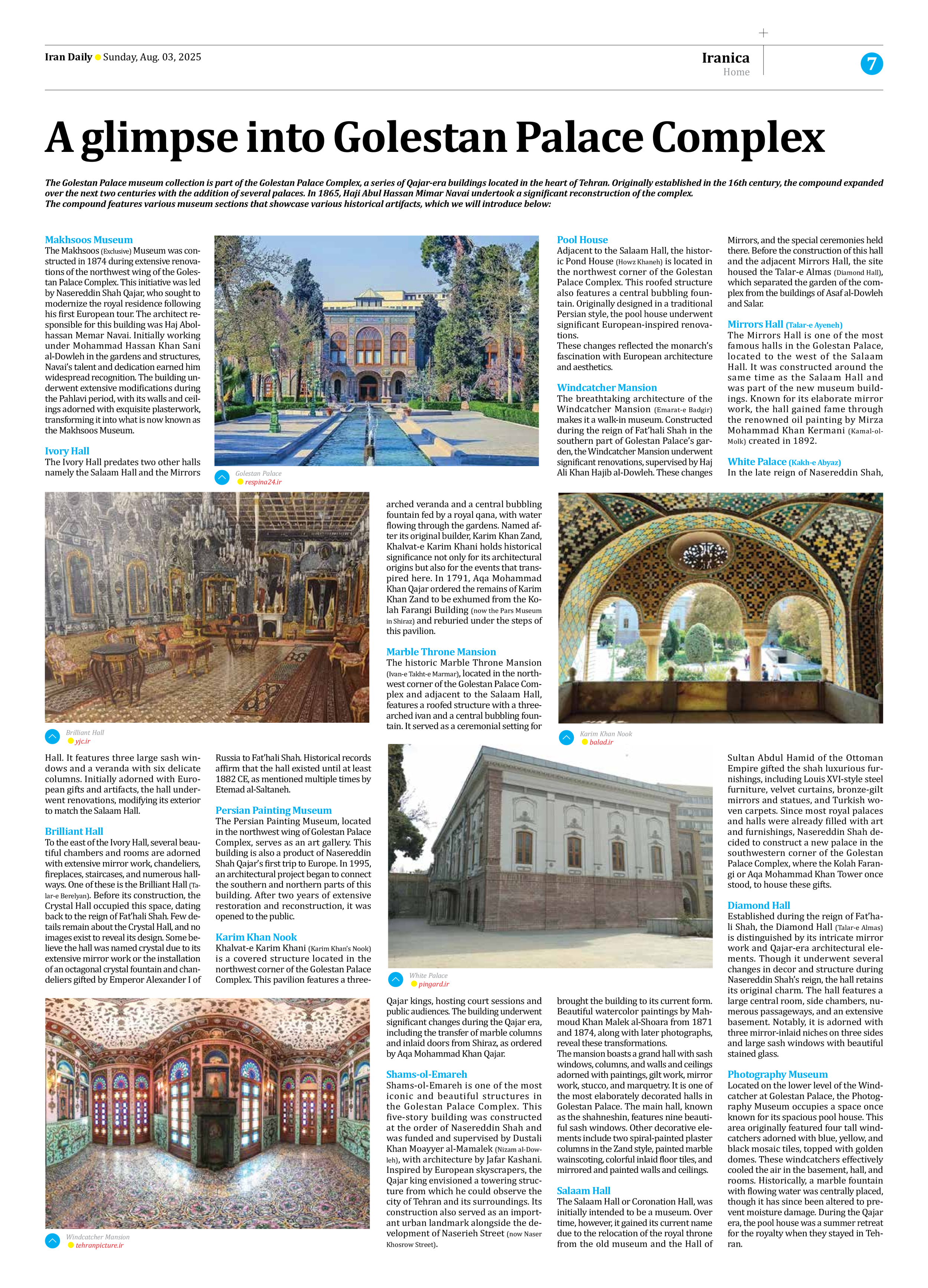


A glimpse into Golestan Palace Complex
The Golestan Palace museum collection is part of the Golestan Palace Complex, a series of Qajar-era buildings located in the heart of Tehran. Originally established in the 16th century, the compound expanded over the next two centuries with the addition of several palaces. In 1865, Haji Abul Hassan Mimar Navai undertook a significant reconstruction of the complex. The compound features various museum sections that showcase various historical artifacts, which we will introduce below:
Makhsoos Museum
The Makhsoos (Exclusive) Museum was constructed in 1874 during extensive renovations of the northwest wing of the Golestan Palace Complex. This initiative was led by Nasereddin Shah Qajar, who sought to modernize the royal residence following his first European tour. The architect responsible for this building was Haj Abolhassan Memar Navai. Initially working under Mohammad Hassan Khan Sani al-Dowleh in the gardens and structures, Navai’s talent and dedication earned him widespread recognition. The building underwent extensive modifications during the Pahlavi period, with its walls and ceilings adorned with exquisite plasterwork, transforming it into what is now known as the Makhsoos Museum.
Ivory Hall
The Ivory Hall predates two other halls namely the Salaam Hall and the Mirrors Hall. It features three large sash windows and a veranda with six delicate columns. Initially adorned with European gifts and artifacts, the hall underwent renovations, modifying its exterior to match the Salaam Hall.
Brilliant Hall
To the east of the Ivory Hall, several beautiful chambers and rooms are adorned with extensive mirror work, chandeliers, fireplaces, staircases, and numerous hallways. One of these is the Brilliant Hall (Talar-e Berelyan). Before its construction, the Crystal Hall occupied this space, dating back to the reign of Fat’hali Shah. Few details remain about the Crystal Hall, and no images exist to reveal its design. Some believe the hall was named crystal due to its extensive mirror work or the installation of an octagonal crystal fountain and chandeliers gifted by Emperor Alexander I of Russia to Fat’hali Shah. Historical records affirm that the hall existed until at least 1882 CE, as mentioned multiple times by Etemad al-Saltaneh.
Persian Painting Museum
The Persian Painting Museum, located in the northwest wing of Golestan Palace Complex, serves as an art gallery. This building is also a product of Nasereddin Shah Qajar’s first trip to Europe. In 1995, an architectural project began to connect the southern and northern parts of this building. After two years of extensive restoration and reconstruction, it was opened to the public.
Karim Khan Nook
Khalvat-e Karim Khani (Karim Khan’s Nook) is a covered structure located in the northwest corner of the Golestan Palace Complex. This pavilion features a three-arched veranda and a central bubbling fountain fed by a royal qana, with water flowing through the gardens. Named after its original builder, Karim Khan Zand, Khalvat-e Karim Khani holds historical significance not only for its architectural origins but also for the events that transpired here. In 1791, Aqa Mohammad Khan Qajar ordered the remains of Karim Khan Zand to be exhumed from the Kolah Farangi Building (now the Pars Museum in Shiraz) and reburied under the steps of this pavilion.
Marble Throne Mansion
The historic Marble Throne Mansion (Ivan-e Takht-e Marmar), located in the northwest corner of the Golestan Palace Complex and adjacent to the Salaam Hall, features a roofed structure with a three-arched ivan and a central bubbling fountain. It served as a ceremonial setting for Qajar kings, hosting court sessions and public audiences. The building underwent significant changes during the Qajar era, including the transfer of marble columns and inlaid doors from Shiraz, as ordered by Aqa Mohammad Khan Qajar.
Shams-ol-Emareh
Shams-ol-Emareh is one of the most iconic and beautiful structures in the Golestan Palace Complex. This five-story building was constructed at the order of Nasereddin Shah and was funded and supervised by Dustali Khan Moayyer al-Mamalek (Nizam al-Dowleh), with architecture by Jafar Kashani. Inspired by European skyscrapers, the Qajar king envisioned a towering structure from which he could observe the city of Tehran and its surroundings. Its construction also served as an important urban landmark alongside the development of Naserieh Street (now Naser Khosrow Street).
Pool House
Adjacent to the Salaam Hall, the historic Pond House (Howz Khaneh) is located in the northwest corner of the Golestan Palace Complex. This roofed structure also features a central bubbling fountain. Originally designed in a traditional Persian style, the pool house underwent significant European-inspired renovations.
These changes reflected the monarch’s fascination with European architecture and aesthetics.
Windcatcher Mansion
The breathtaking architecture of the Windcatcher Mansion (Emarat-e Badgir) makes it a walk-in museum. Constructed during the reign of Fat’hali Shah in the southern part of Golestan Palace’s garden, the Windcatcher Mansion underwent significant renovations, supervised by Haj Ali Khan Hajib al-Dowleh. These changes brought the building to its current form. Beautiful watercolor paintings by Mahmoud Khan Malek al-Shoara from 1871 and 1874, along with later photographs, reveal these transformations.
The mansion boasts a grand hall with sash windows, columns, and walls and ceilings adorned with paintings, gilt work, mirror work, stucco, and marquetry. It is one of the most elaborately decorated halls in Golestan Palace. The main hall, known as the shahneshin, features nine beautiful sash windows. Other decorative elements include two spiral-painted plaster columns in the Zand style, painted marble wainscoting, colorful inlaid floor tiles, and mirrored and painted walls and ceilings.
Salaam Hall
The Salaam Hall or Coronation Hall, was initially intended to be a museum. Over time, however, it gained its current name due to the relocation of the royal throne from the old museum and the Hall of Mirrors, and the special ceremonies held there. Before the construction of this hall and the adjacent Mirrors Hall, the site housed the Talar-e Almas (Diamond Hall), which separated the garden of the complex from the buildings of Asaf al-Dowleh and Salar.
Mirrors Hall (Talar-e Ayeneh)
The Mirrors Hall is one of the most famous halls in the Golestan Palace, located to the west of the Salaam Hall. It was constructed around the same time as the Salaam Hall and was part of the new museum buildings. Known for its elaborate mirror work, the hall gained fame through the renowned oil painting by Mirza Mohammad Khan Kermani (Kamal-ol-Molk) created in 1892.
White Palace (Kakh-e Abyaz)
In the late reign of Nasereddin Shah, Sultan Abdul Hamid of the Ottoman Empire gifted the shah luxurious furnishings, including Louis XVI-style steel furniture, velvet curtains, bronze-gilt mirrors and statues, and Turkish woven carpets. Since most royal palaces and halls were already filled with art and furnishings, Nasereddin Shah decided to construct a new palace in the southwestern corner of the Golestan Palace Complex, where the Kolah Farangi or Aqa Mohammad Khan Tower once stood, to house these gifts.
Diamond Hall
Established during the reign of Fat’hali Shah, the Diamond Hall (Talar-e Almas) is distinguished by its intricate mirror work and Qajar-era architectural elements. Though it underwent several changes in decor and structure during Nasereddin Shah’s reign, the hall retains its original charm. The hall features a large central room, side chambers, numerous passageways, and an extensive basement. Notably, it is adorned with three mirror-inlaid niches on three sides and large sash windows with beautiful stained glass.
Photography Museum
Located on the lower level of the Windcatcher at Golestan Palace, the Photography Museum occupies a space once known for its spacious pool house. This area originally featured four tall windcatchers adorned with blue, yellow, and black mosaic tiles, topped with golden domes. These windcatchers effectively cooled the air in the basement, hall, and rooms. Historically, a marble fountain with flowing water was centrally placed, though it has since been altered to prevent moisture damage. During the Qajar era, the pool house was a summer retreat for the royalty when they stayed in Tehran.