







Maintaining mobile signal using solar panels
By Mehdi Jalilian
Guest contributor
In recent years, frequent power outages in various regions of Iran have been among the country’s vital infrastructure problems. It is not only residential areas and offices that are affected, but, more concerningly, also national telecommunications. The majority of users lose their mobile signal during power cuts — a problem that exists in the shutdown of telecommunication towers that have no backup power supplies. What is more, these disruptions also affect internet access, emergency calls, and a very broad spectrum of mobile-based services.
But is there an environmentally friendly, green, and realistic solution to the issue? Yes — a solution that has worked effectively across many nations and now can be made possible in Iran as well: powering telecom towers with solar panels attached directly onto their facilities.
All but a few Iranian telecom towers, especially in remote or mountainous areas, derive their power entirely from the national grid. In times of power failure, these towers are shut down as they do not have backup batteries or working generators, cutting out local customers from mobile services.
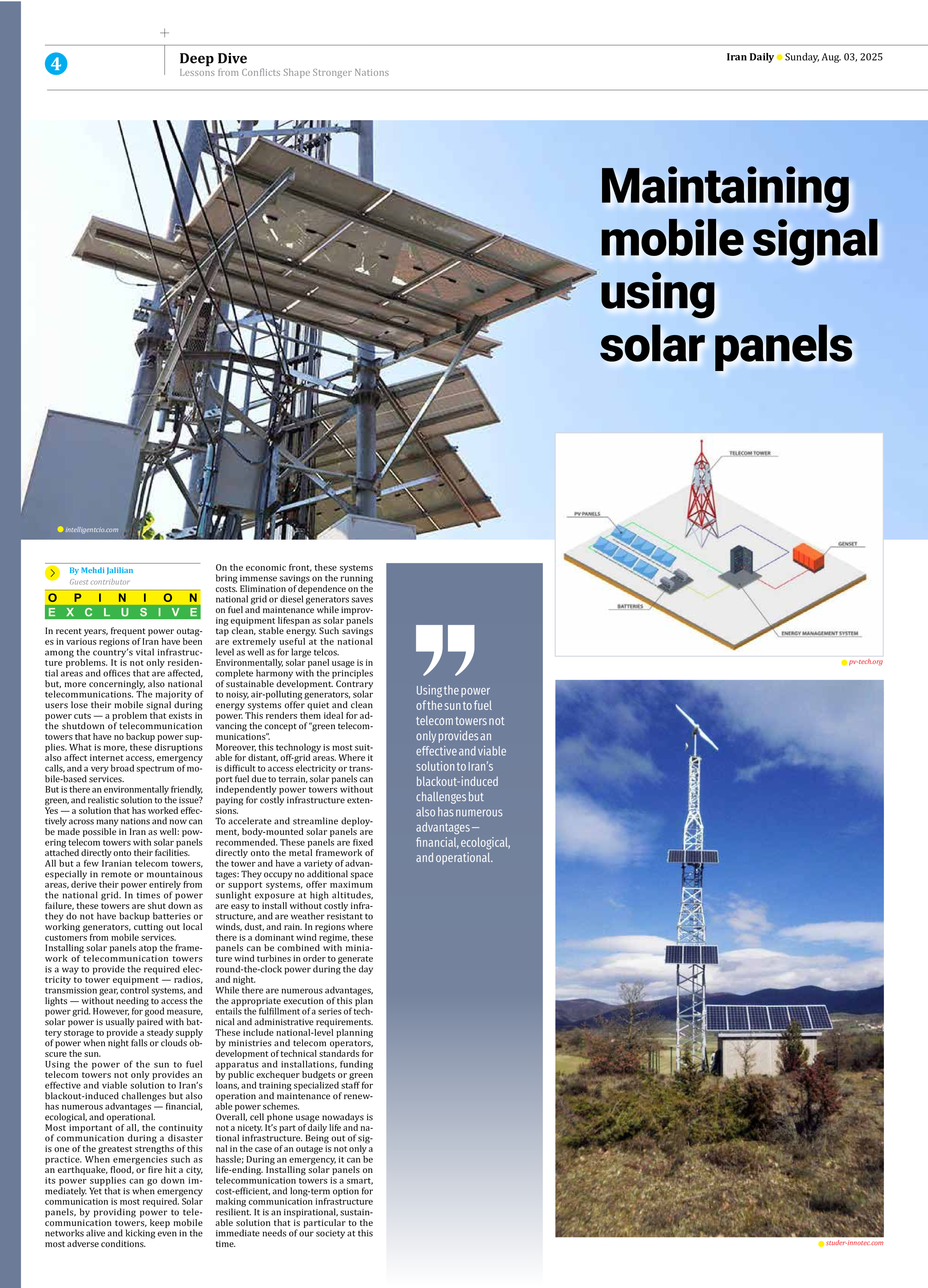
Installing solar panels atop the framework of telecommunication towers is a way to provide the required electricity to tower equipment — radios, transmission gear, control systems, and lights — without needing to access the power grid. However, for good measure, solar power is usually paired with battery storage to provide a steady supply of power when night falls or clouds obscure the sun.
Using the power of the sun to fuel telecom towers not only provides an effective and viable solution to Iran’s blackout-induced challenges but also has numerous advantages — financial, ecological, and operational.
Most important of all, the continuity of communication during a disaster is one of the greatest strengths of this practice. When emergencies such as an earthquake, flood, or fire hit a city, its power supplies can go down immediately. Yet that is when emergency communication is most required. Solar panels, by providing power to telecommunication towers, keep mobile networks alive and kicking even in the most adverse conditions.
On the economic front, these systems bring immense savings on the running costs. Elimination of dependence on the national grid or diesel generators saves on fuel and maintenance while improving equipment lifespan as solar panels tap clean, stable energy. Such savings are extremely useful at the national level as well as for large telcos.
Environmentally, solar panel usage is in complete harmony with the principles of sustainable development. Contrary to noisy, air-polluting generators, solar energy systems offer quiet and clean power. This renders them ideal for advancing the concept of “green telecommunications”.
Moreover, this technology is most suitable for distant, off-grid areas. Where it is difficult to access electricity or transport fuel due to terrain, solar panels can independently power towers without paying for costly infrastructure extensions.
To accelerate and streamline deployment, body-mounted solar panels are recommended. These panels are fixed directly onto the metal framework of the tower and have a variety of advantages: They occupy no additional space or support systems, offer maximum sunlight exposure at high altitudes, are easy to install without costly infrastructure, and are weather resistant to winds, dust, and rain. In regions where there is a dominant wind regime, these panels can be combined with miniature wind turbines in order to generate round-the-clock power during the day and night.
While there are numerous advantages, the appropriate execution of this plan entails the fulfillment of a series of technical and administrative requirements. These include national-level planning by ministries and telecom operators, development of technical standards for apparatus and installations, funding by public exchequer budgets or green loans, and training specialized staff for operation and maintenance of renewable power schemes.
Overall, cell phone usage nowadays is not a nicety. It’s part of daily life and national infrastructure. Being out of signal in the case of an outage is not only a hassle; During an emergency, it can be life-ending. Installing solar panels on telecommunication towers is a smart, cost-efficient, and long-term option for making communication infrastructure resilient. It is an inspirational, sustainable solution that is particular to the immediate needs of our society at this time.