







Tehran, Baghdad discuss resolution of gas export, payment issues
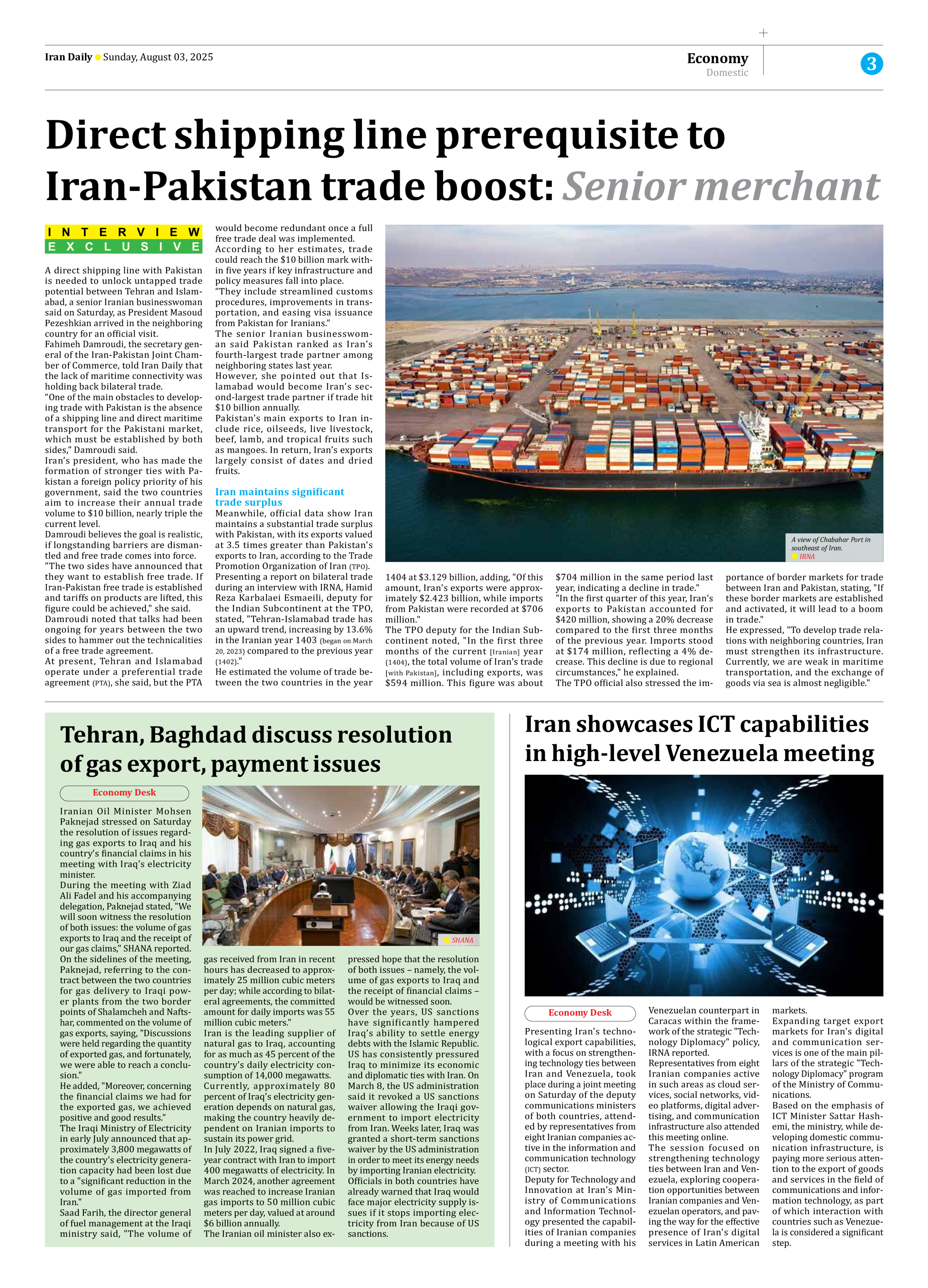
Iranian Oil Minister Mohsen Paknejad stressed on Saturday the resolution of issues regarding gas exports to Iraq and his country’s financial claims in his meeting with Iraq’s electricity minister.
During the meeting with Ziad Ali Fadel and his accompanying delegation, Paknejad stated, "We will soon witness the resolution of both issues: the volume of gas exports to Iraq and the receipt of our gas claims," SHANA reported.
On the sidelines of the meeting, Paknejad, referring to the contract between the two countries for gas delivery to Iraqi power plants from the two border points of Shalamcheh and Naftshar, commented on the volume of gas exports, saying, "Discussions were held regarding the quantity of exported gas, and fortunately, we were able to reach a conclusion."
He added, "Moreover, concerning the financial claims we had for the exported gas, we achieved positive and good results."
The Iraqi Ministry of Electricity in early July announced that approximately 3,800 megawatts of the country's electricity generation capacity had been lost due to a "significant reduction in the volume of gas imported from Iran."
Saad Farih, the director general of fuel management at the Iraqi ministry said, "The volume of gas received from Iran in recent hours has decreased to approximately 25 million cubic meters per day; while according to bilateral agreements, the committed amount for daily imports was 55 million cubic meters."
Iran is the leading supplier of natural gas to Iraq, accounting for as much as 45 percent of the country’s daily electricity consumption of 14,000 megawatts.
Currently, approximately 80 percent of Iraq’s electricity generation depends on natural gas, making the country heavily dependent on Iranian imports to sustain its power grid.
In July 2022, Iraq signed a five-year contract with Iran to import 400 megawatts of electricity. In March 2024, another agreement was reached to increase Iranian gas imports to 50 million cubic meters per day, valued at around $6 billion annually.
The Iranian oil minister also expressed hope that the resolution of both issues – namely, the volume of gas exports to Iraq and the receipt of financial claims – would be witnessed soon.
Over the years, US sanctions have significantly hampered Iraq’s ability to settle energy debts with the Islamic Republic. US has consistently pressured Iraq to minimize its economic and diplomatic ties with Iran. On March 8, the US administration said it revoked a US sanctions waiver allowing the Iraqi government to import electricity from Iran. Weeks later, Iraq was granted a short-term sanctions waiver by the US administration in order to meet its energy needs by importing Iranian electricity.
Officials in both countries have already warned that Iraq would face major electricity supply issues if it stops importing electricity from Iran because of US sanctions.