





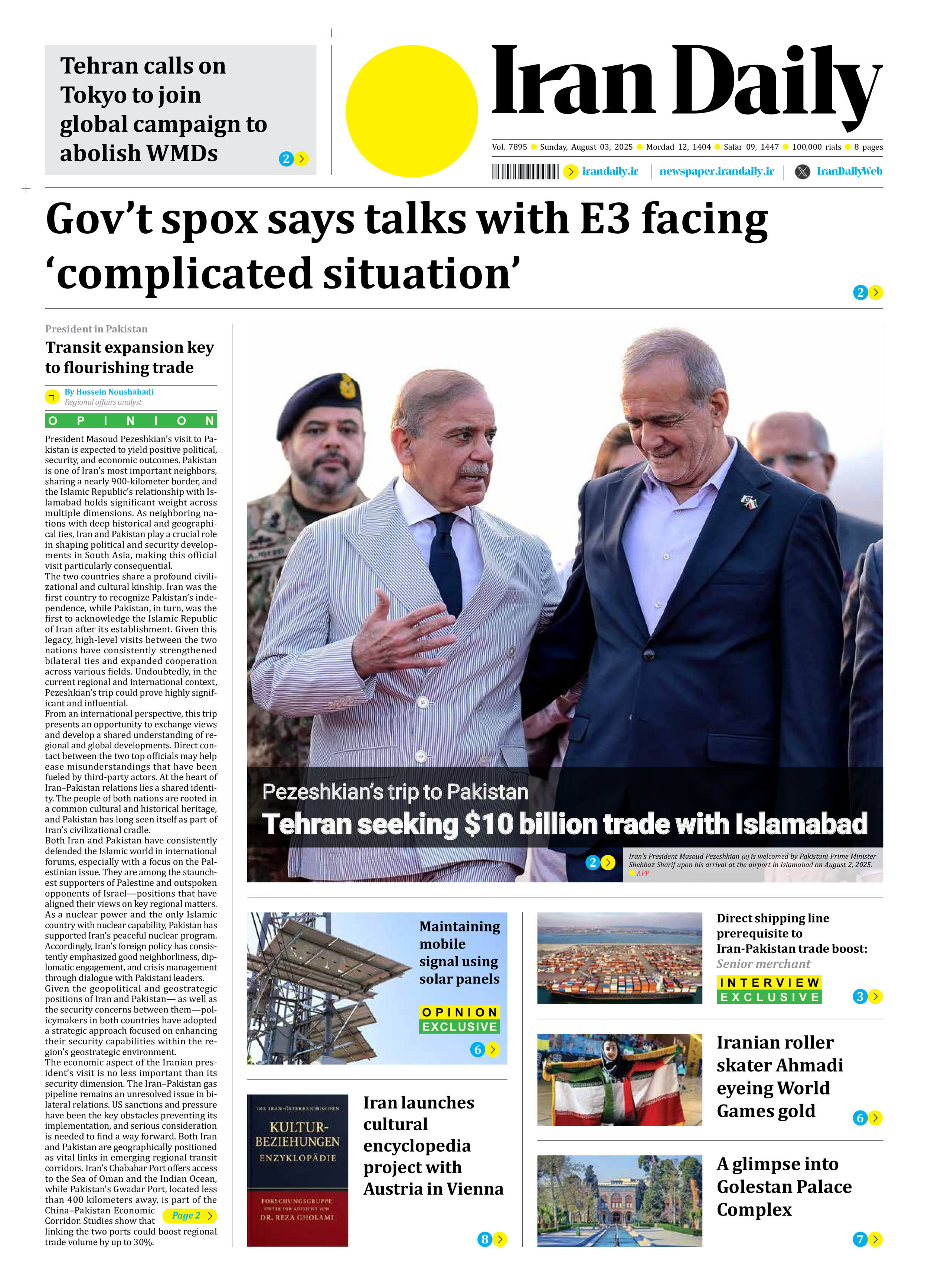


President in Pakistan
Transit expansion key to flourishing trade
By Hossein Noushabadi
Regional affairs analyst
President Masoud Pezeshkian’s visit to Pakistan is expected to yield positive political, security, and economic outcomes. Pakistan is one of Iran’s most important neighbors, sharing a nearly 900-kilometer border, and the Islamic Republic’s relationship with Islamabad holds significant weight across multiple dimensions. As neighboring nations with deep historical and geographical ties, Iran and Pakistan play a crucial role in shaping political and security developments in South Asia, making this official visit particularly consequential.
The two countries share a profound civilizational and cultural kinship. Iran was the first country to recognize Pakistan’s independence, while Pakistan, in turn, was the first to acknowledge the Islamic Republic of Iran after its establishment. Given this legacy, high-level visits between the two nations have consistently strengthened bilateral ties and expanded cooperation across various fields. Undoubtedly, in the current regional and international context, Pezeshkian’s trip could prove highly significant and influential.
From an international perspective, this trip presents an opportunity to exchange views and develop a shared understanding of regional and global developments. Direct contact between the two top officials may help ease misunderstandings that have been fueled by third-party actors. At the heart of Iran–Pakistan relations lies a shared identity. The people of both nations are rooted in a common cultural and historical heritage, and Pakistan has long seen itself as part of Iran’s civilizational cradle.
Both Iran and Pakistan have consistently defended the Islamic world in international forums, especially with a focus on the Palestinian issue. They are among the staunchest supporters of Palestine and outspoken opponents of Israel—positions that have aligned their views on key regional matters. As a nuclear power and the only Islamic country with nuclear capability, Pakistan has supported Iran’s peaceful nuclear program. Accordingly, Iran’s foreign policy has consistently emphasized good neighborliness, diplomatic engagement, and crisis management through dialogue with Pakistani leaders.
Given the geopolitical and geostrategic positions of Iran and Pakistan— as well as the security concerns between them—policymakers in both countries have adopted a strategic approach focused on enhancing their security capabilities within the region’s geostrategic environment.
The economic aspect of the Iranian president’s visit is no less important than its security dimension. The Iran–Pakistan gas pipeline remains an unresolved issue in bilateral relations. US sanctions and pressure have been the key obstacles preventing its implementation, and serious consideration is needed to find a way forward. Both Iran and Pakistan are geographically positioned as vital links in emerging regional transit corridors. Iran’s Chabahar Port offers access to the Sea of Oman and the Indian Ocean, while Pakistan’s Gwadar Port, located less than 400 kilometers away, is part of the China–Pakistan Economic Corridor. Studies show that linking the two ports could boost regional trade volume by up to 30%.
Page 2