





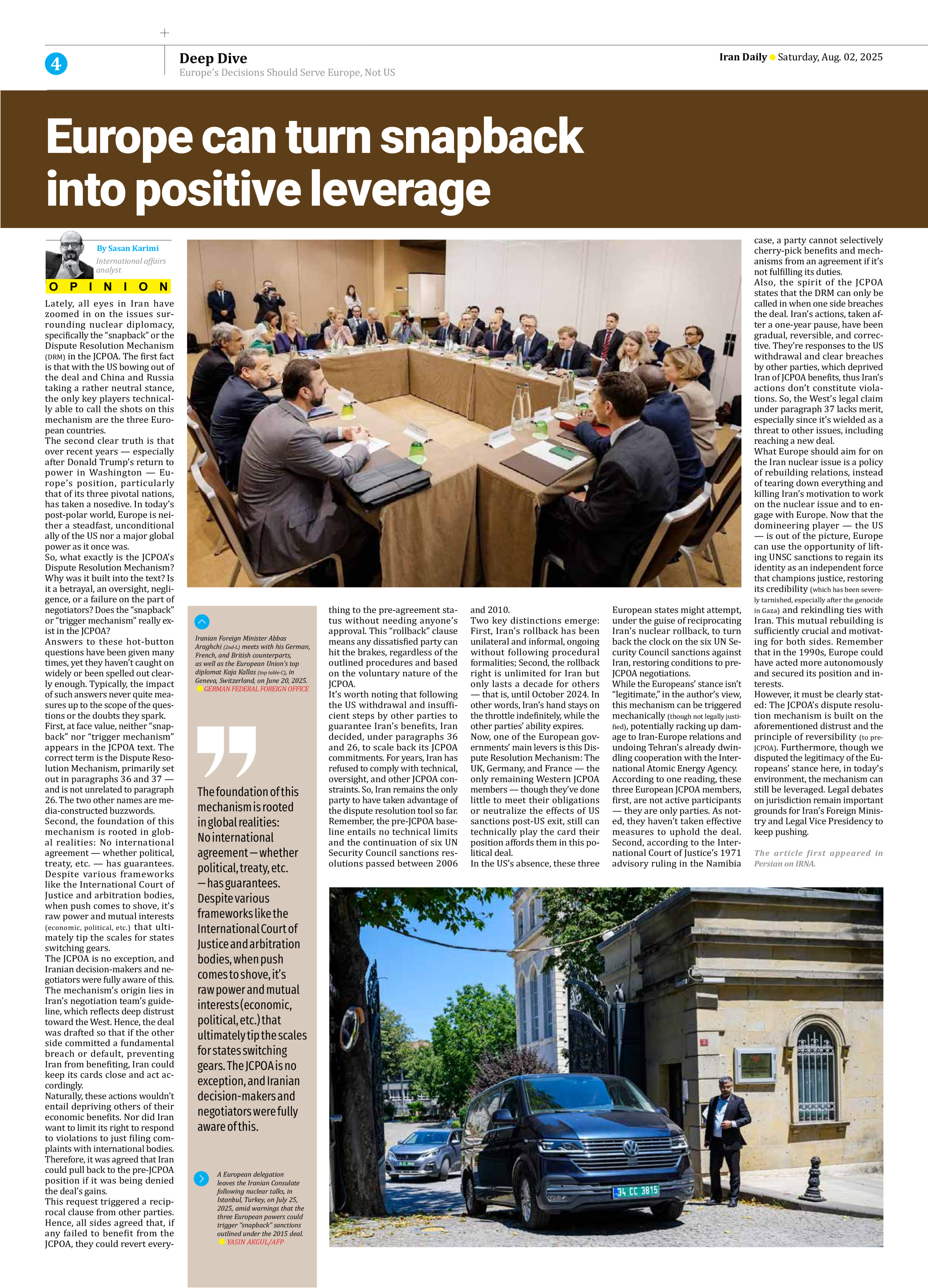


Europe can turn snapback into positive leverage
By Sasan Karimi
International affairs analyst
Lately, all eyes in Iran have zoomed in on the issues surrounding nuclear diplomacy, specifically the “snapback” or the Dispute Resolution Mechanism (DRM) in the JCPOA. The first fact is that with the US bowing out of the deal and China and Russia taking a rather neutral stance, the only key players technically able to call the shots on this mechanism are the three European countries.
The second clear truth is that over recent years — especially after Donald Trump’s return to power in Washington — Europe’s position, particularly that of its three pivotal nations, has taken a nosedive. In today’s post-polar world, Europe is neither a steadfast, unconditional ally of the US nor a major global power as it once was.
So, what exactly is the JCPOA’s Dispute Resolution Mechanism? Why was it built into the text? Is it a betrayal, an oversight, negligence, or a failure on the part of negotiators? Does the “snapback” or “trigger mechanism” really exist in the JCPOA?
Answers to these hot-button questions have been given many times, yet they haven’t caught on widely or been spelled out clearly enough. Typically, the impact of such answers never quite measures up to the scope of the questions or the doubts they spark.
First, at face value, neither “snapback” nor “trigger mechanism” appears in the JCPOA text. The correct term is the Dispute Resolution Mechanism, primarily set out in paragraphs 36 and 37 — and is not unrelated to paragraph 26. The two other names are media-constructed buzzwords.
Second, the foundation of this mechanism is rooted in global realities: No international agreement — whether political, treaty, etc. — has guarantees. Despite various frameworks like the International Court of Justice and arbitration bodies, when push comes to shove, it’s raw power and mutual interests (economic, political, etc.) that ultimately tip the scales for states switching gears.
The JCPOA is no exception, and Iranian decision-makers and negotiators were fully aware of this. The mechanism’s origin lies in Iran’s negotiation team’s guideline, which reflects deep distrust toward the West. Hence, the deal was drafted so that if the other side committed a fundamental breach or default, preventing Iran from benefiting, Iran could keep its cards close and act accordingly.
Naturally, these actions wouldn’t entail depriving others of their economic benefits. Nor did Iran want to limit its right to respond to violations to just filing complaints with international bodies. Therefore, it was agreed that Iran could pull back to the pre-JCPOA position if it was being denied the deal’s gains.
This request triggered a reciprocal clause from other parties. Hence, all sides agreed that, if any failed to benefit from the JCPOA, they could revert everything to the pre-agreement status without needing anyone’s approval. This “rollback” clause means any dissatisfied party can hit the brakes, regardless of the outlined procedures and based on the voluntary nature of the JCPOA.
It’s worth noting that following the US withdrawal and insufficient steps by other parties to guarantee Iran’s benefits, Iran decided, under paragraphs 36 and 26, to scale back its JCPOA commitments. For years, Iran has refused to comply with technical, oversight, and other JCPOA constraints. So, Iran remains the only party to have taken advantage of the dispute resolution tool so far.
Remember, the pre-JCPOA baseline entails no technical limits and the continuation of six UN Security Council sanctions resolutions passed between 2006 and 2010.
Two key distinctions emerge: First, Iran’s rollback has been unilateral and informal, ongoing without following procedural formalities; Second, the rollback right is unlimited for Iran but only lasts a decade for others — that is, until October 2024. In other words, Iran’s hand stays on the throttle indefinitely, while the other parties’ ability expires.
Now, one of the European governments’ main levers is this Dispute Resolution Mechanism: The UK, Germany, and France — the only remaining Western JCPOA members — though they’ve done little to meet their obligations or neutralize the effects of US sanctions post-US exit, still can technically play the card their position affords them in this political deal.
In the US’s absence, these three European states might attempt, under the guise of reciprocating Iran’s nuclear rollback, to turn back the clock on the six UN Security Council sanctions against Iran, restoring conditions to pre-JCPOA negotiations.
While the Europeans’ stance isn’t “legitimate,” in the author’s view, this mechanism can be triggered mechanically (though not legally justified), potentially racking up damage to Iran-Europe relations and undoing Tehran’s already dwindling cooperation with the International Atomic Energy Agency.
According to one reading, these three European JCPOA members, first, are not active participants — they are only parties. As noted, they haven’t taken effective measures to uphold the deal. Second, according to the International Court of Justice’s 1971 advisory ruling in the Namibia case, a party cannot selectively cherry-pick benefits and mechanisms from an agreement if it’s not fulfilling its duties.
Also, the spirit of the JCPOA states that the DRM can only be called in when one side breaches the deal. Iran’s actions, taken after a one-year pause, have been gradual, reversible, and corrective. They’re responses to the US withdrawal and clear breaches by other parties, which deprived Iran of JCPOA benefits, thus Iran’s actions don’t constitute violations. So, the West’s legal claim under paragraph 37 lacks merit, especially since it’s wielded as a threat to other issues, including reaching a new deal.
What Europe should aim for on the Iran nuclear issue is a policy of rebuilding relations, instead of tearing down everything and killing Iran’s motivation to work on the nuclear issue and to engage with Europe. Now that the domineering player — the US — is out of the picture, Europe can use the opportunity of lifting UNSC sanctions to regain its identity as an independent force that champions justice, restoring its credibility (which has been severely tarnished, especially after the genocide in Gaza) and rekindling ties with Iran. This mutual rebuilding is sufficiently crucial and motivating for both sides. Remember that in the 1990s, Europe could have acted more autonomously and secured its position and interests.
However, it must be clearly stated: The JCPOA’s dispute resolution mechanism is built on the aforementioned distrust and the principle of reversibility (to pre-JCPOA). Furthermore, though we disputed the legitimacy of the Europeans’ stance here, in today’s environment, the mechanism can still be leveraged. Legal debates on jurisdiction remain important grounds for Iran’s Foreign Ministry and Legal Vice Presidency to keep pushing.
The article first appeared in
Persian on IRNA.