







Roadmap for Iran-EAEU free trade agreement set for approval in Sept.
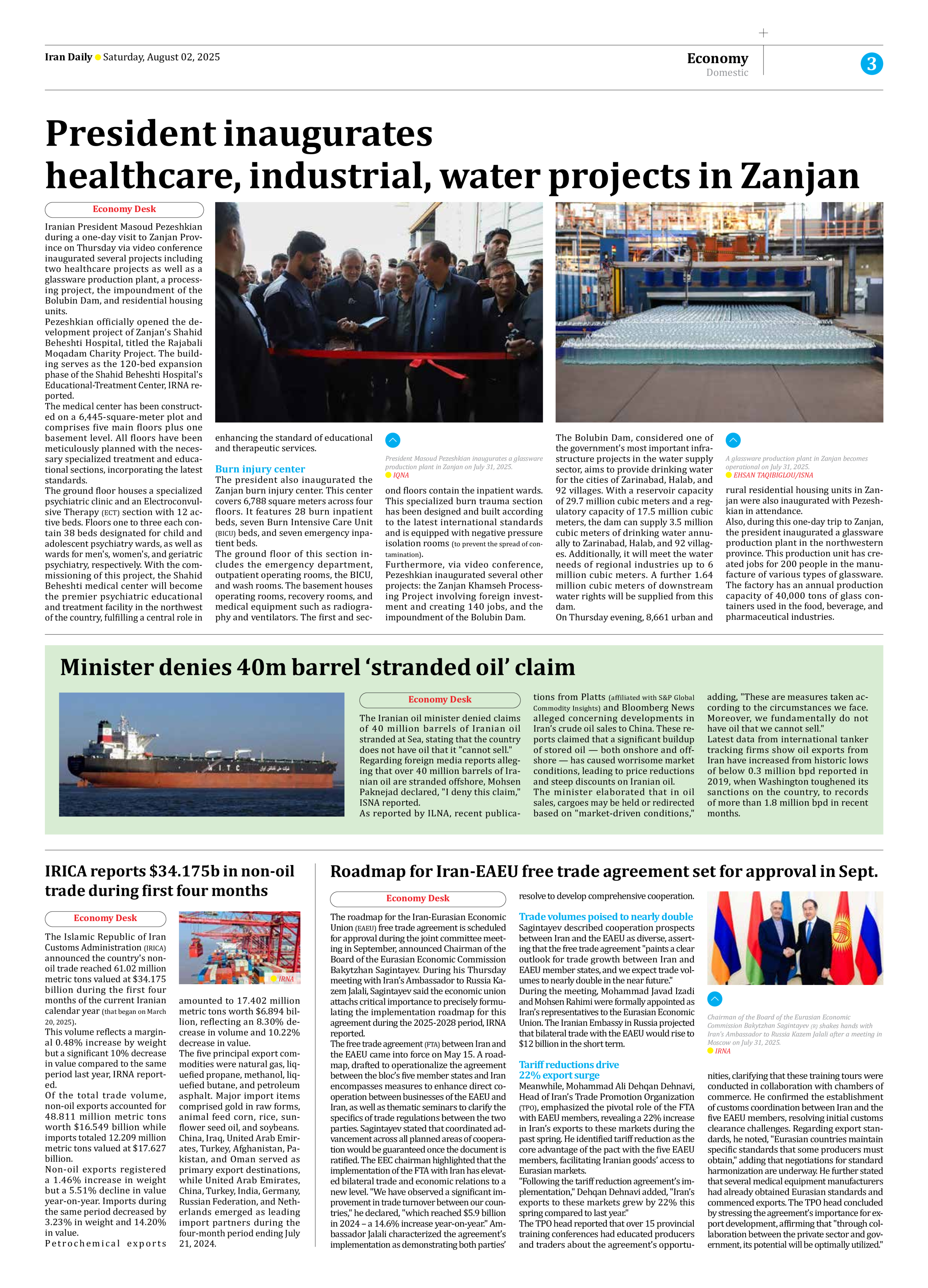
The roadmap for the Iran-Eurasian Economic Union (EAEU) free trade agreement is scheduled for approval during the joint committee meeting in September, announced Chairman of the Board of the Eurasian Economic Commission Bakytzhan Sagintayev. During his Thursday meeting with Iran’s Ambassador to Russia Kazem Jalali, Sagintayev said the economic union attachs critical importance to precisely formulating the implementation roadmap for this agreement during the 2025-2028 period, IRNA reported.
The free trade agreement (FTA) between Iran and the EAEU came into force on May 15. A roadmap, drafted to operationalize the agreement between the bloc’s five member states and Iran encompasses measures to enhance direct cooperation between businesses of the EAEU and Iran, as well as thematic seminars to clarify the specifics of trade regulations between the two parties. Sagintayev stated that coordinated advancement across all planned areas of cooperation would be guaranteed once the document is ratified. The EEC chairman highlighted that the implementation of the FTA with Iran has elevated bilateral trade and economic relations to a new level. "We have observed a significant improvement in trade turnover between our countries," he declared, "which reached $5.9 billion in 2024 – a 14.6% increase year-on-year." Ambassador Jalali characterized the agreement’s implementation as demonstrating both parties’ resolve to develop comprehensive cooperation.
Trade volumes poised to nearly double
Sagintayev described cooperation prospects between Iran and the EAEU as diverse, asserting that the free trade agreement "paints a clear outlook for trade growth between Iran and EAEU member states, and we expect trade volumes to nearly double in the near future."
During the meeting, Mohammad Javad Izadi and Mohsen Rahimi were formally appointed as Iran’s representatives to the Eurasian Economic Union. The Iranian Embassy in Russia projected that bilateral trade with the EAEU would rise to $12 billion in the short term.
Tariff reductions drive
22% export surge
Meanwhile, Mohammad Ali Dehqan Dehnavi, Head of Iran’s Trade Promotion Organization (TPO), emphasized the pivotal role of the FTA with EAEU members, revealing a 22% increase in Iran’s exports to these markets during the past spring. He identified tariff reduction as the core advantage of the pact with the five EAEU members, facilitating Iranian goods’ access to Eurasian markets.
"Following the tariff reduction agreement’s implementation," Dehqan Dehnavi added, "Iran’s exports to these markets grew by 22% this spring compared to last year."
The TPO head reported that over 15 provincial training conferences had educated producers and traders about the agreement’s opportunities, clarifying that these training tours were conducted in collaboration with chambers of commerce. He confirmed the establishment of customs coordination between Iran and the five EAEU members, resolving initial customs clearance challenges. Regarding export standards, he noted, "Eurasian countries maintain specific standards that some producers must obtain," adding that negotiations for standard harmonization are underway. He further stated that several medical equipment manufacturers had already obtained Eurasian standards and commenced exports. The TPO head concluded by stressing the agreement’s importance for export development, affirming that "through collaboration between the private sector and government, its potential will be optimally utilized."