







Copy in clipboard...
Iran pushes to globalize traditional crafts as engines of identity, resilience
Iran’s Deputy Minister of Handicrafts and Traditional Arts, Maryam Jalali, said that the country’s centuries-old craft skills can “shine globally” if integrated with international standards.
Speaking in Tehran during National Skills Week, Jalali emphasized that handicrafts serve not only as market products but also as “pillars of social resilience, cultural diplomacy, and development-focused investment,” according to the Ministry of Cultural Heritage, Tourism and Handicrafts, IRNA reported.
In her remarks, Jalali positioned Iran’s traditional craftsmanship as a distinct national asset in a globalized world. “We are not here to copy-paste global models,” she said. “Cultural globalization today means telling the unique stories of each region.” She called Iran’s rich intangible heritage a “reservoir” of local skills capable of offering an alternative global narrative.
Crafts, she noted, should no longer be seen as tools of mere subsistence or ritual. “We live in a customer-centered era,” she said. “Contemporary skills must be rooted in tradition but operate with the logic of global competitiveness.” Jalali warned against overlooking local craftsmanship in development policies, calling for a smart blend of “creative policymaking, flexible planning, and field-based action” to unlock their full potential.
Jalali dismissed top-down approaches to development, urging instead an ecosystem built on consensus across government, industry, and families. The real meaning of a “Skilled Iran,” she said, lies in merging technique with cultural depth and a civilizational vision.
“Skill becomes convergence when it touches daily life and production,” she added, asserting that crafts can foster both economic durability and national cohesion.
Jalali also argued that the values now hailed by modern development—resilience, sustainability, and cultural inclusion—have long been woven into Iran’s craft heritage. “Handicrafts are the embodiment of local ecology, cultural self-reliance, and community-based economy,” she said.
She underlined that indigenous materials and nature-bound techniques used in crafts foster an “endogenous and wisdom-driven” model of development. “This is an art-industry rooted in history that has always served human and societal needs,” she said, contrasting it with Western-centric views of progress.
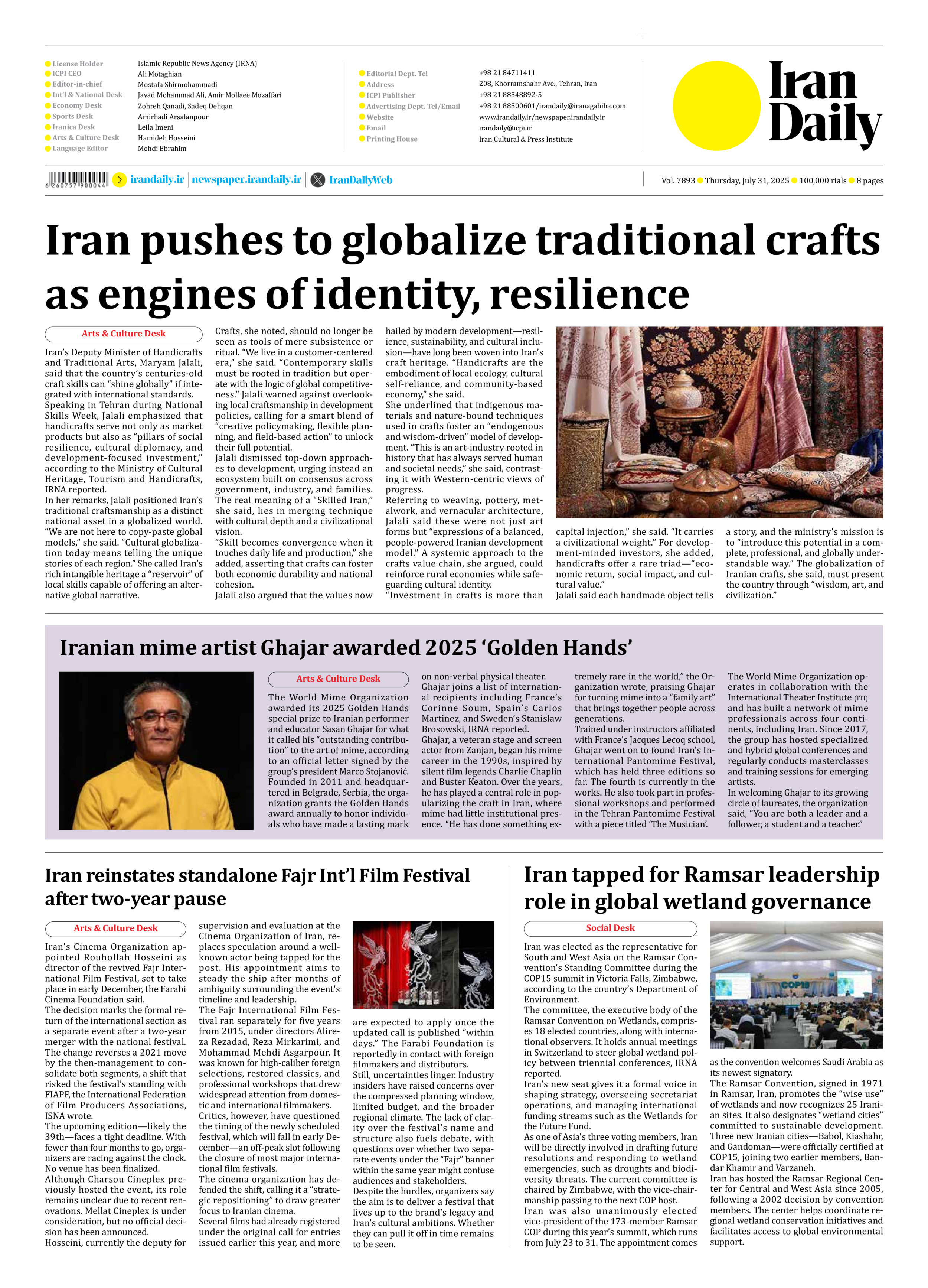
Referring to weaving, pottery, metalwork, and vernacular architecture, Jalali said these were not just art forms but “expressions of a balanced, people-powered Iranian development model.” A systemic approach to the crafts value chain, she argued, could reinforce rural economies while safeguarding cultural identity.
“Investment in crafts is more than capital injection,” she said. “It carries a civilizational weight.” For development-minded investors, she added, handicrafts offer a rare triad—“economic return, social impact, and cultural value.”
Jalali said each handmade object tells a story, and the ministry’s mission is to “introduce this potential in a complete, professional, and globally understandable way.” The globalization of Iranian crafts, she said, must present the country through “wisdom, art, and civilization.”