





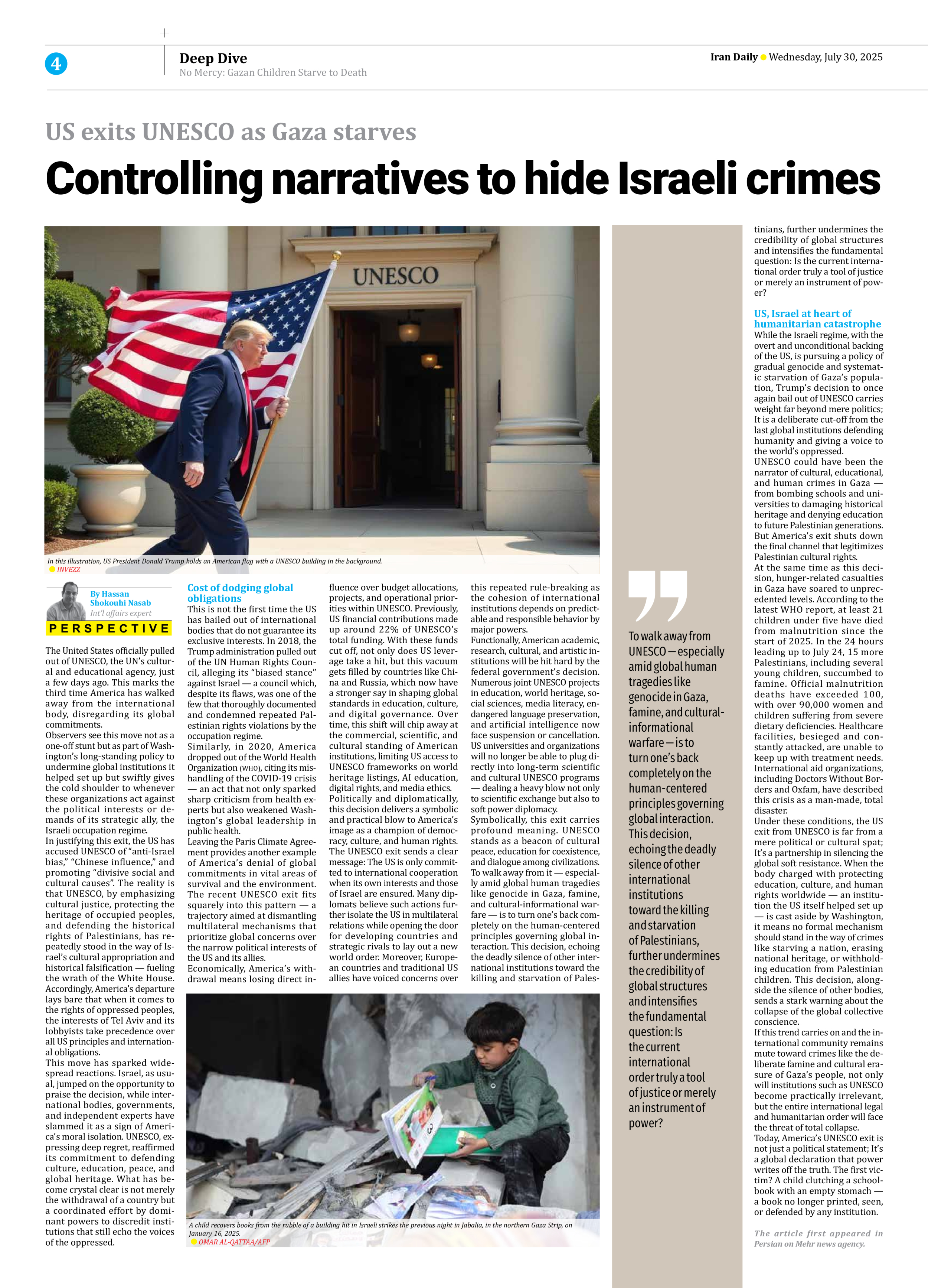


US exits UNESCO as Gaza starves
Controlling narratives to hide Israeli crimes
By Hassan
Shokouhi Nasab
Int'l affairs expert
The United States officially pulled out of UNESCO, the UN’s cultural and educational agency, just a few days ago. This marks the third time America has walked away from the international body, disregarding its global commitments.
Observers see this move not as a one-off stunt but as part of Washington’s long-standing policy to undermine global institutions it helped set up but swiftly gives the cold shoulder to whenever these organizations act against the political interests or demands of its strategic ally, the Israeli occupation regime.
In justifying this exit, the US has accused UNESCO of “anti-Israel bias,” “Chinese influence,” and promoting “divisive social and cultural causes”. The reality is that UNESCO, by emphasizing cultural justice, protecting the heritage of occupied peoples, and defending the historical rights of Palestinians, has repeatedly stood in the way of Israel’s cultural appropriation and historical falsification — fueling the wrath of the White House. Accordingly, America’s departure lays bare that when it comes to the rights of oppressed peoples, the interests of Tel Aviv and its lobbyists take precedence over all US principles and international obligations.
This move has sparked widespread reactions. Israel, as usual, jumped on the opportunity to praise the decision, while international bodies, governments, and independent experts have slammed it as a sign of America’s moral isolation. UNESCO, expressing deep regret, reaffirmed its commitment to defending culture, education, peace, and global heritage. What has become crystal clear is not merely the withdrawal of a country but a coordinated effort by dominant powers to discredit institutions that still echo the voices of the oppressed.
Cost of dodging global obligations
This is not the first time the US has bailed out of international bodies that do not guarantee its exclusive interests. In 2018, the Trump administration pulled out of the UN Human Rights Council, alleging its “biased stance” against Israel — a council which, despite its flaws, was one of the few that thoroughly documented and condemned repeated Palestinian rights violations by the occupation regime.
Similarly, in 2020, America dropped out of the World Health Organization (WHO), citing its mishandling of the COVID-19 crisis — an act that not only sparked sharp criticism from health experts but also weakened Washington’s global leadership in public health.
Leaving the Paris Climate Agreement provides another example of America’s denial of global commitments in vital areas of survival and the environment. The recent UNESCO exit fits squarely into this pattern — a trajectory aimed at dismantling multilateral mechanisms that prioritize global concerns over the narrow political interests of the US and its allies.
Economically, America’s withdrawal means losing direct influence over budget allocations, projects, and operational priorities within UNESCO. Previously, US financial contributions made up around 22% of UNESCO’s total funding. With these funds cut off, not only does US leverage take a hit, but this vacuum gets filled by countries like China and Russia, which now have a stronger say in shaping global standards in education, culture, and digital governance. Over time, this shift will chip away at the commercial, scientific, and cultural standing of American institutions, limiting US access to UNESCO frameworks on world heritage listings, AI education, digital rights, and media ethics.
Politically and diplomatically, this decision delivers a symbolic and practical blow to America’s image as a champion of democracy, culture, and human rights. The UNESCO exit sends a clear message: The US is only committed to international cooperation when its own interests and those of Israel are ensured. Many diplomats believe such actions further isolate the US in multilateral relations while opening the door for developing countries and strategic rivals to lay out a new world order. Moreover, European countries and traditional US allies have voiced concerns over this repeated rule-breaking as the cohesion of international institutions depends on predictable and responsible behavior by major powers.
Functionally, American academic, research, cultural, and artistic institutions will be hit hard by the federal government’s decision. Numerous joint UNESCO projects in education, world heritage, social sciences, media literacy, endangered language preservation, and artificial intelligence now face suspension or cancellation. US universities and organizations will no longer be able to plug directly into long-term scientific and cultural UNESCO programs — dealing a heavy blow not only to scientific exchange but also to soft power diplomacy.
Symbolically, this exit carries profound meaning. UNESCO stands as a beacon of cultural peace, education for coexistence, and dialogue among civilizations. To walk away from it — especially amid global human tragedies like genocide in Gaza, famine, and cultural-informational warfare — is to turn one’s back completely on the human-centered principles governing global interaction. This decision, echoing the deadly silence of other international institutions toward the killing and starvation of Palestinians, further undermines the credibility of global structures and intensifies the fundamental question: Is the current international order truly a tool of justice or merely an instrument of power?
US, Israel at heart of humanitarian catastrophe
While the Israeli regime, with the overt and unconditional backing of the US, is pursuing a policy of gradual genocide and systematic starvation of Gaza’s population, Trump’s decision to once again bail out of UNESCO carries weight far beyond mere politics; It is a deliberate cut-off from the last global institutions defending humanity and giving a voice to the world’s oppressed.
UNESCO could have been the narrator of cultural, educational, and human crimes in Gaza — from bombing schools and universities to damaging historical heritage and denying education to future Palestinian generations. But America’s exit shuts down the final channel that legitimizes Palestinian cultural rights.
At the same time as this decision, hunger-related casualties in Gaza have soared to unprecedented levels. According to the latest WHO report, at least 21 children under five have died from malnutrition since the start of 2025. In the 24 hours leading up to July 24, 15 more Palestinians, including several young children, succumbed to famine. Official malnutrition deaths have exceeded 100, with over 90,000 women and children suffering from severe dietary deficiencies. Healthcare facilities, besieged and constantly attacked, are unable to keep up with treatment needs. International aid organizations, including Doctors Without Borders and Oxfam, have described this crisis as a man-made, total disaster.
Under these conditions, the US exit from UNESCO is far from a mere political or cultural spat; It’s a partnership in silencing the global soft resistance. When the body charged with protecting education, culture, and human rights worldwide — an institution the US itself helped set up — is cast aside by Washington, it means no formal mechanism should stand in the way of crimes like starving a nation, erasing national heritage, or withholding education from Palestinian children. This decision, alongside the silence of other bodies, sends a stark warning about the collapse of the global collective conscience.
If this trend carries on and the international community remains mute toward crimes like the deliberate famine and cultural erasure of Gaza’s people, not only will institutions such as UNESCO become practically irrelevant, but the entire international legal and humanitarian order will face the threat of total collapse.
Today, America’s UNESCO exit is not just a political statement; It’s a global declaration that power writes off the truth. The first victim? A child clutching a schoolbook with an empty stomach — a book no longer printed, seen, or defended by any institution.
The article first appeared in
Persian on Mehr news agency.