







MP: Committee agenda targets water crisis with Persian Gulf transfer, conservation
A member of the Iranian Parliament's Development Committee announced that plans for water transfer from the Persian Gulf and promoting water conservation culture were prioritized during a Tuesday meeting with the energy minister to address the water crisis in Tehran and Fars provinces.
Speaking to ICANA, Mohammad Reza Rezaei Kouchi said, "A meeting was held with the Energy Minister Abbas Aliabadi on Tuesday to examine the water crisis situation in the capital and also to secure drinking water for Fars Province."
Regarding the meeting's outcomes, he said that the session had two main parts. The first part was dedicated to Tehran's water crisis, which has led to a severe shortage of drinking water due to poor advance planning. This situation, he noted, was predictable given population growth and rainfall patterns, yet proper planning had not been undertaken.
Rezaei Kouchi further stated that while the Energy Ministry is attempting to resolve Tehran's problem by transferring water from dams in adjacent counties, this is not a fundamental solution. He emphasized the necessity of changing water consumption habits and establishing sustainable water transfer to Tehran, including from the Caspian Sea, as priorities.
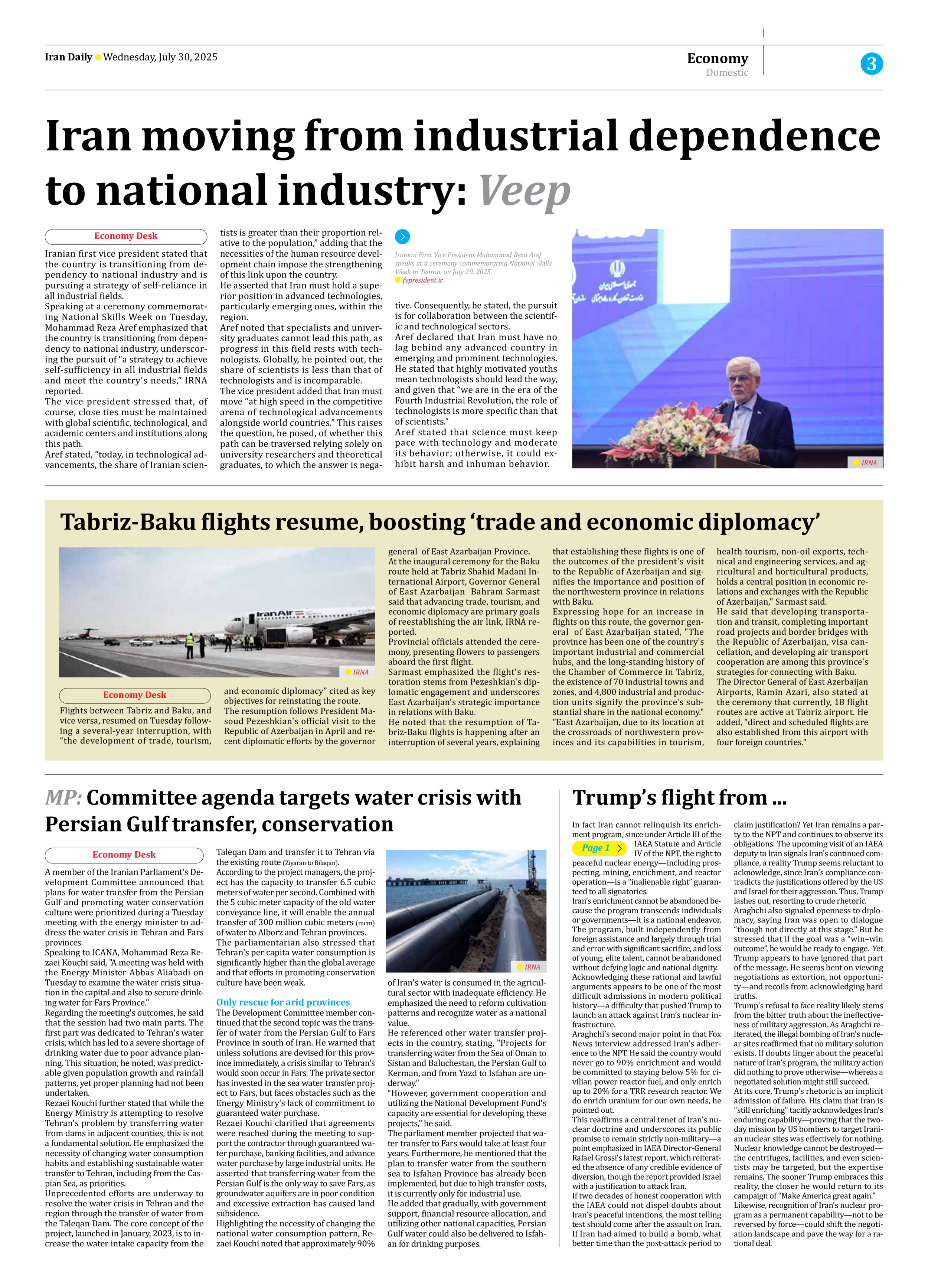
Unprecedented efforts are underway to resolve the water crisis in Tehran and the region through the transfer of water from the Taleqan Dam. The core concept of the project, launched in January, 2023, is to increase the water intake capacity from the Taleqan Dam and transfer it to Tehran via the existing route (Ziyaran to Bilaqan).
According to the project managers, the project has the capacity to transfer 6.5 cubic meters of water per second. Combined with the 5 cubic meter capacity of the old water conveyance line, it will enable the annual transfer of 300 million cubic meters (mcm) of water to Alborz and Tehran provinces.
The parliamentarian also stressed that Tehran's per capita water consumption is significantly higher than the global average and that efforts in promoting conservation culture have been weak.
Only rescue for arid provinces
The Development Committee member continued that the second topic was the transfer of water from the Persian Gulf to Fars Province in south of Iran. He warned that unless solutions are devised for this province immediately, a crisis similar to Tehran's would soon occur in Fars. The private sector has invested in the sea water transfer project to Fars, but faces obstacles such as the Energy Ministry's lack of commitment to guaranteed water purchase.
Rezaei Kouchi clarified that agreements were reached during the meeting to support the contractor through guaranteed water purchase, banking facilities, and advance water purchase by large industrial units. He asserted that transferring water from the Persian Gulf is the only way to save Fars, as groundwater aquifers are in poor condition and excessive extraction has caused land subsidence.
Highlighting the necessity of changing the national water consumption pattern, Rezaei Kouchi noted that approximately 90% of Iran's water is consumed in the agricultural sector with inadequate efficiency. He emphasized the need to reform cultivation patterns and recognize water as a national value.
He referenced other water transfer projects in the country, stating, "Projects for transferring water from the Sea of Oman to Sistan and Baluchestan, the Persian Gulf to Kerman, and from Yazd to Isfahan are underway.”
“However, government cooperation and utilizing the National Development Fund's capacity are essential for developing these projects," he said.
The parliament member projected that water transfer to Fars would take at least four years. Furthermore, he mentioned that the plan to transfer water from the southern sea to Isfahan Province has already been implemented, but due to high transfer costs, it is currently only for industrial use.
He added that gradually, with government support, financial resource allocation, and utilizing other national capacities, Persian Gulf water could also be delivered to Isfahan for drinking purposes.