





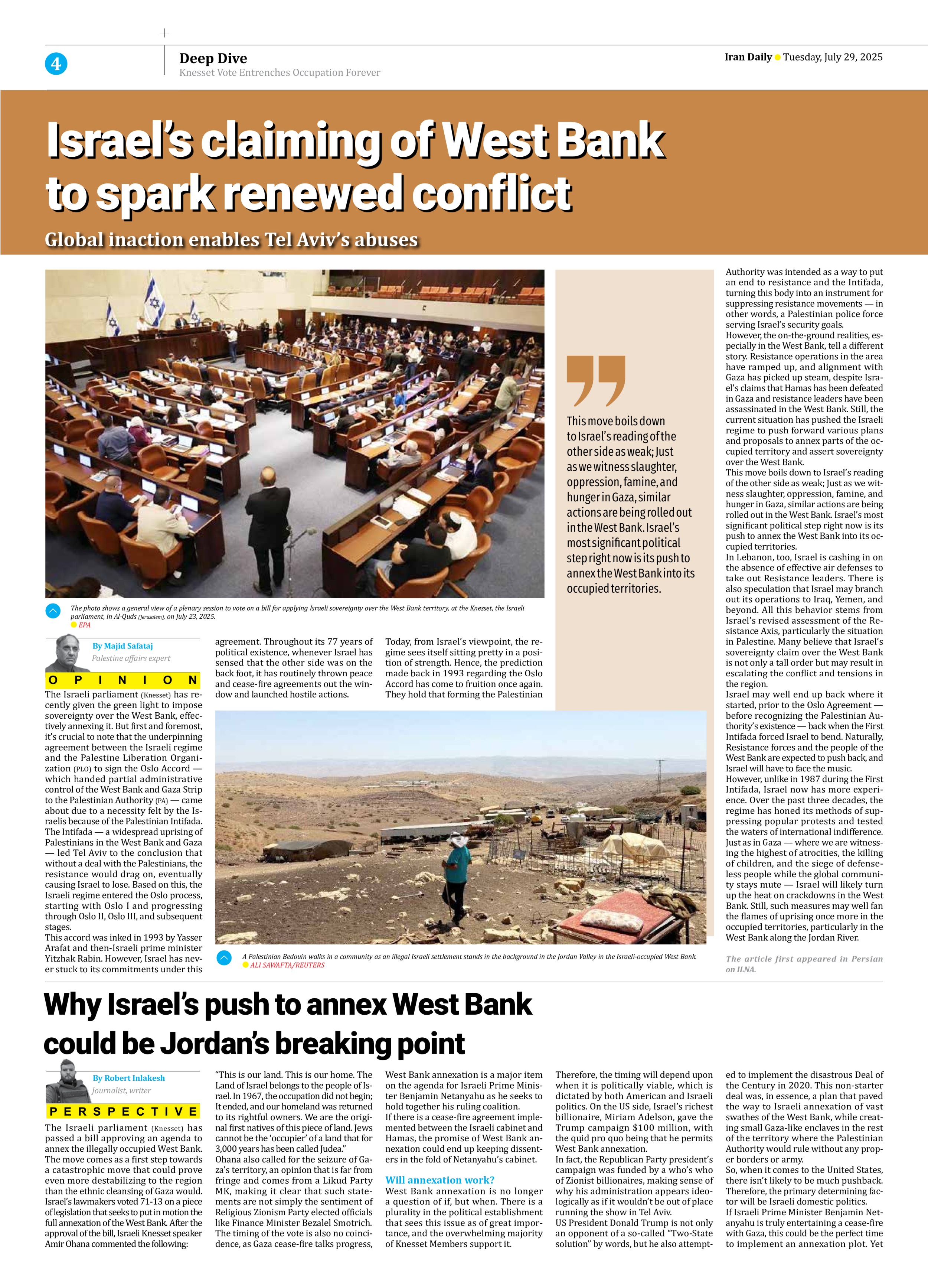


Israel’s claiming of West Bank to spark renewed conflict
Global inaction enables Tel Aviv’s abuses
By Majid Safataj
Palestine affairs expert
The Israeli parliament (Knesset) has recently given the green light to impose sovereignty over the West Bank, effectively annexing it. But first and foremost, it’s crucial to note that the underpinning agreement between the Israeli regime and the Palestine Liberation Organization (PLO) to sign the Oslo Accord — which handed partial administrative control of the West Bank and Gaza Strip to the Palestinian Authority (PA) — came about due to a necessity felt by the Israelis because of the Palestinian Intifada. The Intifada — a widespread uprising of Palestinians in the West Bank and Gaza — led Tel Aviv to the conclusion that without a deal with the Palestinians, the resistance would drag on, eventually causing Israel to lose. Based on this, the Israeli regime entered the Oslo process, starting with Oslo I and progressing through Oslo II, Oslo III, and subsequent stages.
This accord was inked in 1993 by Yasser Arafat and then-Israeli prime minister Yitzhak Rabin. However, Israel has never stuck to its commitments under this agreement. Throughout its 77 years of political existence, whenever Israel has sensed that the other side was on the back foot, it has routinely thrown peace and cease-fire agreements out the window and launched hostile actions.
Today, from Israel’s viewpoint, the regime sees itself sitting pretty in a position of strength. Hence, the prediction made back in 1993 regarding the Oslo Accord has come to fruition once again. They hold that forming the Palestinian Authority was intended as a way to put an end to resistance and the Intifada, turning this body into an instrument for suppressing resistance movements — in other words, a Palestinian police force serving Israel’s security goals.
However, the on-the-ground realities, especially in the West Bank, tell a different story. Resistance operations in the area have ramped up, and alignment with Gaza has picked up steam, despite Israel’s claims that Hamas has been defeated in Gaza and resistance leaders have been assassinated in the West Bank. Still, the current situation has pushed the Israeli regime to push forward various plans and proposals to annex parts of the occupied territory and assert sovereignty over the West Bank.
This move boils down to Israel’s reading of the other side as weak; Just as we witness slaughter, oppression, famine, and hunger in Gaza, similar actions are being rolled out in the West Bank. Israel’s most significant political step right now is its push to annex the West Bank into its occupied territories.
In Lebanon, too, Israel is cashing in on the absence of effective air defenses to take out Resistance leaders. There is also speculation that Israel may branch out its operations to Iraq, Yemen, and beyond. All this behavior stems from Israel’s revised assessment of the Resistance Axis, particularly the situation in Palestine. Many believe that Israel’s sovereignty claim over the West Bank is not only a tall order but may result in escalating the conflict and tensions in the region.
Israel may well end up back where it started, prior to the Oslo Agreement — before recognizing the Palestinian Authority’s existence — back when the First Intifada forced Israel to bend. Naturally, Resistance forces and the people of the West Bank are expected to push back, and Israel will have to face the music.
However, unlike in 1987 during the First Intifada, Israel now has more experience. Over the past three decades, the regime has honed its methods of suppressing popular protests and tested the waters of international indifference. Just as in Gaza — where we are witnessing the highest of atrocities, the killing of children, and the siege of defenseless people while the global community stays mute — Israel will likely turn up the heat on crackdowns in the West Bank. Still, such measures may well fan the flames of uprising once more in the occupied territories, particularly in the West Bank along the Jordan River.
The article first appeared in Persian
on ILNA.