







Opportunities, challenges facing Tehran, Beijing’s cooperation
By Mohammad Mehdi Mazaheri
University professor
From Iran’s standpoint, the biggest headache in its ties with China is cutting back on reliance on oil revenues, diversifying non-oil exports, pulling in foreign investment for critical infrastructure and industries, and getting around unilateral Western sanctions. Iran is on the lookout for a strong partner that can back it up in technology, infrastructure, and economic development. Also, China’s political support in international forums — especially against Western pressure — is of high importance. Expanding defense and security cooperation is another key concern for Iran.
On the flip side, China’s main worry regarding Iran is stability and security in West Asia, which it wants to be guaranteed to ensure steady energy supplies and maintain international trade routes. As the world’s largest energy consumer, China depends on oil and gas imports from Iran as a stable source. Moreover, the Belt and Road Initiative, which runs through Iran, holds huge geostrategic value for Beijing. China wants to keep on good terms with all regional players to safeguard its economic and geopolitical interests and to avoid any military flare-ups that could throw a wrench in its trade routes and investments. Maintaining balance with other regional countries — especially Arab states and even Israel — is also crucial for China to play the role of a neutral and influential mediator.
Despite these somewhat divergent concerns, the Iran-China relationship holds a lot of water for development. The 25-year comprehensive cooperation agreement between the two countries has opened up new horizons in various fields. These opportunities include:
• Economic and trade: Iran, as one of the largest holders of oil and gas reserves globally, and China, as the biggest consumer, make a natural fit economically. Besides oil and gas, there’s huge potential for exporting Iran’s non-oil products to China and importing technology and industrial goods from China. Steel and iron products, knowledge-based sectors like nanotechnology and biotechnology (Iran’s scientific strongholds), along with Iran’s handicrafts and popular hand-woven carpets, can find niche markets in China.
• Infrastructure and development: Chinese investment in Iranian infrastructure projects — including transportation (railways, roads, ports), energy (power plants, refineries), and communications (5G development) — can give a big boost to Iran’s economic growth. Completing east-west and north-south railways, developing the Makoran coast and Jask port, desertification control, and supporting sustainable agriculture are among these opportunities.
• Technology and knowledge-based sectors: Technology transfer and joint work in emerging fields like AI and autonomous vehicles can enhance Iran’s scientific and industrial capabilities.
• Geopolitical and regional: Both Iran and China aim at establishing a multipolar world order and push back against US unilateralism. Iran’s membership in the Shanghai Cooperation Organisation (SCO) and BRICS has unlocked new chances for political and security convergence.
Nevertheless, plenty of opportunities and favorable conditions don’t automatically translate into broad cooperation — there are plenty of roadblocks on the way as well:
• Western sanctions: The biggest hurdle for expanding ties is ongoing and escalating US and Western sanctions on Iran, which make major Chinese companies think twice before teaming up with Iran. This often limits cooperation to smaller, non-state firms or more complex mechanisms. As of 2024, Iran’s share of China’s total foreign trade was only 0.02% (down 9% compared to the previous year), even though China’s global trade hit $6.1 trillion with a 7% increase from the previous year.
• Trade imbalance: Most Iranian exports to China are raw materials (crude oil and oil products, ethylene polymers and other petrochemicals, iron ore, other minerals, agricultural products, and dried fruits). In contrast, China’s exports to Iran — in both quantity and quality (machinery, industrial equipment, vehicles and auto parts, electronics, telecommunications gear, plastic products, iron and steel, household appliances, textiles, and clothing) — have the upper hand. According to Chinese customs data (which excludes Iranian oil imports due to sanctions), Iran-China trade hit about $13.4 billion in 2024, with $8.9 billion from China to Iran and $4.4 billion the other way. This shows a major trade surplus in China’s favor. Including oil exports reduces this gap somewhat, but raw material exporting remains a deep-rooted problem, potentially leading to Iran’s increased economic dependency, diminished Iranian bargaining power politically, and even China’s strategic dominance in the long term.
• Regional and geopolitical issues: China, with broad interests in West Asia, is keen on keeping on an even keel with all regional countries and does not want to pick sides overtly in regional conflicts. This approach can sometimes fail to meet Iran’s expectations during critical moments.
• Internal obstacles in Iran: Lengthy bureaucracy, inefficient laws for foreign investment, and occasional lack of transparency in project implementation can slow down cooperation. Furthermore, shifts in foreign policy with every government change and unstable management can hinder the operationalization of agreements and the full leverage of cooperation potential, posing serious long-term challenges.
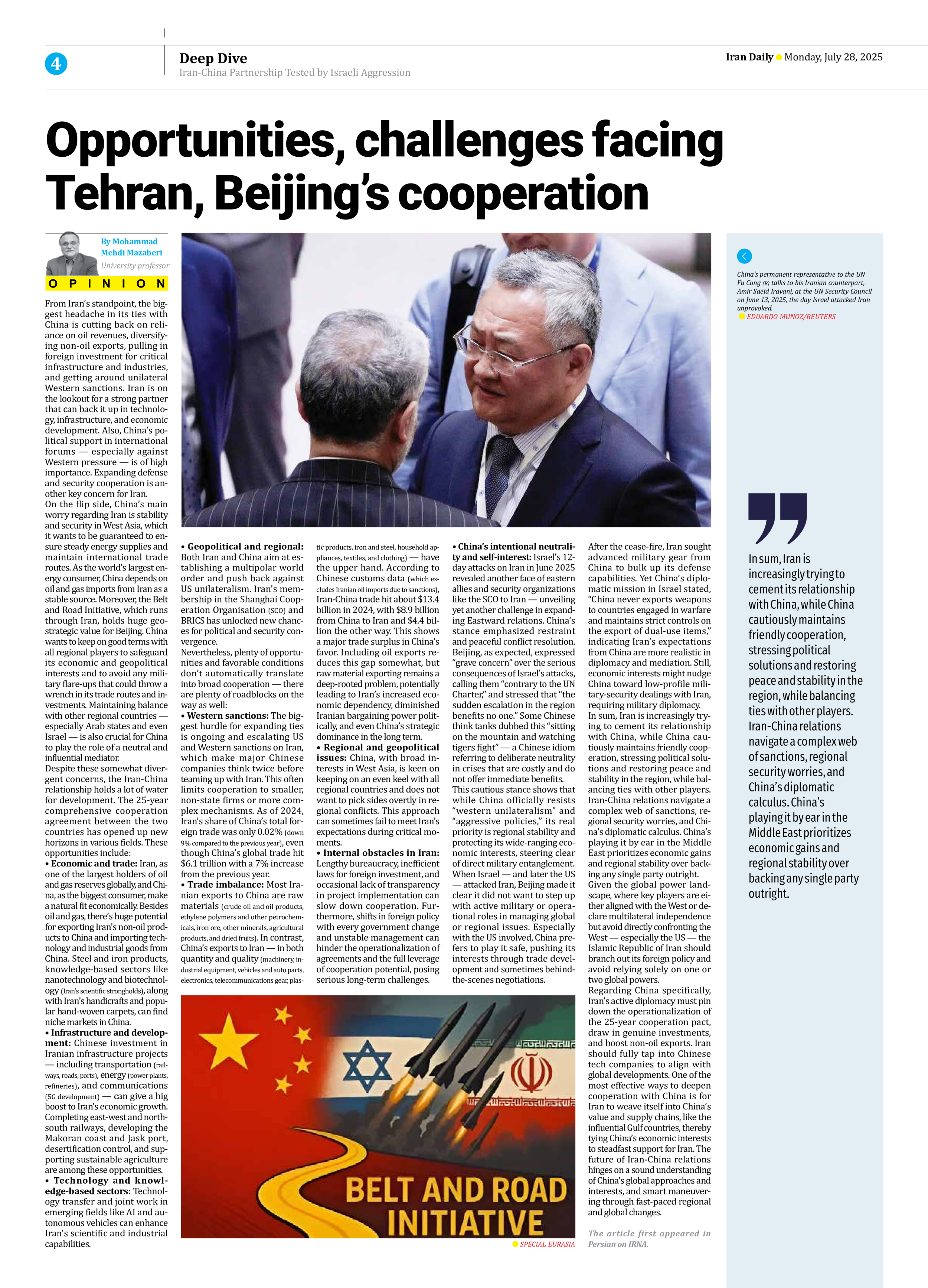
• China’s intentional neutrality and self-interest: Israel’s 12-day attacks on Iran in June 2025 revealed another face of eastern allies and security organizations like the SCO to Iran — unveiling yet another challenge in expanding Eastward relations. China’s stance emphasized restraint and peaceful conflict resolution. Beijing, as expected, expressed “grave concern” over the serious consequences of Israel’s attacks, calling them “contrary to the UN Charter,” and stressed that “the sudden escalation in the region benefits no one.” Some Chinese think tanks dubbed this “sitting on the mountain and watching tigers fight” — a Chinese idiom referring to deliberate neutrality in crises that are costly and do not offer immediate benefits.
This cautious stance shows that while China officially resists “western unilateralism” and “aggressive policies,” its real priority is regional stability and protecting its wide-ranging economic interests, steering clear of direct military entanglement.
When Israel — and later the US — attacked Iran, Beijing made it clear it did not want to step up with active military or operational roles in managing global or regional issues. Especially with the US involved, China prefers to play it safe, pushing its interests through trade development and sometimes behind-the-scenes negotiations.
After the cease-fire, Iran sought advanced military gear from China to bulk up its defense capabilities. Yet China’s diplomatic mission in Israel stated, “China never exports weapons to countries engaged in warfare and maintains strict controls on the export of dual-use items,” indicating Iran’s expectations from China are more realistic in diplomacy and mediation. Still, economic interests might nudge China toward low-profile military-security dealings with Iran, requiring military diplomacy.
In sum, Iran is increasingly trying to cement its relationship with China, while China cautiously maintains friendly cooperation, stressing political solutions and restoring peace and stability in the region, while balancing ties with other players. Iran-China relations navigate a complex web of sanctions, regional security worries, and China’s diplomatic calculus. China’s playing it by ear in the Middle East prioritizes economic gains and regional stability over backing any single party outright.
Given the global power landscape, where key players are either aligned with the West or declare multilateral independence but avoid directly confronting the West — especially the US — the Islamic Republic of Iran should branch out its foreign policy and avoid relying solely on one or two global powers.
Regarding China specifically, Iran’s active diplomacy must pin down the operationalization of the 25-year cooperation pact, draw in genuine investments, and boost non-oil exports. Iran should fully tap into Chinese tech companies to align with global developments. One of the most effective ways to deepen cooperation with China is for Iran to weave itself into China’s value and supply chains, like the influential Gulf countries, thereby tying China’s economic interests to steadfast support for Iran. The future of Iran-China relations hinges on a sound understanding of China’s global approaches and interests, and smart maneuvering through fast-paced regional and global changes.
The article first appeared in
Persian on IRNA.