







Minister criticizes power cuts to self-sufficient industries
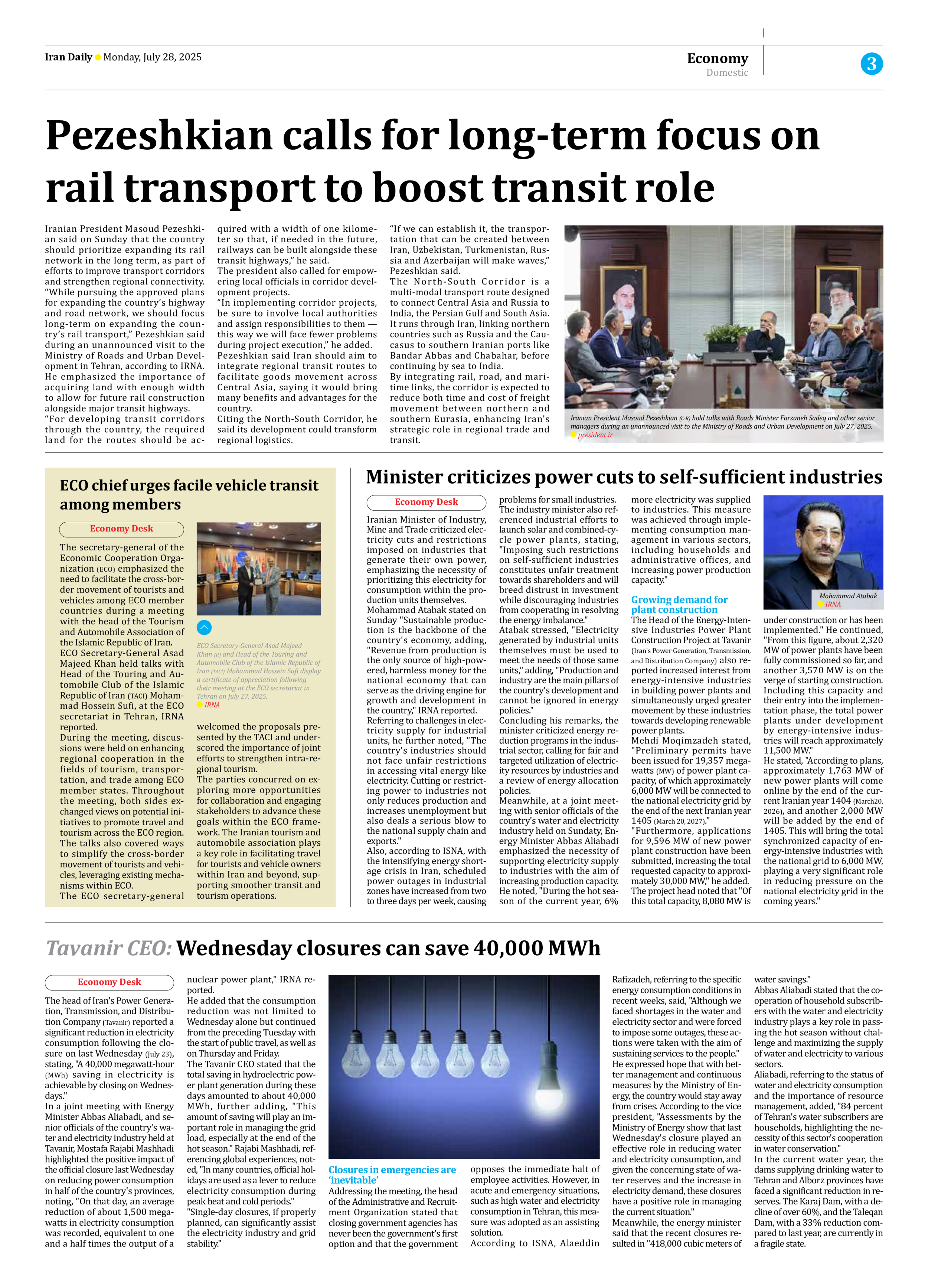
Iranian Minister of Industry, Mine and Trade criticized electricity cuts and restrictions imposed on industries that generate their own power, emphasizing the necessity of prioritizing this electricity for consumption within the production units themselves.
Mohammad Atabak stated on Sunday "Sustainable production is the backbone of the country's economy, adding, "Revenue from production is the only source of high-powered, harmless money for the national economy that can serve as the driving engine for growth and development in the country," IRNA reported.
Referring to challenges in electricity supply for industrial units, he further noted, "The country's industries should not face unfair restrictions in accessing vital energy like electricity. Cutting or restricting power to industries not only reduces production and increases unemployment but also deals a serious blow to the national supply chain and exports."
Also, according to ISNA, with the intensifying energy shortage crisis in Iran, scheduled power outages in industrial zones have increased from two to three days per week, causing problems for small industries.
The industry minister also referenced industrial efforts to launch solar and combined-cycle power plants, stating, "Imposing such restrictions on self-sufficient industries constitutes unfair treatment towards shareholders and will breed distrust in investment while discouraging industries from cooperating in resolving the energy imbalance."
Atabak stressed, "Electricity generated by industrial units themselves must be used to meet the needs of those same units," adding, "Production and industry are the main pillars of the country's development and cannot be ignored in energy policies."
Concluding his remarks, the minister criticized energy reduction programs in the industrial sector, calling for fair and targeted utilization of electricity resources by industries and a review of energy allocation policies.
Meanwhile, at a joint meeting with senior officials of the country's water and electricity industry held on Sundaty, Energy Minister Abbas Aliabadi emphasized the necessity of supporting electricity supply to industries with the aim of increasing production capacity.
He noted, "During the hot season of the current year, 6% more electricity was supplied to industries. This measure was achieved through implementing consumption management in various sectors, including households and administrative offices, and increasing power production capacity."
Growing demand for plant construction
The Head of the Energy-Intensive Industries Power Plant Construction Project at Tavanir (Iran's Power Generation, Transmission, and Distribution Company) also reported increased interest from energy-intensive industries in building power plants and simultaneously urged greater movement by these industries towards developing renewable power plants.
Mehdi Moqimzadeh stated, "Preliminary permits have been issued for 19,357 megawatts (MW) of power plant capacity, of which approximately 6,000 MW will be connected to the national electricity grid by the end of the next Iranian year 1405 (March 20, 2027)."
"Furthermore, applications for 9,596 MW of new power plant construction have been submitted, increasing the total requested capacity to approximately 30,000 MW," he added.
The project head noted that "Of this total capacity, 8,080 MW is under construction or has been implemented." He continued, "From this figure, about 2,320 MW of power plants have been fully commissioned so far, and another 3,570 MW is on the verge of starting construction. Including this capacity and their entry into the implementation phase, the total power plants under development by energy-intensive industries will reach approximately 11,500 MW."
He stated, "According to plans, approximately 1,763 MW of new power plants will come online by the end of the current Iranian year 1404 (March20, 2026), and another 2,000 MW will be added by the end of 1405. This will bring the total synchronized capacity of energy-intensive industries with the national grid to 6,000 MW, playing a very significant role in reducing pressure on the national electricity grid in the coming years."