





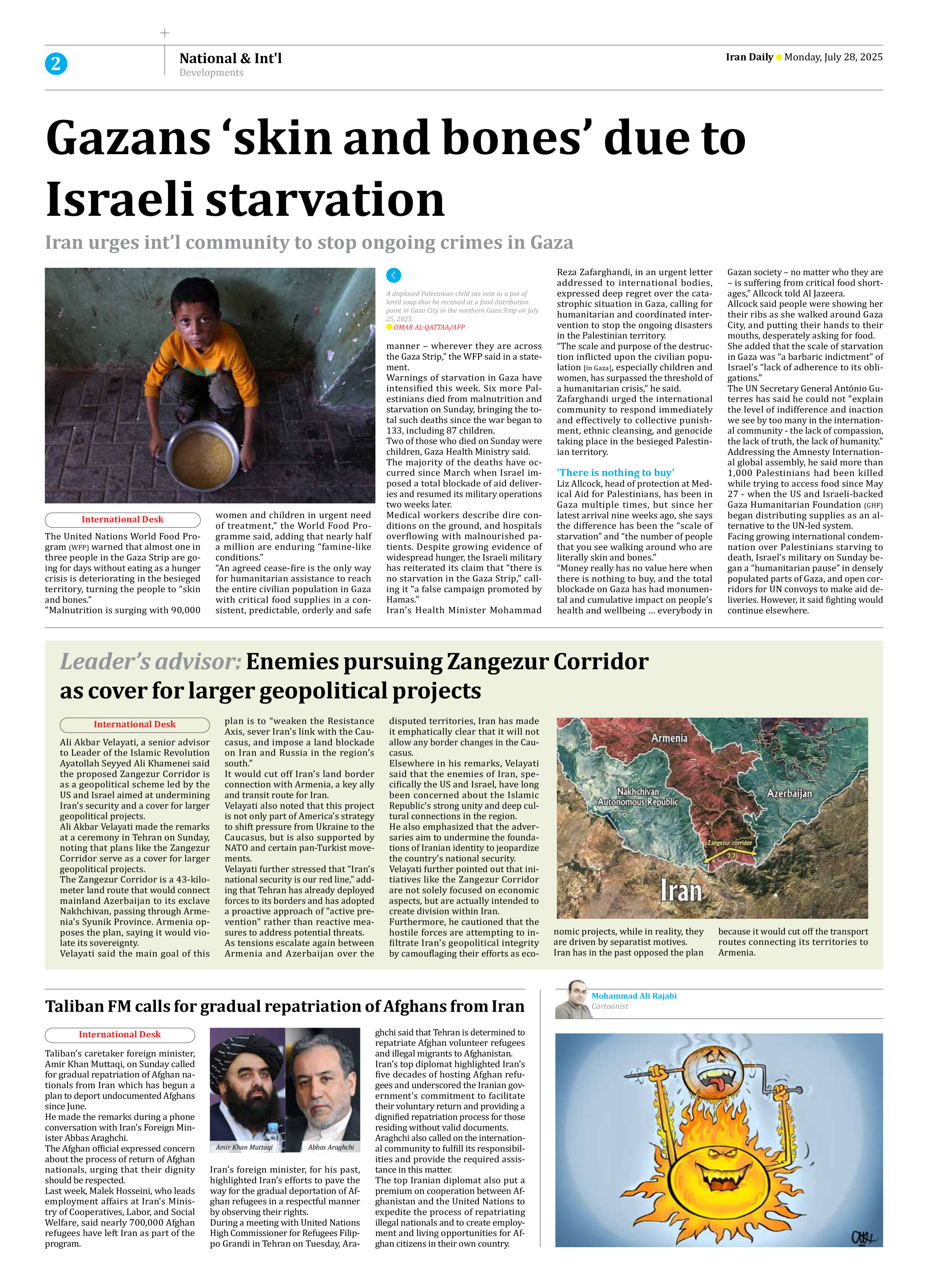


Gazans ‘skin and bones’ due to Israeli starvation
Iran urges int’l community to stop ongoing crimes in Gaza
The United Nations World Food Program (WFP) warned that almost one in three people in the Gaza Strip are going for days without eating as a hunger crisis is deteriorating in the besieged territory, turning the people to “skin and bones.”
"Malnutrition is surging with 90,000 women and children in urgent need of treatment," the World Food Programme said, adding that nearly half a million are enduring “famine-like conditions.”
“An agreed cease-fire is the only way for humanitarian assistance to reach the entire civilian population in Gaza with critical food supplies in a consistent, predictable, orderly and safe manner – wherever they are across the Gaza Strip,” the WFP said in a statement.
Warnings of starvation in Gaza have intensified this week. Six more Palestinians died from malnutrition and starvation on Sunday, bringing the total such deaths since the war began to 133, including 87 children.
Two of those who died on Sunday were children, Gaza Health Ministry said.
The majority of the deaths have occurred since March when Israel imposed a total blockade of aid deliveries and resumed its military operations two weeks later.
Medical workers describe dire conditions on the ground, and hospitals overflowing with malnourished patients. Despite growing evidence of widespread hunger, the Israeli military has reiterated its claim that “there is no starvation in the Gaza Strip,” calling it “a false campaign promoted by Hamas.”
Iran’s Health Minister Mohammad Reza Zafarghandi, in an urgent letter addressed to international bodies, expressed deep regret over the catastrophic situation in Gaza, calling for humanitarian and coordinated intervention to stop the ongoing disasters in the Palestinian territory.
“The scale and purpose of the destruction inflicted upon the civilian population [in Gaza], especially children and women, has surpassed the threshold of a humanitarian crisis,” he said.
Zafarghandi urged the international community to respond immediately and effectively to collective punishment, ethnic cleansing, and genocide taking place in the besieged Palestinian territory.
‘There is nothing to buy’
Liz Allcock, head of protection at Medical Aid for Palestinians, has been in Gaza multiple times, but since her latest arrival nine weeks ago, she says the difference has been the “scale of starvation” and “the number of people that you see walking around who are literally skin and bones.”
“Money really has no value here when there is nothing to buy, and the total blockade on Gaza has had monumental and cumulative impact on people’s health and wellbeing … everybody in Gazan society – no matter who they are – is suffering from critical food shortages,” Allcock told Al Jazeera.
Allcock said people were showing her their ribs as she walked around Gaza City, and putting their hands to their mouths, desperately asking for food.
She added that the scale of starvation in Gaza was “a barbaric indictment” of Israel’s “lack of adherence to its obligations.”
The UN Secretary General António Guterres has said he could not "explain the level of indifference and inaction we see by too many in the international community - the lack of compassion, the lack of truth, the lack of humanity."
Addressing the Amnesty International global assembly, he said more than 1,000 Palestinians had been killed while trying to access food since May 27 - when the US and Israeli-backed Gaza Humanitarian Foundation (GHF) began distributing supplies as an alternative to the UN-led system.
Facing growing international condemnation over Palestinians starving to death, Israel’s military on Sunday began a “humanitarian pause” in densely populated parts of Gaza, and open corridors for UN convoys to make aid deliveries. However, it said fighting would continue elsewhere.