







Variables at play in normalizing Syria-Israel relations
By Alireza Majidi
West Asia affairs expert
Before the recent crisis in Sweida, Ahmed al-Sharaa had already put forward his readiness to strike a deal on normalizing relations with the Israeli regime. In this regard, two schools of thought had already come up against each other in the United States regarding how to deal with him: One camp is pessimistic of Sharaa but at the same time believes it is necessary to come to terms with him as a current reality in Syria and to tap into his capacities to a certain extent. Brett McGurk, former US special presidential envoy for Syria under the Obama, Biden administrations, and early Trump presidency, backs this approach.
On the other side, President Trump currently supports a contrasting view, which is also endorsed by Tom Barrack, the present US special envoy for Syria. Barrack claims that Sharaa holds unique capacities in Syria and has pulled off actions that no one else could have. According to Barrack, Sharaa’s most significant achievement was that he managed to pave the way for the withdrawal of Iranian forces from Syria.
Barrack also credits Sharaa with finishing the terrorist group Hurras al-Din, an Al-Qaeda affiliate in Syria. He attributes to Sharaa the elimination of the radical Salafi movement and the holding in check of the moderate Jihadi movement in the country. The key distinction between these two groups is that the radical Jihadis do not recognize borders and emphasize global citizenship and “armed uprising” to enforce Sharia across nations, while moderate Jihadis acknowledge borders and support contextual interpretations of Sharia according to time and place.
Furthermore, Barrack states that since 2017, Sharaa had attempted to make contact with the US-led international coalition battling terrorism by feeding intel on dangerous wanted terrorists, enabling their targeted air strikes — an approach repeatedly carried out in Idlib. Given these facts, Barrack believes the US should team up with Sharaa in Syria. In return, Americans expect Sharaa to have Syria join the Abraham Accords and simultaneously utilize Syria’s resources for US objectives in Lebanon and to even exert influence over Iraq.
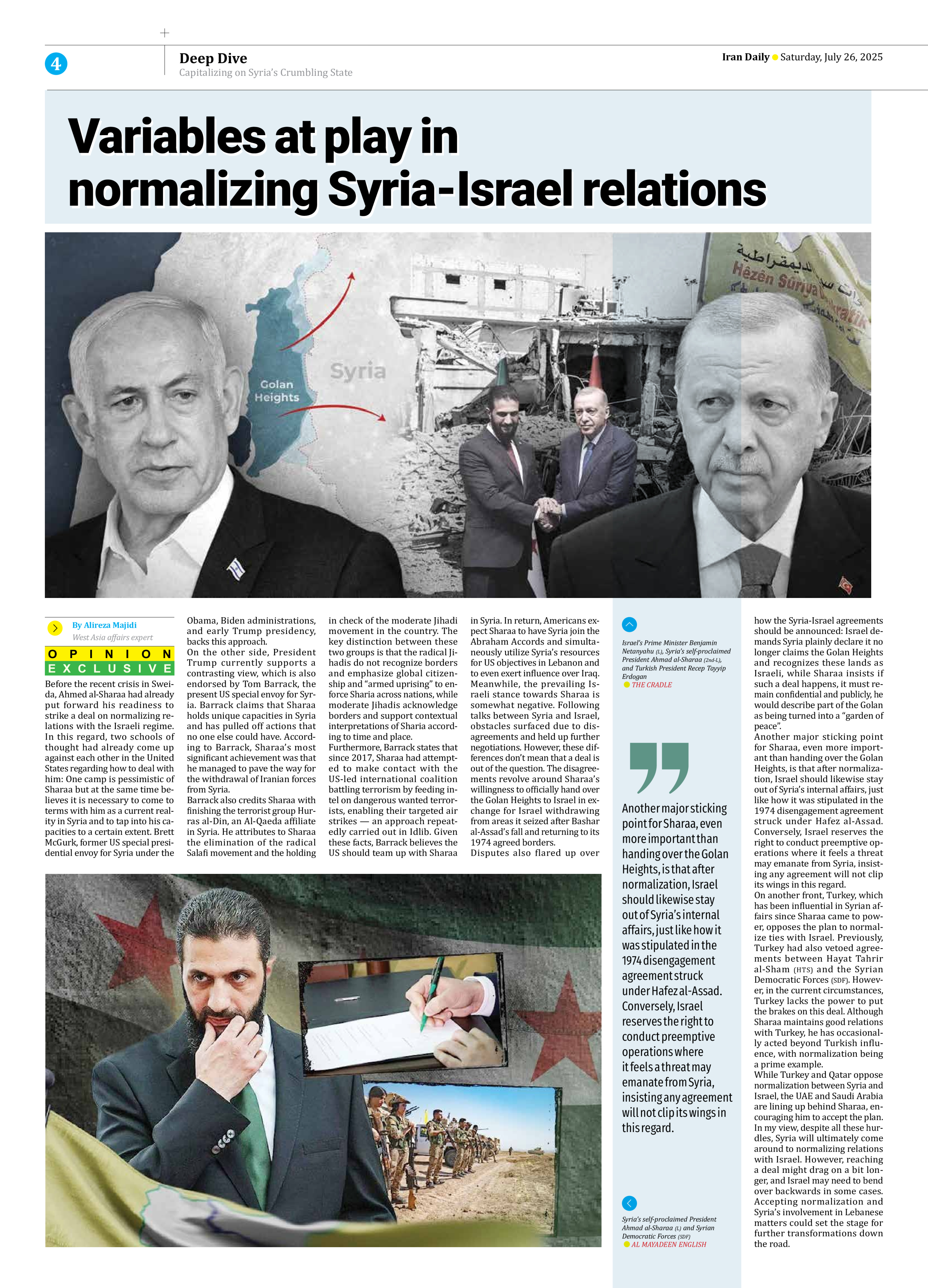
Meanwhile, the prevailing Israeli stance towards Sharaa is somewhat negative. Following talks between Syria and Israel, obstacles surfaced due to disagreements and held up further negotiations. However, these differences don’t mean that a deal is out of the question. The disagreements revolve around Sharaa’s willingness to officially hand over the Golan Heights to Israel in exchange for Israel withdrawing from areas it seized after Bashar al-Assad’s fall and returning to its 1974 agreed borders.
Disputes also flared up over how the Syria-Israel agreements should be announced: Israel demands Syria plainly declare it no longer claims the Golan Heights and recognizes these lands as Israeli, while Sharaa insists if such a deal happens, it must remain confidential and publicly, he would describe part of the Golan as being turned into a “garden of peace”.
Another major sticking point for Sharaa, even more important than handing over the Golan Heights, is that after normalization, Israel should likewise stay out of Syria’s internal affairs, just like how it was stipulated in the 1974 disengagement agreement struck under Hafez al-Assad. Conversely, Israel reserves the right to conduct preemptive operations where it feels a threat may emanate from Syria, insisting any agreement will not clip its wings in this regard.
On another front, Turkey, which has been influential in Syrian affairs since Sharaa came to power, opposes the plan to normalize ties with Israel. Previously, Turkey had also vetoed agreements between Hayat Tahrir al-Sham (HTS) and the Syrian Democratic Forces (SDF). However, in the current circumstances, Turkey lacks the power to put the brakes on this deal. Although Sharaa maintains good relations with Turkey, he has occasionally acted beyond Turkish influence, with normalization being a prime example.
While Turkey and Qatar oppose normalization between Syria and Israel, the UAE and Saudi Arabia are lining up behind Sharaa, encouraging him to accept the plan.
In my view, despite all these hurdles, Syria will ultimately come around to normalizing relations with Israel. However, reaching a deal might drag on a bit longer, and Israel may need to bend over backwards in some cases. Accepting normalization and Syria’s involvement in Lebanese matters could set the stage for further transformations down the road.