







Copy in clipboard...
Iran’s top-grossing animation ‘Woolina and the No Birds’ targets global market
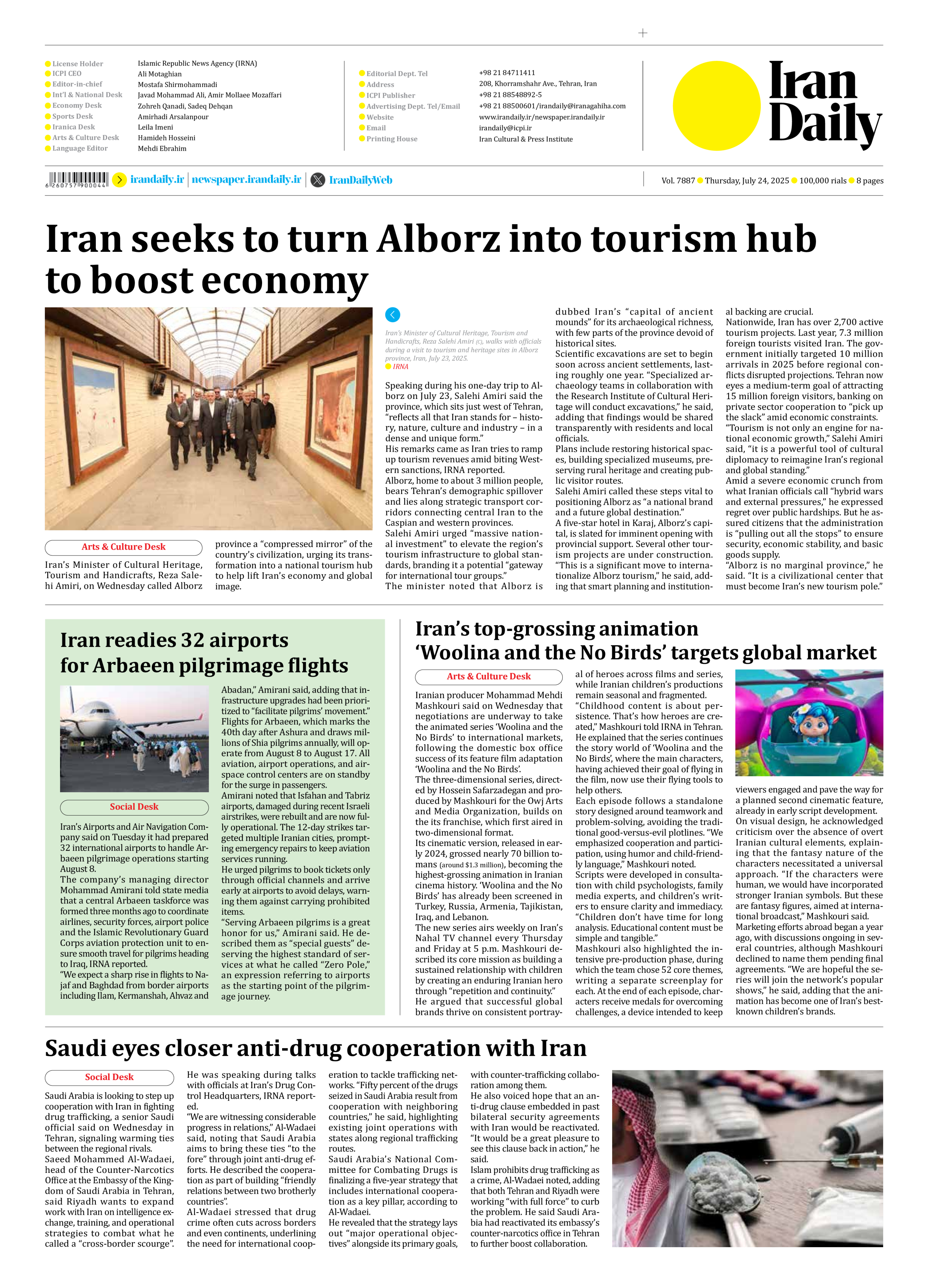
Iranian producer Mohammad Mehdi Mashkouri said on Wednesday that negotiations are underway to take the animated series ‘Woolina and the No Birds’ to international markets, following the domestic box office success of its feature film adaptation ‘Woolina and the No Birds’.
The three-dimensional series, directed by Hossein Safarzadegan and produced by Mashkouri for the Owj Arts and Media Organization, builds on the its franchise, which first aired in two-dimensional format.
Its cinematic version, released in early 2024, grossed nearly 70 billion tomans (around $1.3 million), becoming the highest-grossing animation in Iranian cinema history. ‘Woolina and the No Birds’ has already been screened in Turkey, Russia, Armenia, Tajikistan, Iraq, and Lebanon.
The new series airs weekly on Iran’s Nahal TV channel every Thursday and Friday at 5 p.m. Mashkouri described its core mission as building a sustained relationship with children by creating an enduring Iranian hero through “repetition and continuity.”
He argued that successful global brands thrive on consistent portrayal of heroes across films and series, while Iranian children’s productions remain seasonal and fragmented.
“Childhood content is about persistence. That’s how heroes are created,” Mashkouri told IRNA in Tehran. He explained that the series continues the story world of ‘Woolina and the No Birds’, where the main characters, having achieved their goal of flying in the film, now use their flying tools to help others.
Each episode follows a standalone story designed around teamwork and problem-solving, avoiding the traditional good-versus-evil plotlines. “We emphasized cooperation and participation, using humor and child-friendly language,” Mashkouri noted.
Scripts were developed in consultation with child psychologists, family media experts, and children’s writers to ensure clarity and immediacy. “Children don’t have time for long analysis. Educational content must be simple and tangible.”
Mashkouri also highlighted the intensive pre-production phase, during which the team chose 52 core themes, writing a separate screenplay for each. At the end of each episode, characters receive medals for overcoming challenges, a device intended to keep viewers engaged and pave the way for a planned second cinematic feature, already in early script development.
On visual design, he acknowledged criticism over the absence of overt Iranian cultural elements, explaining that the fantasy nature of the characters necessitated a universal approach. “If the characters were human, we would have incorporated stronger Iranian symbols. But these are fantasy figures, aimed at international broadcast,” Mashkouri said.
Marketing efforts abroad began a year ago, with discussions ongoing in several countries, although Mashkouri declined to name them pending final agreements. “We are hopeful the series will join the network’s popular shows,” he said, adding that the animation has become one of Iran’s best-known children’s brands.