





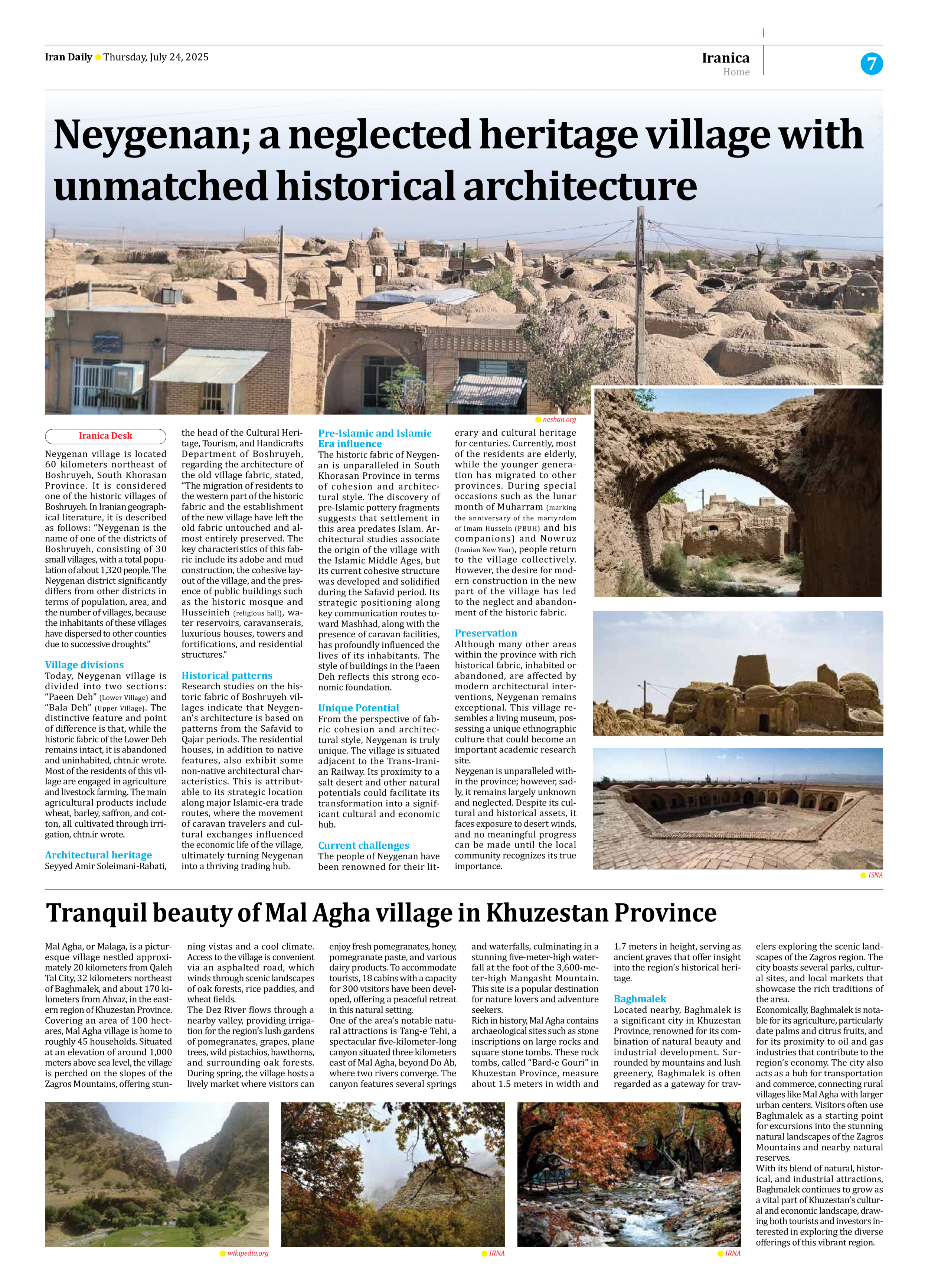


Neygenan; a neglected heritage village with unmatched historical architecture
Neygenan village is located 60 kilometers northeast of Boshruyeh, South Khorasan Province. It is considered one of the historic villages of Boshruyeh. In Iranian geographical literature, it is described as follows: “Neygenan is the name of one of the districts of Boshruyeh, consisting of 30 small villages, with a total population of about 1,320 people. The Neygenan district significantly differs from other districts in terms of population, area, and the number of villages, because the inhabitants of these villages have dispersed to other counties due to successive droughts.”
Village divisions
Today, Neygenan village is divided into two sections: “Paeen Deh” (Lower Village) and “Bala Deh” (Upper Village). The distinctive feature and point of difference is that, while the historic fabric of the Lower Deh remains intact, it is abandoned and uninhabited, chtn.ir wrote.
Most of the residents of this village are engaged in agriculture and livestock farming. The main agricultural products include wheat, barley, saffron, and cotton, all cultivated through irrigation, chtn.ir wrote.
Architectural heritage
Seyyed Amir Soleimani-Rabati, the head of the Cultural Heritage, Tourism, and Handicrafts Department of Boshruyeh, regarding the architecture of the old village fabric, stated, “The migration of residents to the western part of the historic fabric and the establishment of the new village have left the old fabric untouched and almost entirely preserved. The key characteristics of this fabric include its adobe and mud construction, the cohesive layout of the village, and the presence of public buildings such as the historic mosque and Husseinieh (religious hall), water reservoirs, caravanserais, luxurious houses, towers and fortifications, and residential structures.”
Historical patterns
Research studies on the historic fabric of Boshruyeh villages indicate that Neygenan’s architecture is based on patterns from the Safavid to Qajar periods. The residential houses, in addition to native features, also exhibit some non-native architectural characteristics. This is attributable to its strategic location along major Islamic-era trade routes, where the movement of caravan travelers and cultural exchanges influenced the economic life of the village, ultimately turning Neygenan into a thriving trading hub.
Pre-Islamic and Islamic Era influence
The historic fabric of Neygenan is unparalleled in South Khorasan Province in terms of cohesion and architectural style. The discovery of pre-Islamic pottery fragments suggests that settlement in this area predates Islam. Architectural studies associate the origin of the village with the Islamic Middle Ages, but its current cohesive structure was developed and solidified during the Safavid period. Its strategic positioning along key communication routes toward Mashhad, along with the presence of caravan facilities, has profoundly influenced the lives of its inhabitants. The style of buildings in the Paeen Deh reflects this strong economic foundation.
Unique Potential
From the perspective of fabric cohesion and architectural style, Neygenan is truly unique. The village is situated adjacent to the Trans-Iranian Railway. Its proximity to a salt desert and other natural potentials could facilitate its transformation into a significant cultural and economic hub.
Current challenges
The people of Neygenan have been renowned for their literary and cultural heritage for centuries. Currently, most of the residents are elderly, while the younger generation has migrated to other provinces. During special occasions such as the lunar month of Muharram (marking the anniversary of the martyrdom of Imam Hussein (PBUH) and his companions) and Nowruz (Iranian New Year), people return to the village collectively. However, the desire for modern construction in the new part of the village has led to the neglect and abandonment of the historic fabric.
Preservation
Although many other areas within the province with rich historical fabric, inhabited or abandoned, are affected by modern architectural interventions, Neygenan remains exceptional. This village resembles a living museum, possessing a unique ethnographic culture that could become an important academic research site.
Neygenan is unparalleled within the province; however, sadly, it remains largely unknown and neglected. Despite its cultural and historical assets, it faces exposure to desert winds, and no meaningful progress can be made until the local community recognizes its true importance.