







Diplomatic path spells win-win for Europe, Tehran: Expert
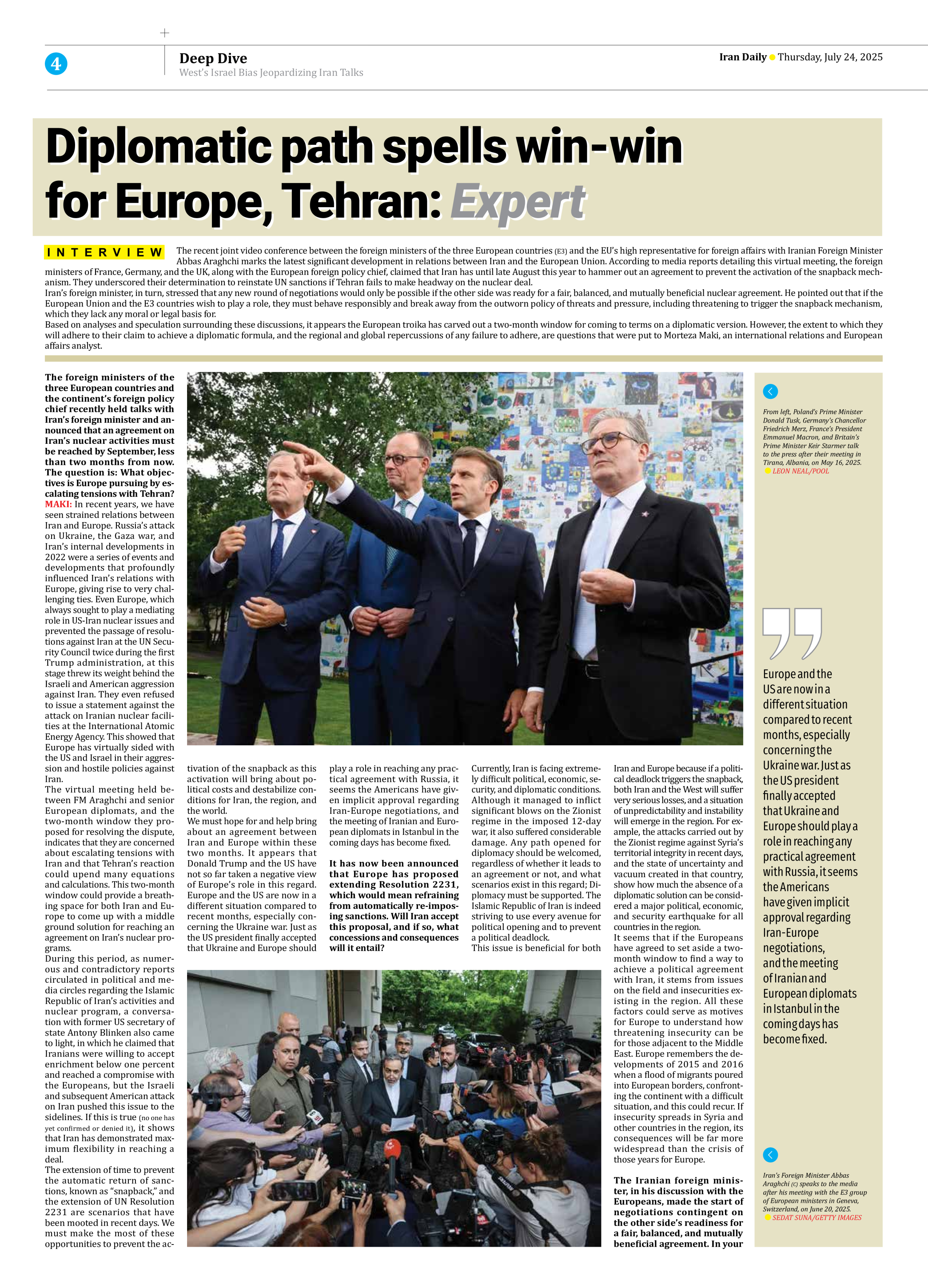
The recent joint video conference between the foreign ministers of the three European countries (E3) and the EU’s high representative for foreign affairs with Iranian Foreign Minister Abbas Araghchi marks the latest significant development in relations between Iran and the European Union. According to media reports detailing this virtual meeting, the foreign ministers of France, Germany, and the UK, along with the European foreign policy chief, claimed that Iran has until late August this year to hammer out an agreement to prevent the activation of the snapback mechanism. They underscored their determination to reinstate UN sanctions if Tehran fails to make headway on the nuclear deal. Iran’s foreign minister, in turn, stressed that any new round of negotiations would only be possible if the other side was ready for a fair, balanced, and mutually beneficial nuclear agreement. He pointed out that if the European Union and the E3 countries wish to play a role, they must behave responsibly and break away from the outworn policy of threats and pressure, including threatening to trigger the snapback mechanism, which they lack any moral or legal basis for. Based on analyses and speculation surrounding these discussions, it appears the European troika has carved out a two-month window for coming to terms on a diplomatic version. However, the extent to which they will adhere to their claim to achieve a diplomatic formula, and the regional and global repercussions of any failure to adhere, are questions that were put to Morteza Maki, an international relations and European affairs analyst.
The foreign ministers of the three European countries and the continent’s foreign policy chief recently held talks with Iran’s foreign minister and announced that an agreement on Iran’s nuclear activities must be reached by September, less than two months from now. The question is: What objectives is Europe pursuing by escalating tensions with Tehran?
MAKI: In recent years, we have seen strained relations between Iran and Europe. Russia’s attack on Ukraine, the Gaza war, and Iran’s internal developments in 2022 were a series of events and developments that profoundly influenced Iran’s relations with Europe, giving rise to very challenging ties. Even Europe, which always sought to play a mediating role in US-Iran nuclear issues and prevented the passage of resolutions against Iran at the UN Security Council twice during the first Trump administration, at this stage threw its weight behind the Israeli and American aggression against Iran. They even refused to issue a statement against the attack on Iranian nuclear facilities at the International Atomic Energy Agency. This showed that Europe has virtually sided with the US and Israel in their aggression and hostile policies against Iran.
The virtual meeting held between FM Araghchi and senior European diplomats, and the two-month window they proposed for resolving the dispute, indicates that they are concerned about escalating tensions with Iran and that Tehran’s reaction could upend many equations and calculations. This two-month window could provide a breathing space for both Iran and Europe to come up with a middle ground solution for reaching an agreement on Iran’s nuclear programs.
During this period, as numerous and contradictory reports circulated in political and media circles regarding the Islamic Republic of Iran’s activities and nuclear program, a conversation with former US secretary of state Antony Blinken also came to light, in which he claimed that Iranians were willing to accept enrichment below one percent and reached a compromise with the Europeans, but the Israeli and subsequent American attack on Iran pushed this issue to the sidelines. If this is true (no one has yet confirmed or denied it), it shows that Iran has demonstrated maximum flexibility in reaching a deal.
The extension of time to prevent the automatic return of sanctions, known as “snapback,” and the extension of UN Resolution 2231 are scenarios that have been mooted in recent days. We must make the most of these opportunities to prevent the activation of the snapback as this activation will bring about political costs and destabilize conditions for Iran, the region, and the world.
We must hope for and help bring about an agreement between Iran and Europe within these two months. It appears that Donald Trump and the US have not so far taken a negative view of Europe’s role in this regard. Europe and the US are now in a different situation compared to recent months, especially concerning the Ukraine war. Just as the US president finally accepted that Ukraine and Europe should play a role in reaching any practical agreement with Russia, it seems the Americans have given implicit approval regarding Iran-Europe negotiations, and the meeting of Iranian and European diplomats in Istanbul in the coming days has become fixed.
It has now been announced that Europe has proposed extending Resolution 2231, which would mean refraining from automatically re-imposing sanctions. Will Iran accept this proposal, and if so, what concessions and consequences will it entail?
Currently, Iran is facing extremely difficult political, economic, security, and diplomatic conditions. Although it managed to inflict significant blows on the Zionist regime in the imposed 12-day war, it also suffered considerable damage. Any path opened for diplomacy should be welcomed, regardless of whether it leads to an agreement or not, and what scenarios exist in this regard; Diplomacy must be supported. The Islamic Republic of Iran is indeed striving to use every avenue for political opening and to prevent a political deadlock.
This issue is beneficial for both Iran and Europe because if a political deadlock triggers the snapback, both Iran and the West will suffer very serious losses, and a situation of unpredictability and instability will emerge in the region. For example, the attacks carried out by the Zionist regime against Syria’s territorial integrity in recent days, and the state of uncertainty and vacuum created in that country, show how much the absence of a diplomatic solution can be considered a major political, economic, and security earthquake for all countries in the region.
It seems that if the Europeans have agreed to set aside a two-month window to find a way to achieve a political agreement with Iran, it stems from issues on the field and insecurities existing in the region. All these factors could serve as motives for Europe to understand how threatening insecurity can be for those adjacent to the Middle East. Europe remembers the developments of 2015 and 2016 when a flood of migrants poured into European borders, confronting the continent with a difficult situation, and this could recur. If insecurity spreads in Syria and other countries in the region, its consequences will be far more widespread than the crisis of those years for Europe.
The Iranian foreign minister, in his discussion with the Europeans, made the start of negotiations contingent on the other side’s readiness for a fair, balanced, and mutually beneficial agreement. In your opinion, what characteristics should a fair agreement possess, considering our current situation?
No agreement should diminish Iran’s deterrent power as Iran seeks nothing beyond the NPT, and Iran’s missile capability serves the country’s security against aggression. The 12-day war of aggression clearly demonstrated the importance of this missile capability in defending national security and territorial integrity. One of Iran’s demands in any negotiation and agreement in this regard will be that this deterrent capability is not reduced.
On the other hand, the Islamic Republic of Iran aims to strip the US and the Zionist regime of the Iranophobia lever they have held onto in the region for decades, and which they attempted to use to securitize Iran’s nuclear file at the regional level, portraying Tehran as a threat to its neighbors. The Israeli regime and the US justified actions and operations against Iran within the framework of this lever and Iranophobia, and the only way to neutralize this lever and scenario is through diplomacy. This diplomacy must lean on national cohesion, unity, and defensive and military capabilities. These are essential for Iranian diplomats to sit with confidence at the negotiating table and work in synergy.
Iran has shown maximum flexibility to allow the Europeans to verify Iran’s nuclear activities. If the West is genuinely concerned about enrichment in Iran, their wishes will be fulfilled through such targeted proposals. However, if not, Iran will continue to resist their threats. Nevertheless, to prevent any conflict and tension, the door to diplomacy must be kept open. The “no war, no peace” situation has been very difficult for Iran and will make governing the country challenging, and we must move past this stage. Iran-Europe relations and engagement in the next two months will be very sensitive and could bring about breakthroughs.
Can negotiations with Europe be seen as a bridge for negotiations with the US, or should these two be viewed separately?
Currently, and unfortunately, Iran has become a bridge for alignment and convergence between the US, Israel, and Europe. Even though the US and Europe have deep disagreements on political, economic, and security issues, which have not reached this level in the past 80 years and relations have not been this challenging, they have found a kind of convergence on Iran. Iran-Europe talks can help Europe act with more caution or considerations regarding Iran in its alignment with the US and Israel. These talks can certainly contribute to alleviating tensions with the Americans as well.
The US concluded concerning Ukraine that they cannot resolve the war without Europe’s cooperation. It appears that after the 12-day attacks on Iran, Washington has once again come to the conclusion that Europeans, compared to other regional mediators like Arab countries, Oman, and Qatar, or China and Russia, can be more helpful in reaching a deal with Iran. Although the European troika and Iran currently have very strained relations and there is hostile rhetoric, against this pressure diplomacy, public and media diplomacy can certainly offer an opportunity for the Islamic Republic of Iran to emerge from these difficult political and economic conditions.
The interview first appeared in
Persian on IRNA.