







Iran celebrates cultural resilience, national unity through arts after Israeli aggression
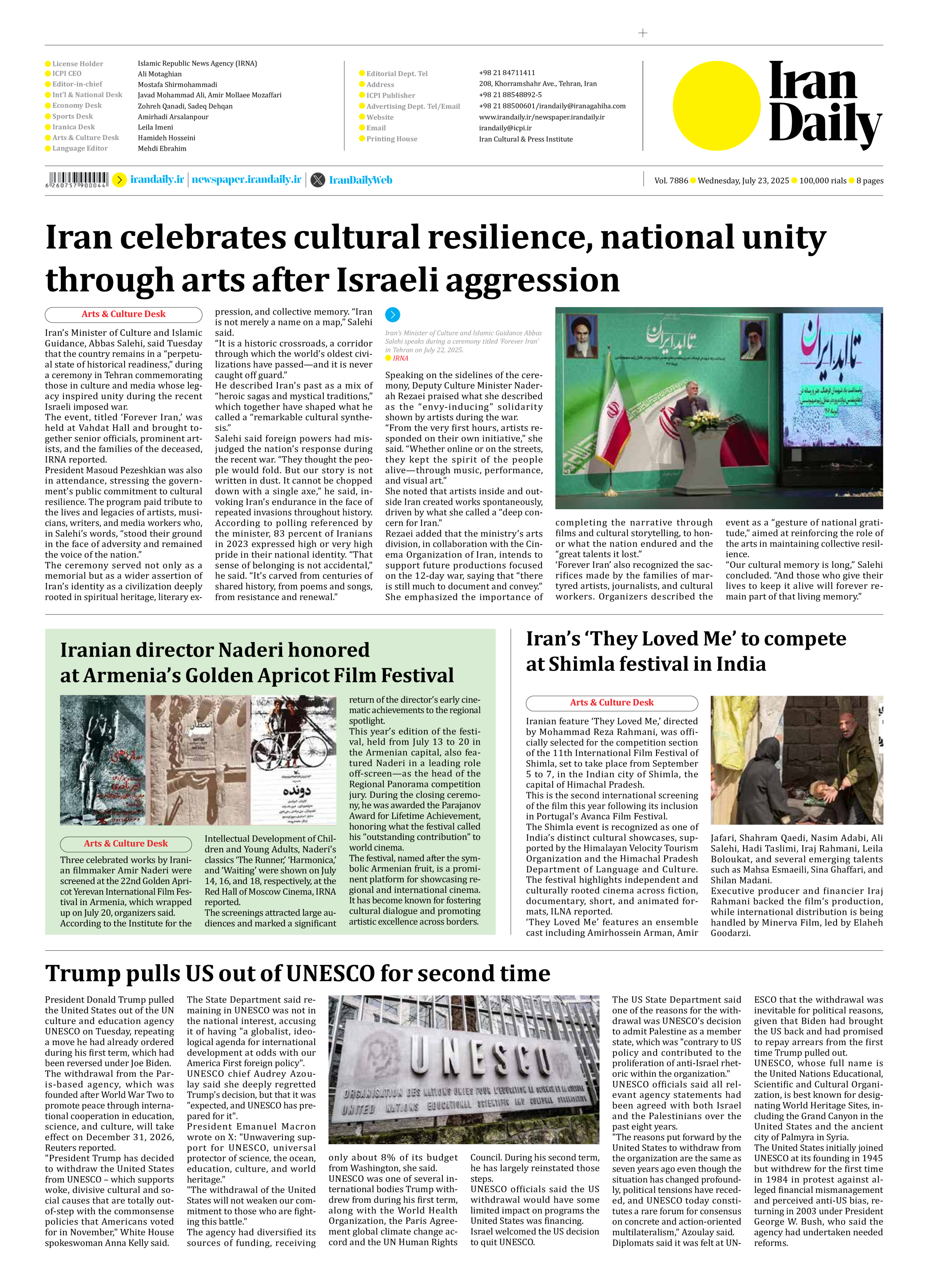
Iran’s Minister of Culture and Islamic Guidance, Abbas Salehi, said Tuesday that the country remains in a “perpetual state of historical readiness,” during a ceremony in Tehran commemorating those in culture and media whose legacy inspired unity during the recent Israeli imposed war.
The event, titled ‘Forever Iran,’ was held at Vahdat Hall and brought together senior officials, prominent artists, and the families of the deceased, IRNA reported.
President Masoud Pezeshkian was also in attendance, stressing the government's public commitment to cultural resilience. The program paid tribute to the lives and legacies of artists, musicians, writers, and media workers who, in Salehi’s words, “stood their ground in the face of adversity and remained the voice of the nation.”
The ceremony served not only as a memorial but as a wider assertion of Iran’s identity as a civilization deeply rooted in spiritual heritage, literary expression, and collective memory. “Iran is not merely a name on a map,” Salehi said.
“It is a historic crossroads, a corridor through which the world’s oldest civilizations have passed—and it is never caught off guard.”
He described Iran’s past as a mix of “heroic sagas and mystical traditions,” which together have shaped what he called a “remarkable cultural synthesis.”
Salehi said foreign powers had misjudged the nation’s response during the recent war. “They thought the people would fold. But our story is not written in dust. It cannot be chopped down with a single axe,” he said, invoking Iran’s endurance in the face of repeated invasions throughout history.
According to polling referenced by the minister, 83 percent of Iranians in 2023 expressed high or very high pride in their national identity. “That sense of belonging is not accidental,” he said. “It’s carved from centuries of shared history, from poems and songs, from resistance and renewal.”
Speaking on the sidelines of the ceremony, Deputy Culture Minister Naderah Rezaei praised what she described as the “envy-inducing” solidarity shown by artists during the war.
“From the very first hours, artists responded on their own initiative,” she said. “Whether online or on the streets, they kept the spirit of the people alive—through music, performance, and visual art.”
She noted that artists inside and outside Iran created works spontaneously, driven by what she called a “deep concern for Iran.”
Rezaei added that the ministry’s arts division, in collaboration with the Cinema Organization of Iran, intends to support future productions focused on the 12-day war, saying that “there is still much to document and convey.”
She emphasized the importance of completing the narrative through films and cultural storytelling, to honor what the nation endured and the “great talents it lost.”
‘Forever Iran’ also recognized the sacrifices made by the families of martyred artists, journalists, and cultural workers. Organizers described the event as a “gesture of national gratitude,” aimed at reinforcing the role of the arts in maintaining collective resilience.
“Our cultural memory is long,” Salehi concluded. “And those who give their lives to keep it alive will forever remain part of that living memory.”