





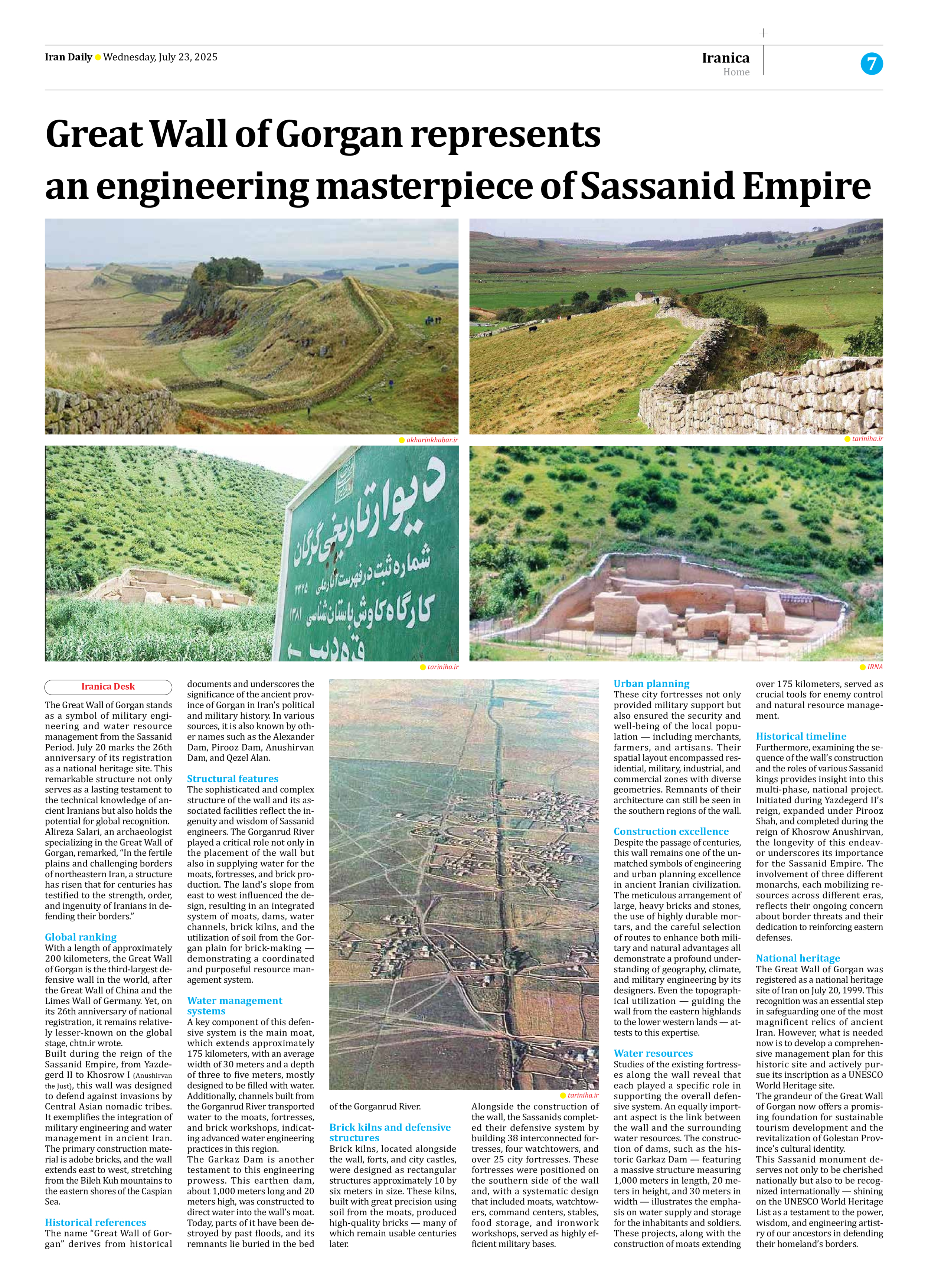


Great Wall of Gorgan represents an engineering masterpiece of Sassanid Empire
The Great Wall of Gorgan stands as a symbol of military engineering and water resource management from the Sassanid Period. July 20 marks the 26th anniversary of its registration as a national heritage site. This remarkable structure not only serves as a lasting testament to the technical knowledge of ancient Iranians but also holds the potential for global recognition.
Alireza Salari, an archaeologist specializing in the Great Wall of Gorgan, remarked, “In the fertile plains and challenging borders of northeastern Iran, a structure has risen that for centuries has testified to the strength, order, and ingenuity of Iranians in defending their borders.”
Global ranking
With a length of approximately 200 kilometers, the Great Wall of Gorgan is the third-largest defensive wall in the world, after the Great Wall of China and the Limes Wall of Germany. Yet, on its 26th anniversary of national registration, it remains relatively lesser-known on the global stage, chtn.ir wrote.
Built during the reign of the Sassanid Empire, from Yazdegerd II to Khosrow I (Anushirvan the Just), this wall was designed to defend against invasions by Central Asian nomadic tribes. It exemplifies the integration of military engineering and water management in ancient Iran. The primary construction material is adobe bricks, and the wall extends east to west, stretching from the Bileh Kuh mountains to the eastern shores of the Caspian Sea.
Historical references
The name “Great Wall of Gorgan” derives from historical documents and underscores the significance of the ancient province of Gorgan in Iran’s political and military history. In various sources, it is also known by other names such as the Alexander Dam, Pirooz Dam, Anushirvan Dam, and Qezel Alan.
Structural features
The sophisticated and complex structure of the wall and its associated facilities reflect the ingenuity and wisdom of Sassanid engineers. The Gorganrud River played a critical role not only in the placement of the wall but also in supplying water for the moats, fortresses, and brick production. The land’s slope from east to west influenced the design, resulting in an integrated system of moats, dams, water channels, brick kilns, and the utilization of soil from the Gorgan plain for brick-making — demonstrating a coordinated and purposeful resource management system.
Water management systems
A key component of this defensive system is the main moat, which extends approximately 175 kilometers, with an average width of 30 meters and a depth of three to five meters, mostly designed to be filled with water. Additionally, channels built from the Gorganrud River transported water to the moats, fortresses, and brick workshops, indicating advanced water engineering practices in this region.
The Garkaz Dam is another testament to this engineering prowess. This earthen dam, about 1,000 meters long and 20 meters high, was constructed to direct water into the wall’s moat. Today, parts of it have been destroyed by past floods, and its remnants lie buried in the bed of the Gorganrud River.
Brick kilns and defensive structures
Brick kilns, located alongside the wall, forts, and city castles, were designed as rectangular structures approximately 10 by six meters in size. These kilns, built with great precision using soil from the moats, produced high-quality bricks — many of which remain usable centuries later.
Alongside the construction of the wall, the Sassanids completed their defensive system by building 38 interconnected fortresses, four watchtowers, and over 25 city fortresses. These fortresses were positioned on the southern side of the wall and, with a systematic design that included moats, watchtowers, command centers, stables, food storage, and ironwork workshops, served as highly efficient military bases.
Urban planning
These city fortresses not only provided military support but also ensured the security and well-being of the local population — including merchants, farmers, and artisans. Their spatial layout encompassed residential, military, industrial, and commercial zones with diverse geometries. Remnants of their architecture can still be seen in the southern regions of the wall.
Construction excellence
Despite the passage of centuries, this wall remains one of the unmatched symbols of engineering and urban planning excellence in ancient Iranian civilization. The meticulous arrangement of large, heavy bricks and stones, the use of highly durable mortars, and the careful selection of routes to enhance both military and natural advantages all demonstrate a profound understanding of geography, climate, and military engineering by its designers. Even the topographical utilization — guiding the wall from the eastern highlands to the lower western lands — attests to this expertise.
Water resources
Studies of the existing fortresses along the wall reveal that each played a specific role in supporting the overall defensive system. An equally important aspect is the link between the wall and the surrounding water resources. The construction of dams, such as the historic Garkaz Dam — featuring a massive structure measuring 1,000 meters in length, 20 meters in height, and 30 meters in width — illustrates the emphasis on water supply and storage for the inhabitants and soldiers. These projects, along with the construction of moats extending over 175 kilometers, served as crucial tools for enemy control and natural resource management.
Historical timeline
Furthermore, examining the sequence of the wall’s construction and the roles of various Sassanid kings provides insight into this multi-phase, national project. Initiated during Yazdegerd II’s reign, expanded under Pirooz Shah, and completed during the reign of Khosrow Anushirvan, the longevity of this endeavor underscores its importance for the Sassanid Empire. The involvement of three different monarchs, each mobilizing resources across different eras, reflects their ongoing concern about border threats and their dedication to reinforcing eastern defenses.
National heritage
The Great Wall of Gorgan was registered as a national heritage site of Iran on July 20, 1999. This recognition was an essential step in safeguarding one of the most magnificent relics of ancient Iran. However, what is needed now is to develop a comprehensive management plan for this historic site and actively pursue its inscription as a UNESCO World Heritage site.
The grandeur of the Great Wall of Gorgan now offers a promising foundation for sustainable tourism development and the revitalization of Golestan Province’s cultural identity.
This Sassanid monument deserves not only to be cherished nationally but also to be recognized internationally — shining on the UNESCO World Heritage List as a testament to the power, wisdom, and engineering artistry of our ancestors in defending their homeland’s borders.