







Copy in clipboard...
Pezeshkian urges urgent action amid worsening water crisis
Iranian President Masoud Pezeshkian on Monday said the country’s water crisis, especially in Tehran, is “more serious than widely discussed,” calling for swift and coordinated action to avert long-term damage.
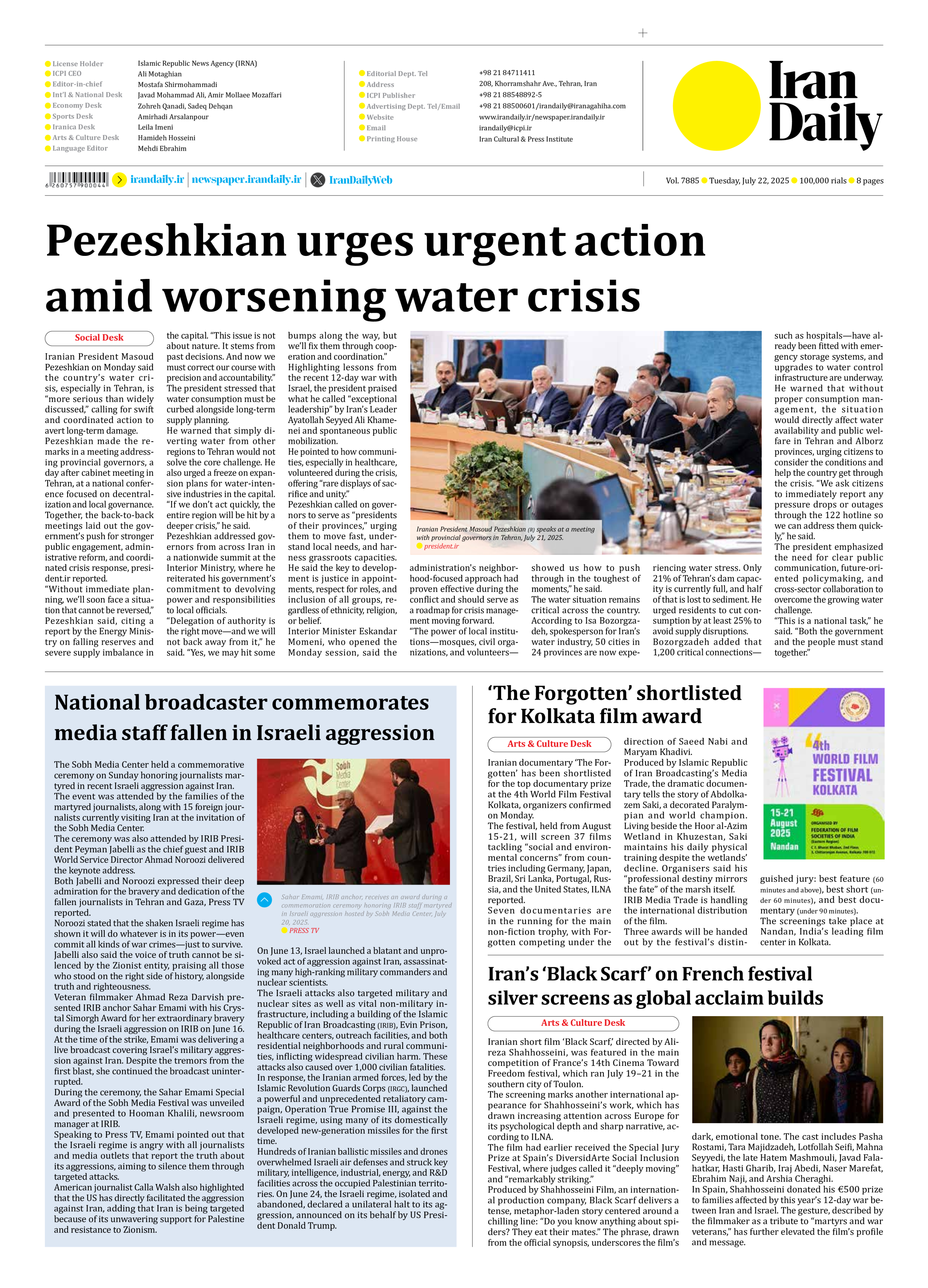
Pezeshkian made the remarks in a meeting addressing provincial governors, a day after cabinet meeting in Tehran, at a national conference focused on decentralization and local governance. Together, the back-to-back meetings laid out the government’s push for stronger public engagement, administrative reform, and coordinated crisis response, president.ir reported.
“Without immediate planning, we’ll soon face a situation that cannot be reversed,” Pezeshkian said, citing a report by the Energy Ministry on falling reserves and severe supply imbalance in the capital. “This issue is not about nature. It stems from past decisions. And now we must correct our course with precision and accountability.”
The president stressed that water consumption must be curbed alongside long-term supply planning.
He warned that simply diverting water from other regions to Tehran would not solve the core challenge. He also urged a freeze on expansion plans for water-intensive industries in the capital. “If we don’t act quickly, the entire region will be hit by a deeper crisis,” he said.
Pezeshkian addressed governors from across Iran in a nationwide summit at the Interior Ministry, where he reiterated his government’s commitment to devolving power and responsibilities to local officials.
“Delegation of authority is the right move—and we will not back away from it,” he said. “Yes, we may hit some bumps along the way, but we’ll fix them through cooperation and coordination.”
Highlighting lessons from the recent 12-day war with Israel, the president praised what he called “exceptional leadership” by Iran’s Leader Ayatollah Seyyed Ali Khamenei and spontaneous public mobilization.
He pointed to how communities, especially in healthcare, volunteered during the crisis, offering “rare displays of sacrifice and unity.”
Pezeshkian called on governors to serve as “presidents of their provinces,” urging them to move fast, understand local needs, and harness grassroots capacities. He said the key to development is justice in appointments, respect for roles, and inclusion of all groups, regardless of ethnicity, religion, or belief.
Interior Minister Eskandar Momeni, who opened the Monday session, said the administration's neighborhood-focused approach had proven effective during the conflict and should serve as a roadmap for crisis management moving forward.
“The power of local institutions—mosques, civil organizations, and volunteers—showed us how to push through in the toughest of moments,” he said.
The water situation remains critical across the country. According to Isa Bozorgzadeh, spokesperson for Iran’s water industry, 50 cities in 24 provinces are now experiencing water stress. Only 21% of Tehran’s dam capacity is currently full, and half of that is lost to sediment. He urged residents to cut consumption by at least 25% to avoid supply disruptions.
Bozorgzadeh added that 1,200 critical connections—such as hospitals—have already been fitted with emergency storage systems, and upgrades to water control infrastructure are underway.
He warned that without proper consumption management, the situation would directly affect water availability and public welfare in Tehran and Alborz provinces, urging citizens to consider the conditions and help the country get through the crisis. “We ask citizens to immediately report any pressure drops or outages through the 122 hotline so we can address them quickly,” he said.
The president emphasized the need for clear public communication, future-oriented policymaking, and cross-sector collaboration to overcome the growing water challenge.
“This is a national task,” he said. “Both the government and the people must stand together.”