







Manal Bafi of Bafq; an ancient craft at risk of extinction
Among the cities of Yazd Province, Bafq is renowned for having the highest number of date palms. As such, its product — Bafq dates — has long been considered one of the region’s characteristic features. Not so long ago, the presence of 400,000 date palms in Bafq not only reflected the agricultural sector’s focus on date production but also indicated that this tree has numerous uses for the local population. A large portion of the region’s products and handicrafts are directly related to different parts of this tree. Examples include fan weaving, various types of mats, brooms, door mats, and other similar items.
Utilization of date palm parts
The diversity and extent of utilization of different parts of this tree are so remarkable that the region’s handicrafts can truly be regarded as an inseparable extension of the products of this tree. Fans are woven from its leaves and fiber; the twigs of its branches are used to make handles for fans; its tough fibers are woven into mats; and the same parts are also employed to weave ropes or, locally, Manal Bafi (Manal weaving), chtn.ir wrote.
Cultural significance
Overall, besides the reliance of the region’s handicrafts on date palm products, this craft has historically prompted local people to hold ceremonies for seed planting and the ceremonial planting of date palms.
Manal Bafi signifies the optimal use of the date palm, and it is also considered a vital pillar supporting other local handicrafts in Bafq. Regarding its applications, it is worth noting that the spun fibers of the date palm are used as strong ropes for descending into wells, climbing date palms to harvest fruit, weaving door mats, making ropes for plastering, and, more recently, primarily for securing vine trellises and various other purposes.
Raw materials
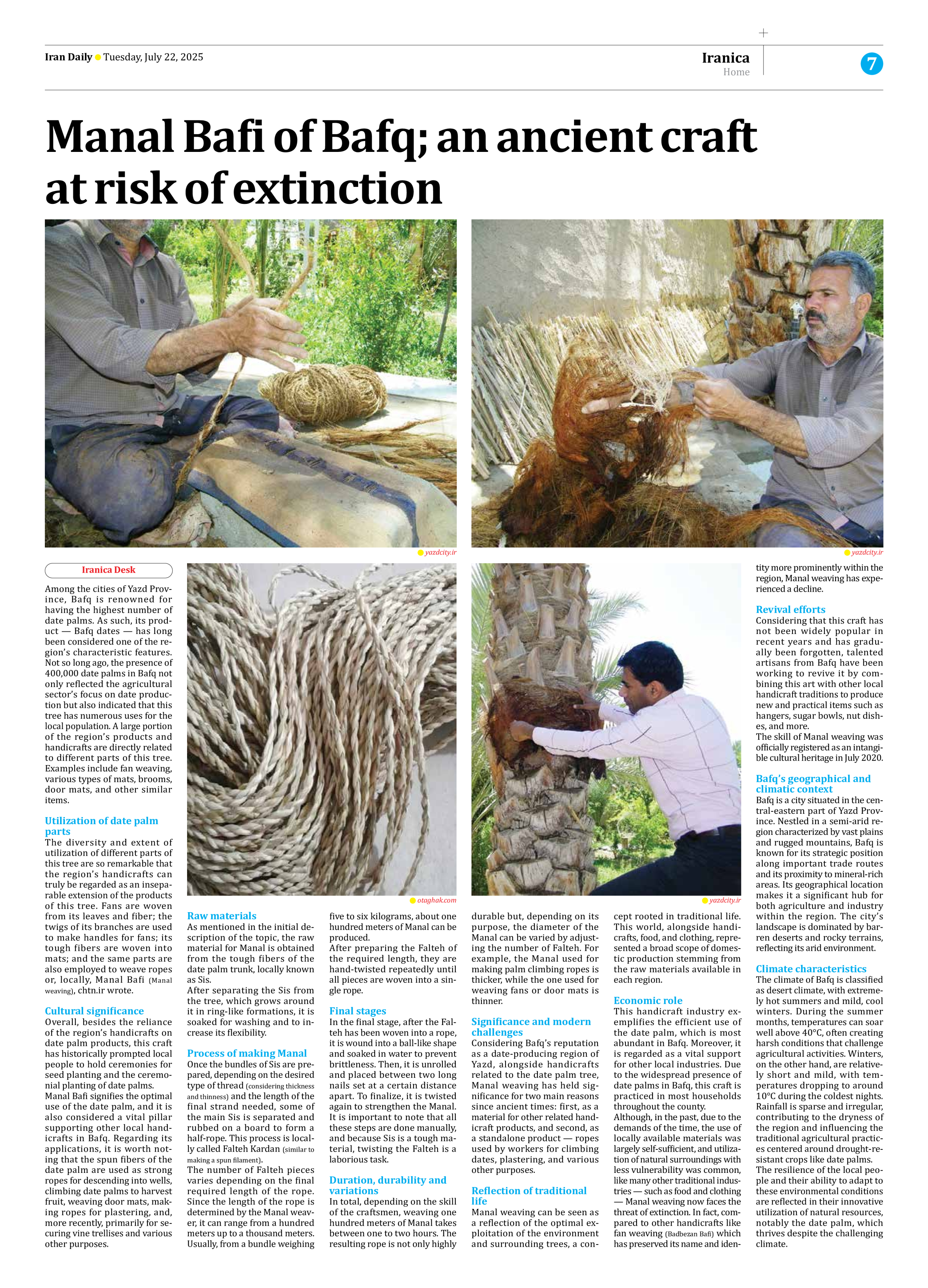
As mentioned in the initial description of the topic, the raw material for Manal is obtained from the tough fibers of the date palm trunk, locally known as Sis.
After separating the Sis from the tree, which grows around it in ring-like formations, it is soaked for washing and to increase its flexibility.
Process of making Manal
Once the bundles of Sis are prepared, depending on the desired type of thread (considering thickness and thinness) and the length of the final strand needed, some of the main Sis is separated and rubbed on a board to form a half-rope. This process is locally called Falteh Kardan (similar to making a spun filament).
The number of Falteh pieces varies depending on the final required length of the rope. Since the length of the rope is determined by the Manal weaver, it can range from a hundred meters up to a thousand meters. Usually, from a bundle weighing five to six kilograms, about one hundred meters of Manal can be produced.
After preparing the Falteh of the required length, they are hand-twisted repeatedly until all pieces are woven into a single rope.
Final stages
In the final stage, after the Falteh has been woven into a rope, it is wound into a ball-like shape and soaked in water to prevent brittleness. Then, it is unrolled and placed between two long nails set at a certain distance apart. To finalize, it is twisted again to strengthen the Manal. It is important to note that all these steps are done manually, and because Sis is a tough material, twisting the Falteh is a laborious task.
Duration, durability and variations
In total, depending on the skill of the craftsmen, weaving one hundred meters of Manal takes between one to two hours. The resulting rope is not only highly durable but, depending on its purpose, the diameter of the Manal can be varied by adjusting the number of Falteh. For example, the Manal used for making palm climbing ropes is thicker, while the one used for weaving fans or door mats is thinner.
Significance and modern challenges
Considering Bafq’s reputation as a date-producing region of Yazd, alongside handicrafts related to the date palm tree, Manal weaving has held significance for two main reasons since ancient times: first, as a material for other related handicraft products, and second, as a standalone product — ropes used by workers for climbing dates, plastering, and various other purposes.
Reflection of traditional life
Manal weaving can be seen as a reflection of the optimal exploitation of the environment and surrounding trees, a concept rooted in traditional life. This world, alongside handicrafts, food, and clothing, represented a broad scope of domestic production stemming from the raw materials available in each region.
Economic role
This handicraft industry exemplifies the efficient use of the date palm, which is most abundant in Bafq. Moreover, it is regarded as a vital support for other local industries. Due to the widespread presence of date palms in Bafq, this craft is practiced in most households throughout the county.
Although, in the past, due to the demands of the time, the use of locally available materials was largely self-sufficient, and utilization of natural surroundings with less vulnerability was common, like many other traditional industries — such as food and clothing — Manal weaving now faces the threat of extinction. In fact, compared to other handicrafts like fan weaving (Badbezan Bafi) which has preserved its name and identity more prominently within the region, Manal weaving has experienced a decline.
Revival efforts
Considering that this craft has not been widely popular in recent years and has gradually been forgotten, talented artisans from Bafq have been working to revive it by combining this art with other local handicraft traditions to produce new and practical items such as hangers, sugar bowls, nut dishes, and more.
The skill of Manal weaving was officially registered as an intangible cultural heritage in July 2020.
Bafq’s geographical and climatic context
Bafq is a city situated in the central-eastern part of Yazd Province. Nestled in a semi-arid region characterized by vast plains and rugged mountains, Bafq is known for its strategic position along important trade routes and its proximity to mineral-rich areas. Its geographical location makes it a significant hub for both agriculture and industry within the region. The city’s landscape is dominated by barren deserts and rocky terrains, reflecting its arid environment.
Climate characteristics
The climate of Bafq is classified as desert climate, with extremely hot summers and mild, cool winters. During the summer months, temperatures can soar well above 40°C, often creating harsh conditions that challenge agricultural activities. Winters, on the other hand, are relatively short and mild, with temperatures dropping to around 10°C during the coldest nights. Rainfall is sparse and irregular, contributing to the dryness of the region and influencing the traditional agricultural practices centered around drought-resistant crops like date palms.
The resilience of the local people and their ability to adapt to these environmental conditions are reflected in their innovative utilization of natural resources, notably the date palm, which thrives despite the challenging climate.