







Leadership without protocol
A world in disorder
By Kamran Yeganegi
Foreign policy expert
At the dawn of the 21st century, we face a world more interconnected, vulnerable, and in need of clear rules and responsible leadership than ever before. However, what we are witnessing in reality is a divergence from the very principles upon which modern civilization was built: multilateralism, respect for national sovereignty, diplomacy over violence, and predictability in the behavior of statesmen. Today, we clearly observe a form of leadership failure on the global stage — a failure stemming less from a lack of resources or external threats, and more from the presence of leaders who distance themselves from the protocols of international politics and sometimes deliberately undermine the rules of the global game.
The international order, though always relative and fraught with tensions, was built over the past decades on a minimal consensus among countries regarding fundamental principles. This order was born of bloody wars, difficult treaties, and decades of humanity’s harsh experience in an insecure world. Yet, when leaders consciously or carelessly disregard these frameworks and reduce politics to personal preferences, media spectacle, or partisan competition, the outcome is nothing but global instability, weakening of multilateral institutions, and the spread of crises from one point to another.
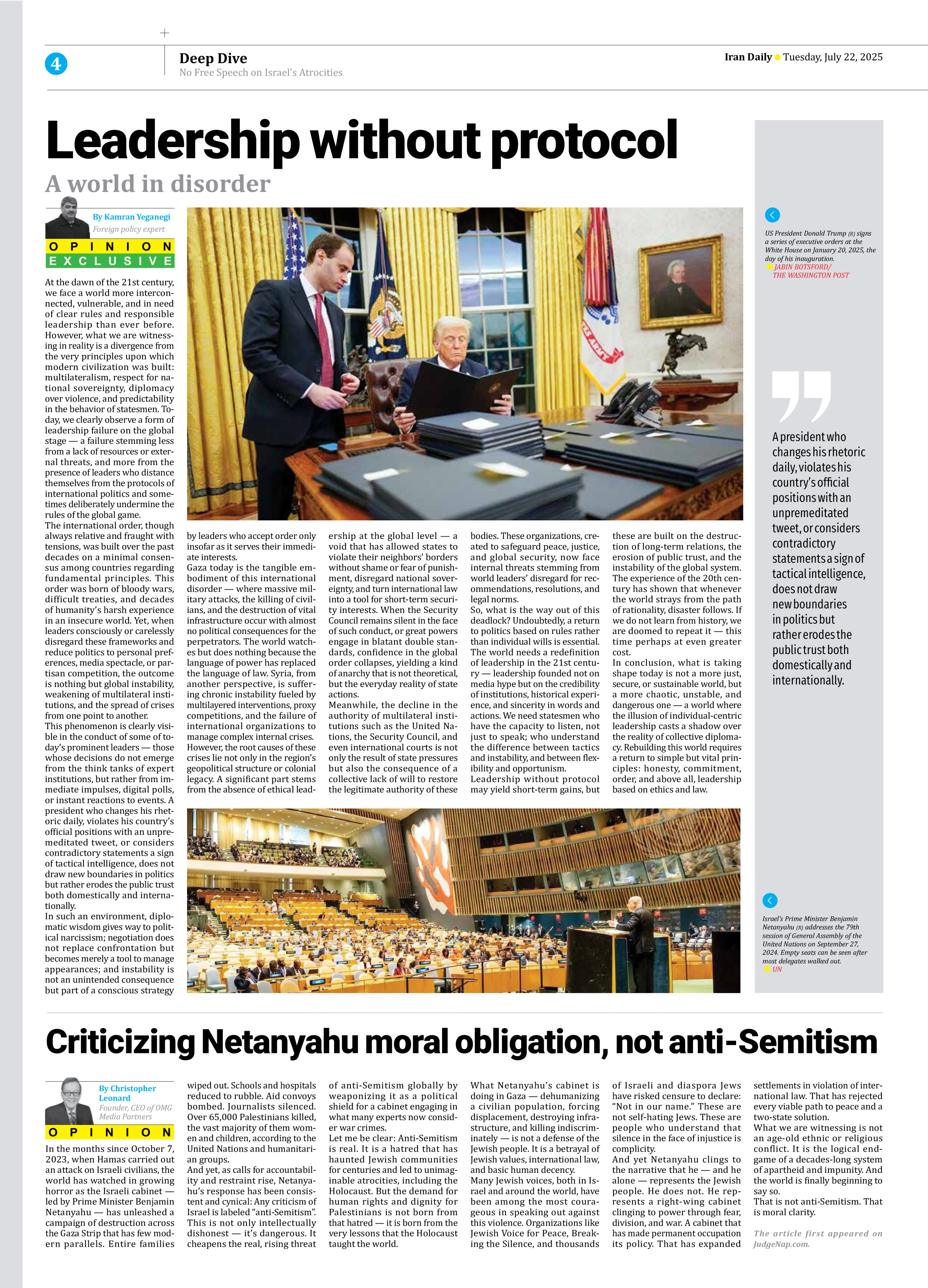
This phenomenon is clearly visible in the conduct of some of today’s prominent leaders — those whose decisions do not emerge from the think tanks of expert institutions, but rather from immediate impulses, digital polls, or instant reactions to events. A president who changes his rhetoric daily, violates his country’s official positions with an unpremeditated tweet, or considers contradictory statements a sign of tactical intelligence, does not draw new boundaries in politics but rather erodes the public trust both domestically and internationally.
In such an environment, diplomatic wisdom gives way to political narcissism; negotiation does not replace confrontation but becomes merely a tool to manage appearances; and instability is not an unintended consequence but part of a conscious strategy by leaders who accept order only insofar as it serves their immediate interests.
Gaza today is the tangible embodiment of this international disorder — where massive military attacks, the killing of civilians, and the destruction of vital infrastructure occur with almost no political consequences for the perpetrators. The world watches but does nothing because the language of power has replaced the language of law. Syria, from another perspective, is suffering chronic instability fueled by multilayered interventions, proxy competitions, and the failure of international organizations to manage complex internal crises.
However, the root causes of these crises lie not only in the region’s geopolitical structure or colonial legacy. A significant part stems from the absence of ethical leadership at the global level — a void that has allowed states to violate their neighbors’ borders without shame or fear of punishment, disregard national sovereignty, and turn international law into a tool for short-term security interests. When the Security Council remains silent in the face of such conduct, or great powers engage in blatant double standards, confidence in the global order collapses, yielding a kind of anarchy that is not theoretical, but the everyday reality of state actions.
Meanwhile, the decline in the authority of multilateral institutions such as the United Nations, the Security Council, and even international courts is not only the result of state pressures but also the consequence of a collective lack of will to restore the legitimate authority of these bodies. These organizations, created to safeguard peace, justice, and global security, now face internal threats stemming from world leaders’ disregard for recommendations, resolutions, and legal norms.
So, what is the way out of this deadlock? Undoubtedly, a return to politics based on rules rather than individual wills is essential. The world needs a redefinition of leadership in the 21st century — leadership founded not on media hype but on the credibility of institutions, historical experience, and sincerity in words and actions. We need statesmen who have the capacity to listen, not just to speak; who understand the difference between tactics and instability, and between flexibility and opportunism.
Leadership without protocol may yield short-term gains, but these are built on the destruction of long-term relations, the erosion of public trust, and the instability of the global system. The experience of the 20th century has shown that whenever the world strays from the path of rationality, disaster follows. If we do not learn from history, we are doomed to repeat it — this time perhaps at even greater cost.
In conclusion, what is taking shape today is not a more just, secure, or sustainable world, but a more chaotic, unstable, and dangerous one — a world where the illusion of individual-centric leadership casts a shadow over the reality of collective diplomacy. Rebuilding this world requires a return to simple but vital principles: honesty, commitment, order, and above all, leadership based on ethics and law.