





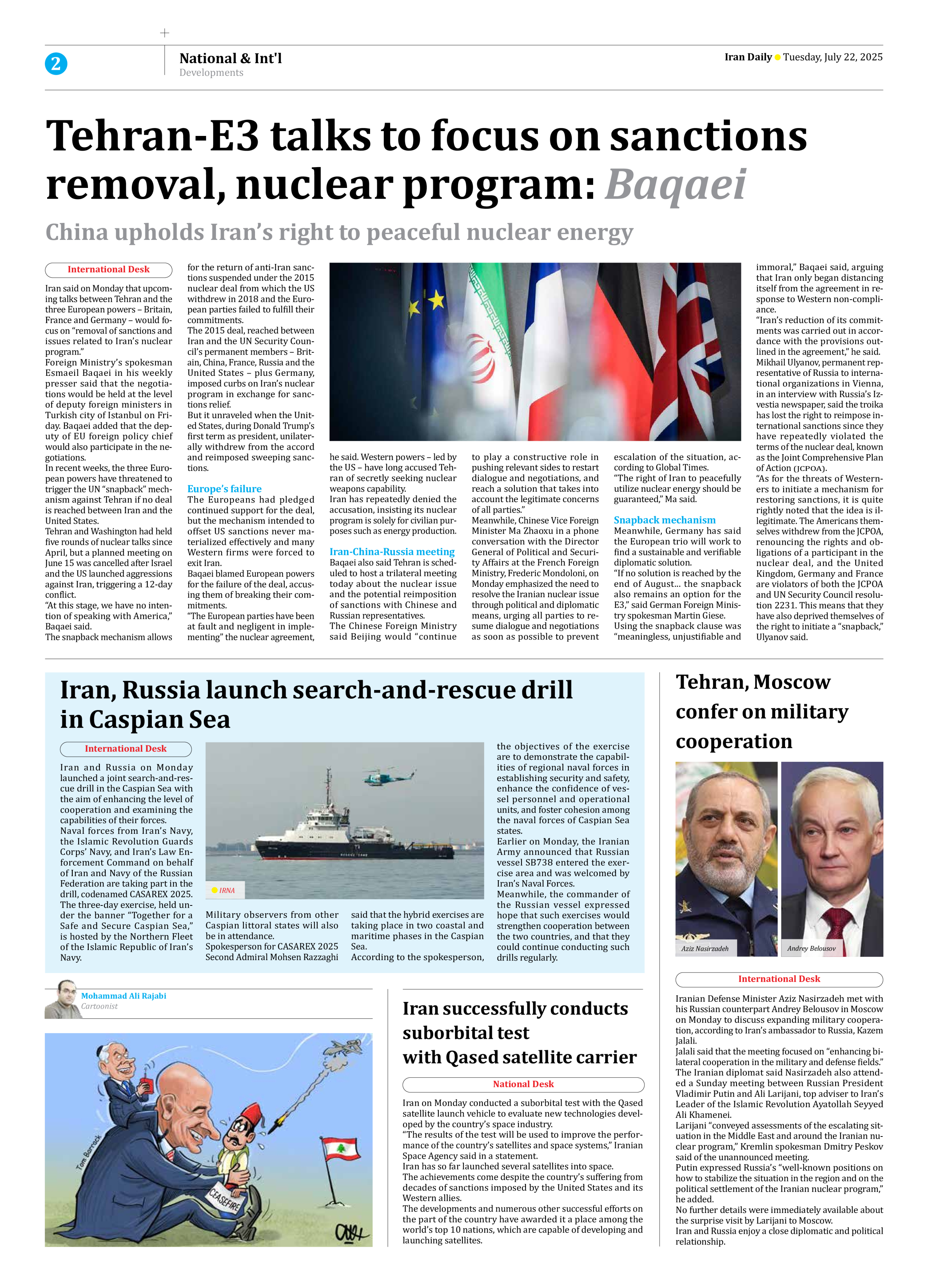


Tehran-E3 talks to focus on sanctions removal, nuclear program: Baqaei
China upholds Iran’s right to peaceful nuclear energy
Iran said on Monday that upcoming talks between Tehran and the three European powers – Britain, France and Germany – would focus on “removal of sanctions and issues related to Iran’s nuclear program.”
Foreign Ministry’s spokesman Esmaeil Baqaei in his weekly presser said that the negotiations would be held at the level of deputy foreign ministers in Turkish city of Istanbul on Friday. Baqaei added that the deputy of EU foreign policy chief would also participate in the negotiations.
In recent weeks, the three European powers have threatened to trigger the UN “snapback” mechanism against Tehran if no deal is reached between Iran and the United States.
Tehran and Washington had held five rounds of nuclear talks since April, but a planned meeting on June 15 was cancelled after Israel and the US launched aggressions against Iran, triggering a 12-day conflict.
“At this stage, we have no intention of speaking with America,” Baqaei said.
The snapback mechanism allows for the return of anti-Iran sanctions suspended under the 2015 nuclear deal from which the US withdrew in 2018 and the European parties failed to fulfill their commitments.
The 2015 deal, reached between Iran and the UN Security Council’s permanent members – Britain, China, France, Russia and the United States – plus Germany, imposed curbs on Iran’s nuclear program in exchange for sanctions relief.
But it unraveled when the United States, during Donald Trump’s first term as president, unilaterally withdrew from the accord and reimposed sweeping sanctions.
Europe’s failure
The Europeans had pledged continued support for the deal, but the mechanism intended to offset US sanctions never materialized effectively and many Western firms were forced to exit Iran.
Baqaei blamed European powers for the failure of the deal, accusing them of breaking their commitments.
“The European parties have been at fault and negligent in implementing” the nuclear agreement, he said. Western powers – led by the US – have long accused Tehran of secretly seeking nuclear weapons capability.
Iran has repeatedly denied the accusation, insisting its nuclear program is solely for civilian purposes such as energy production.
Iran-China-Russia meeting
Baqaei also said Tehran is scheduled to host a trilateral meeting today about the nuclear issue and the potential reimposition of sanctions with Chinese and Russian representatives.
The Chinese Foreign Ministry said Beijing would “continue to play a constructive role in pushing relevant sides to restart dialogue and negotiations, and reach a solution that takes into account the legitimate concerns of all parties.”
Meanwhile, Chinese Vice Foreign Minister Ma Zhaoxu in a phone conversation with the Director General of Political and Security Affairs at the French Foreign Ministry, Frederic Mondoloni, on Monday emphasized the need to resolve the Iranian nuclear issue through political and diplomatic means, urging all parties to resume dialogue and negotiations as soon as possible to prevent escalation of the situation, according to Global Times.
“The right of Iran to peacefully utilize nuclear energy should be guaranteed,” Ma said.
Snapback mechanism
Meanwhile, Germany has said the European trio will work to find a sustainable and verifiable diplomatic solution.
“If no solution is reached by the end of August... the snapback also remains an option for the E3,” said German Foreign Ministry spokesman Martin Giese.
Using the snapback clause was “meaningless, unjustifiable and immoral,” Baqaei said, arguing that Iran only began distancing itself from the agreement in response to Western non-compliance.
“Iran’s reduction of its commitments was carried out in accordance with the provisions outlined in the agreement,” he said.
Mikhail Ulyanov, permanent representative of Russia to international organizations in Vienna, in an interview with Russia’s Izvestia newspaper, said the troika has lost the right to reimpose international sanctions since they have repeatedly violated the terms of the nuclear deal, known as the Joint Comprehensive Plan of Action (JCPOA).
“As for the threats of Westerners to initiate a mechanism for restoring sanctions, it is quite rightly noted that the idea is illegitimate. The Americans themselves withdrew from the JCPOA, renouncing the rights and obligations of a participant in the nuclear deal, and the United Kingdom, Germany and France are violators of both the JCPOA and UN Security Council resolution 2231. This means that they have also deprived themselves of the right to initiate a “snapback,” Ulyanov said.