







Israel scheming to bring ‘irreparable damage’ to region: Former envoy
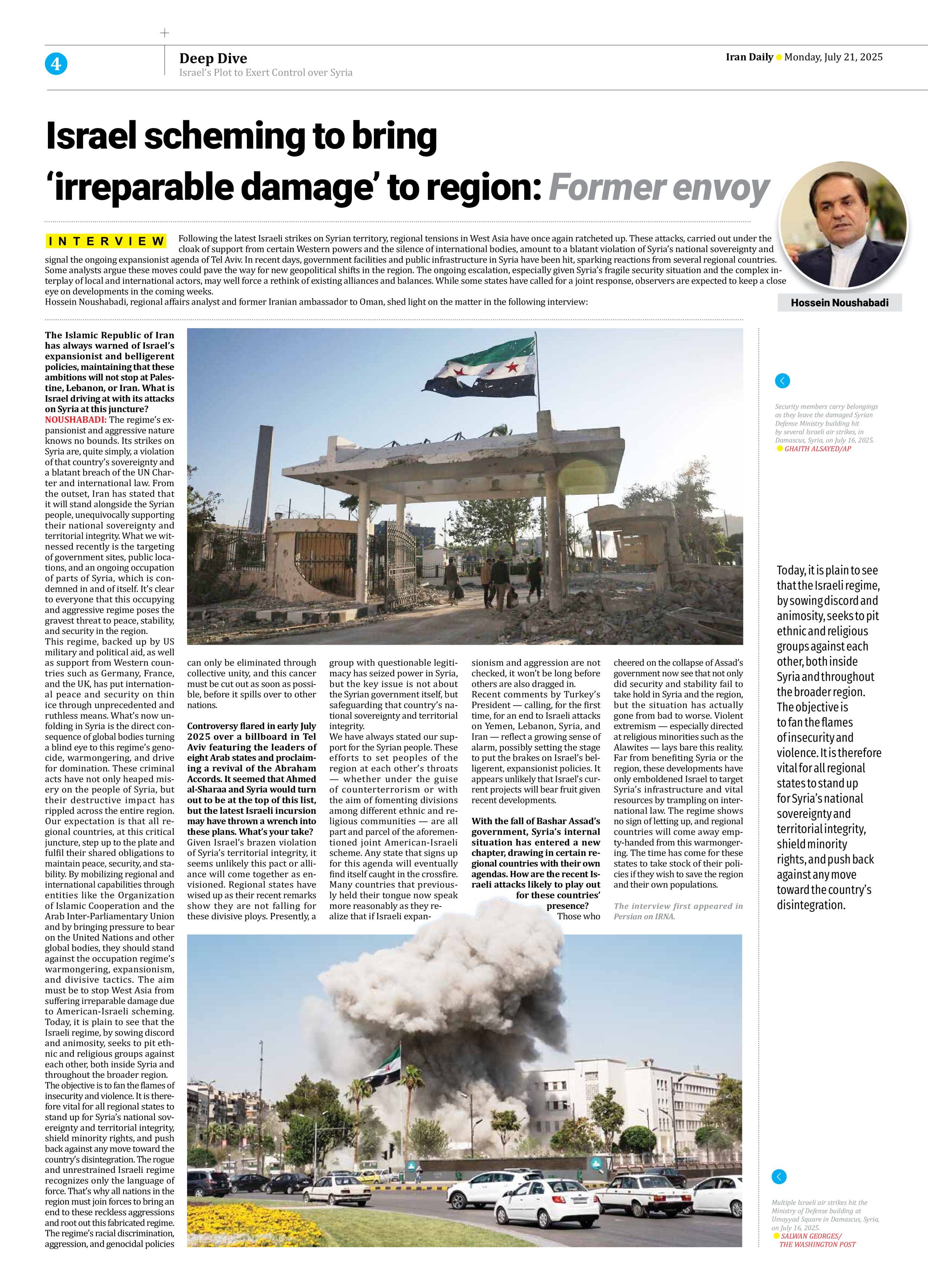
Following the latest Israeli strikes on Syrian territory, regional tensions in West Asia have once again ratcheted up. These attacks, carried out under the cloak of support from certain Western powers and the silence of international bodies, amount to a blatant violation of Syria’s national sovereignty and signal the ongoing expansionist agenda of Tel Aviv. In recent days, government facilities and public infrastructure in Syria have been hit, sparking reactions from several regional countries. Some analysts argue these moves could pave the way for new geopolitical shifts in the region. The ongoing escalation, especially given Syria’s fragile security situation and the complex interplay of local and international actors, may well force a rethink of existing alliances and balances. While some states have called for a joint response, observers are expected to keep a close eye on developments in the coming weeks. Hossein Noushabadi, regional affairs analyst and former Iranian ambassador to Oman, shed light on the matter in the following interview:
Hossein Noushabadi
The Islamic Republic of Iran has always warned of Israel’s expansionist and belligerent policies, maintaining that these ambitions will not stop at Palestine, Lebanon, or Iran. What is Israel driving at with its attacks on Syria at this juncture?
NOUSHABADI: The regime’s expansionist and aggressive nature knows no bounds. Its strikes on Syria are, quite simply, a violation of that country’s sovereignty and a blatant breach of the UN Charter and international law. From the outset, Iran has stated that it will stand alongside the Syrian people, unequivocally supporting their national sovereignty and territorial integrity. What we witnessed recently is the targeting of government sites, public locations, and an ongoing occupation of parts of Syria, which is condemned in and of itself. It’s clear to everyone that this occupying and aggressive regime poses the gravest threat to peace, stability, and security in the region.
This regime, backed up by US military and political aid, as well as support from Western countries such as Germany, France, and the UK, has put international peace and security on thin ice through unprecedented and ruthless means. What’s now unfolding in Syria is the direct consequence of global bodies turning a blind eye to this regime’s genocide, warmongering, and drive for domination. These criminal acts have not only heaped misery on the people of Syria, but their destructive impact has rippled across the entire region. Our expectation is that all regional countries, at this critical juncture, step up to the plate and fulfil their shared obligations to maintain peace, security, and stability. By mobilizing regional and international capabilities through entities like the Organization of Islamic Cooperation and the Arab Inter-Parliamentary Union and by bringing pressure to bear on the United Nations and other global bodies, they should stand against the occupation regime’s warmongering, expansionism, and divisive tactics. The aim must be to stop West Asia from suffering irreparable damage due to American-Israeli scheming. Today, it is plain to see that the Israeli regime, by sowing discord and animosity, seeks to pit ethnic and religious groups against each other, both inside Syria and throughout the broader region.
The objective is to fan the flames of insecurity and violence. It is therefore vital for all regional states to stand up for Syria’s national sovereignty and territorial integrity, shield minority rights, and push back against any move toward the country’s disintegration. The rogue and unrestrained Israeli regime recognizes only the language of force. That’s why all nations in the region must join forces to bring an end to these reckless aggressions and root out this fabricated regime. The regime’s racial discrimination, aggression, and genocidal policies can only be eliminated through collective unity, and this cancer must be cut out as soon as possible, before it spills over to other nations.
Controversy flared in early July 2025 over a billboard in Tel Aviv featuring the leaders of eight Arab states and proclaiming a revival of the Abraham Accords. It seemed that Ahmed al-Sharaa and Syria would turn out to be at the top of this list, but the latest Israeli incursion may have thrown a wrench into these plans. What’s your take?
Given Israel’s brazen violation of Syria’s territorial integrity, it seems unlikely this pact or alliance will come together as envisioned. Regional states have wised up as their recent remarks show they are not falling for these divisive ploys. Presently, a group with questionable legitimacy has seized power in Syria, but the key issue is not about the Syrian government itself, but safeguarding that country’s national sovereignty and territorial integrity.
We have always stated our support for the Syrian people. These efforts to set peoples of the region at each other’s throats — whether under the guise of counterterrorism or with the aim of fomenting divisions among different ethnic and religious communities — are all part and parcel of the aforementioned joint American-Israeli scheme. Any state that signs up for this agenda will eventually find itself caught in the crossfire. Many countries that previously held their tongue now speak more reasonably as they realize that if Israeli expansionism and aggression are not checked, it won’t be long before others are also dragged in.
Recent comments by Turkey’s President — calling, for the first time, for an end to Israeli attacks on Yemen, Lebanon, Syria, and Iran — reflect a growing sense of alarm, possibly setting the stage to put the brakes on Israel’s belligerent, expansionist policies. It appears unlikely that Israel’s current projects will bear fruit given recent developments.
With the fall of Bashar Assad’s government, Syria’s internal situation has entered a new chapter, drawing in certain regional countries with their own agendas. How are the recent Israeli attacks likely to play out for these countries’ presence?
Those who cheered on the collapse of Assad’s government now see that not only did security and stability fail to take hold in Syria and the region, but the situation has actually gone from bad to worse. Violent extremism — especially directed at religious minorities such as the Alawites — lays bare this reality. Far from benefiting Syria or the region, these developments have only emboldened Israel to target Syria’s infrastructure and vital resources by trampling on international law. The regime shows no sign of letting up, and regional countries will come away empty-handed from this warmongering. The time has come for these states to take stock of their policies if they wish to save the region and their own populations.
The interview first appeared in
Persian on IRNA.