







Lut Desert’s role in sustainable development, global dialogue
Beyond the hot lines of Iran’s eastern geography, where the radiant sun shines brighter than anywhere else on earth upon the soil, the vastness of Lut Desert stands tall with its millennia-old passion and resilience. It is an incomparable treasure that, from the depths of history to the heights of modern science, not only proclaims Iranian identity with deep-seated national pride and vibrant natural vitality but also serves as a profound source of inspiration for dialogue among civilizations and the expansion of human knowledge.
On the anniversary of the registration of Lut Desert on UNESCO’s World Heritage List, we revisit a unique narrative — one that represents the most tangible connection between history, nature, and humanity on the global heritage stage. A story that keeps the footprints of civilization alive amid the scorching sands and the whispering wind in the kaluts, echoing the resilience and enduring spirit of those who have and still do inhabit this extraordinary land, chtn.ir wrote.
Spanning over 175,000 square kilometers from northeastern Kerman to the borders of Sistan and Baluchestan and South Khorasan, Lut Desert continuously traverses this vast territory, concealing within itself secrets that continue to astonish the greatest scholars across the globe. Representing just ten percent of Iran’s landmass, it nonetheless commands one hundred percent importance in ecological, scientific, civilizational, and cultural frameworks. The remarkable temperature record of 70.7°C in 2005 is merely a small reflection of the monumental phenomena within this land.
On July 17, 2016, the world finally acknowledged Lut Desert’s greatness by including Iran’s first natural heritage site on the UNESCO World Heritage List. This achievement was not merely a formal registration but a powerful global affirmation of Iran’s millennial legacy of adapting to and coexisting with nature, of its unparalleled scientific potential, and of Lut’s extraordinary stature within the Earth’s biological and geological processes.
This recognition is the culmination of extensive research, rigorous scientific documentation, and collaborative efforts involving government agencies, indigenous communities, and scholarly elites. Over the years, the Lut Desert has evolved from a mere geographic feature into an inspiring emblem in global scientific, cultural, and environmental discourse. Today, Lut is no longer solely a national asset — its story is inscribed on the international stage; a place where every grain of sand whispers a history of resilience and transformation.
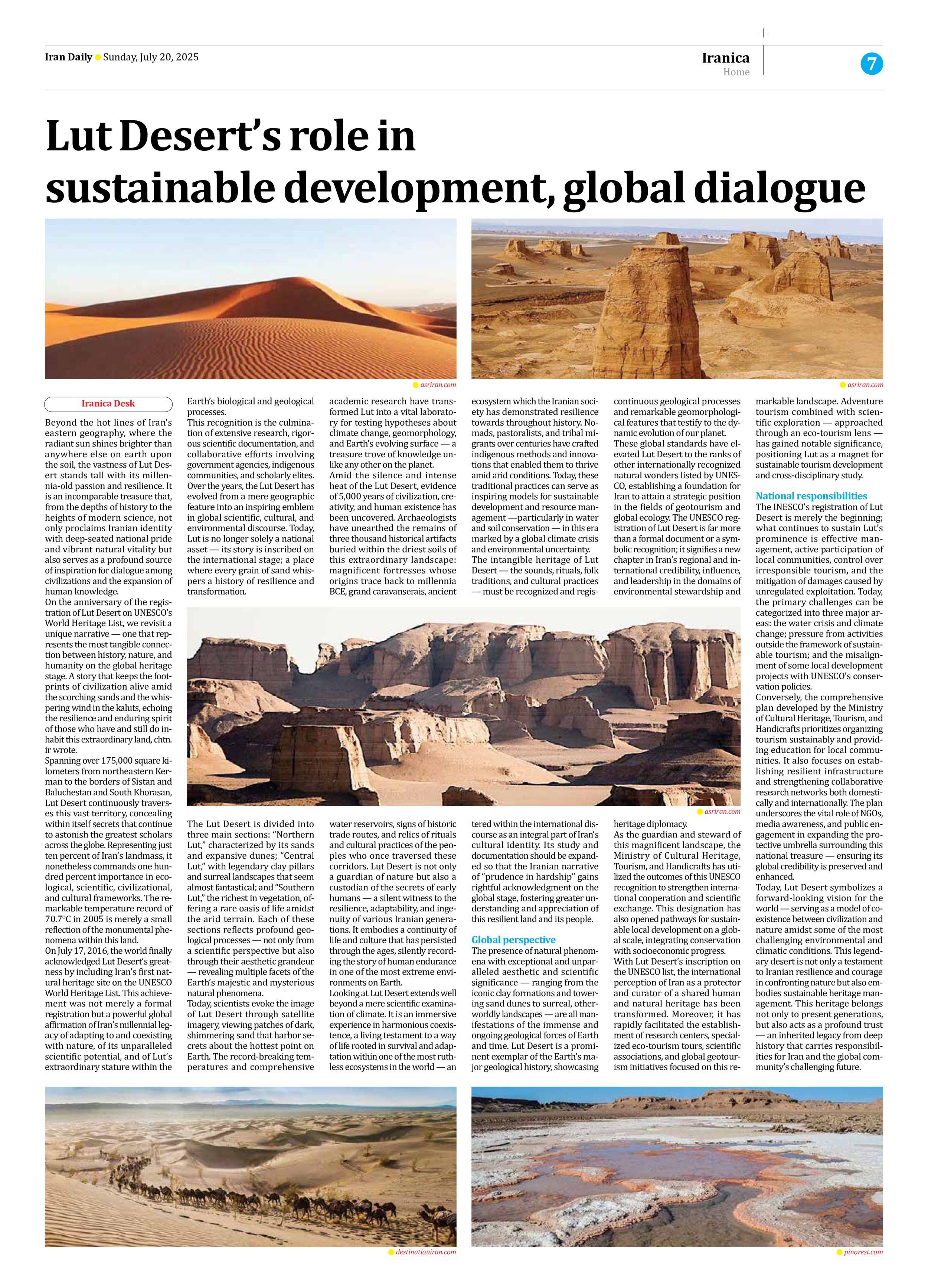
The Lut Desert is divided into three main sections: “Northern Lut,” characterized by its sands and expansive dunes; “Central Lut,” with legendary clay pillars and surreal landscapes that seem almost fantastical; and “Southern Lut,” the richest in vegetation, offering a rare oasis of life amidst the arid terrain. Each of these sections reflects profound geological processes — not only from a scientific perspective but also through their aesthetic grandeur — revealing multiple facets of the Earth’s majestic and mysterious natural phenomena.
Today, scientists evoke the image of Lut Desert through satellite imagery, viewing patches of dark, shimmering sand that harbor secrets about the hottest point on Earth. The record-breaking temperatures and comprehensive academic research have transformed Lut into a vital laboratory for testing hypotheses about climate change, geomorphology, and Earth’s evolving surface — a treasure trove of knowledge unlike any other on the planet.
Amid the silence and intense heat of the Lut Desert, evidence of 5,000 years of civilization, creativity, and human existence has been uncovered. Archaeologists have unearthed the remains of three thousand historical artifacts buried within the driest soils of this extraordinary landscape: magnificent fortresses whose origins trace back to millennia BCE, grand caravanserais, ancient water reservoirs, signs of historic trade routes, and relics of rituals and cultural practices of the peoples who once traversed these corridors. Lut Desert is not only a guardian of nature but also a custodian of the secrets of early humans — a silent witness to the resilience, adaptability, and ingenuity of various Iranian generations. It embodies a continuity of life and culture that has persisted through the ages, silently recording the story of human endurance in one of the most extreme environments on Earth.
Looking at Lut Desert extends well beyond a mere scientific examination of climate. It is an immersive experience in harmonious coexistence, a living testament to a way of life rooted in survival and adaptation within one of the most ruthless ecosystems in the world — an ecosystem which the Iranian society has demonstrated resilience towards throughout history. Nomads, pastoralists, and tribal migrants over centuries have crafted indigenous methods and innovations that enabled them to thrive amid arid conditions. Today, these traditional practices can serve as inspiring models for sustainable development and resource management —particularly in water and soil conservation — in this era marked by a global climate crisis and environmental uncertainty.
The intangible heritage of Lut Desert — the sounds, rituals, folk traditions, and cultural practices — must be recognized and registered within the international discourse as an integral part of Iran’s cultural identity. Its study and documentation should be expanded so that the Iranian narrative of “prudence in hardship” gains rightful acknowledgment on the global stage, fostering greater understanding and appreciation of this resilient land and its people.
Global perspective
The presence of natural phenomena with exceptional and unparalleled aesthetic and scientific significance — ranging from the iconic clay formations and towering sand dunes to surreal, otherworldly landscapes — are all manifestations of the immense and ongoing geological forces of Earth and time. Lut Desert is a prominent exemplar of the Earth’s major geological history, showcasing continuous geological processes and remarkable geomorphological features that testify to the dynamic evolution of our planet.
These global standards have elevated Lut Desert to the ranks of other internationally recognized natural wonders listed by UNESCO, establishing a foundation for Iran to attain a strategic position in the fields of geotourism and global ecology. The UNESCO registration of Lut Desert is far more than a formal document or a symbolic recognition; it signifies a new chapter in Iran’s regional and international credibility, influence, and leadership in the domains of environmental stewardship and heritage diplomacy.
As the guardian and steward of this magnificent landscape, the Ministry of Cultural Heritage, Tourism, and Handicrafts has utilized the outcomes of this UNESCO recognition to strengthen international cooperation and scientific exchange. This designation has also opened pathways for sustainable local development on a global scale, integrating conservation with socioeconomic progress.
With Lut Desert’s inscription on the UNESCO list, the international perception of Iran as a protector and curator of a shared human and natural heritage has been transformed. Moreover, it has rapidly facilitated the establishment of research centers, specialized eco-tourism tours, scientific associations, and global geotourism initiatives focused on this remarkable landscape. Adventure tourism combined with scientific exploration — approached through an eco-tourism lens — has gained notable significance, positioning Lut as a magnet for sustainable tourism development and cross-disciplinary study.
National responsibilities
The INESCO’s registration of Lut Desert is merely the beginning; what continues to sustain Lut’s prominence is effective management, active participation of local communities, control over irresponsible tourism, and the mitigation of damages caused by unregulated exploitation. Today, the primary challenges can be categorized into three major areas: the water crisis and climate change; pressure from activities outside the framework of sustainable tourism; and the misalignment of some local development projects with UNESCO’s conservation policies.
Conversely, the comprehensive plan developed by the Ministry of Cultural Heritage, Tourism, and Handicrafts prioritizes organizing tourism sustainably and providing education for local communities. It also focuses on establishing resilient infrastructure and strengthening collaborative research networks both domestically and internationally. The plan underscores the vital role of NGOs, media awareness, and public engagement in expanding the protective umbrella surrounding this national treasure — ensuring its global credibility is preserved and enhanced.
Today, Lut Desert symbolizes a forward-looking vision for the world — serving as a model of coexistence between civilization and nature amidst some of the most challenging environmental and climatic conditions. This legendary desert is not only a testament to Iranian resilience and courage in confronting nature but also embodies sustainable heritage management. This heritage belongs not only to present generations, but also acts as a profound trust — an inherited legacy from deep history that carries responsibilities for Iran and the global community’s challenging future.