







Sustainable waste models for local change
Turkey’s zero waste success inspires change
Waste management has turned into an environmental and social crisis in Iran, with 58,000 tons of waste being generated daily, 75% of which is buried in an unjustified manner. Meanwhile, the neighboring country of Turkey has successfully implemented the “Zero Waste” plan, setting an example for the world. According to Euronews, Mohammad Baqer Qalibaf, the speaker of the Iranian Parliament, recently stated in an open session of the parliament, “There are very simple issues with no financial or technological difficulties that have not been solved yet. Waste is one of them. If we cannot solve the waste problem, what can we solve?” Waste management in Iran has even received people’s complaints and police intervention. Recently, the inability to manage waste has taken on a strange form, with northern Iranian cities dumping their waste in the city of Damavand. This is while in 2024, Iran ranked 121st in the world in controlled waste management. The speaker of the Parliament further said that only the central city of Isfahan separates waste at the source, whereas in other parts of Iran, a crisis is unfolding. Meanwhile, the Turkish first lady has launched a movement, called “Zero Waste”, in her country since 2017. It was approved by the UN in early 2023, which even named March 30th after it.
Graveyard for waste
Speaker Qalibaf, who was once the mayor of the capital and responsible for Tehran’s waste management, once talked about generating electricity from waste incineration in Tehran during the presidential election campaign in 2017. However, such a project never saw the light of day and its true merits remained unknown.
The Agriculture, Water, Natural Resources, and Environment Committee of the Iranian Parliament has recently submitted a report on the status of waste management in the country. According to the report, the occupation of land for waste burial, water pollution due to leachate penetration, the production of greenhouse gases, and not using the resources for recycling cause annual damage of 1070 billion Rials to the environment, excluding the costs of treating diseases caused by improper waste disposal.
The report also expresses that 58,000 tons of waste are generated daily in Iran, 75% of which is buried in an unjustified manner. Shina Ansari, the vice president of Iran and the head of the Department of Environment (DoE), also said in the same parliamentary session where the report was presented that 93% of urban waste in Iran is disposed of in an unhygienic and piling manner.
She said that annually, nearly 21 million tons of ordinary waste, 150,000 tons of hospital waste, 35 million tons of industrial waste, 170 million tons of agricultural waste, 8 million tons of hazardous waste, and 150 million tons of construction waste are produced.
One of the largest landfills in Iran is in Aradkooh in southern Tehran, which has been cited several times as the source of bad smells that fill the road from the airport to Tehran. NASA published a report in October 2022, describing the Aradkooh region as one of the largest methane-producing areas in the Middle East. Dariush Golalizadeh, the head of the National Center for Air and Climate Change at the DoE, confirmed that the methane-emitting cloud in southern Tehran cannot be denied.
There is no transparent performance report available on the Aradkooh site, which is the largest and most important waste management site in Iran for hospital waste. However, the Aradkooh waste incineration site can seemingly only process 200 tons of Tehran’s waste, which is about 5% of the city’s 7,000 tons of waste. It is said that only some Iranian cities including Tehran, Nowshahr, Shiraz, and Mashhad have waste incineration facilities.
Temporary landfills become permanent
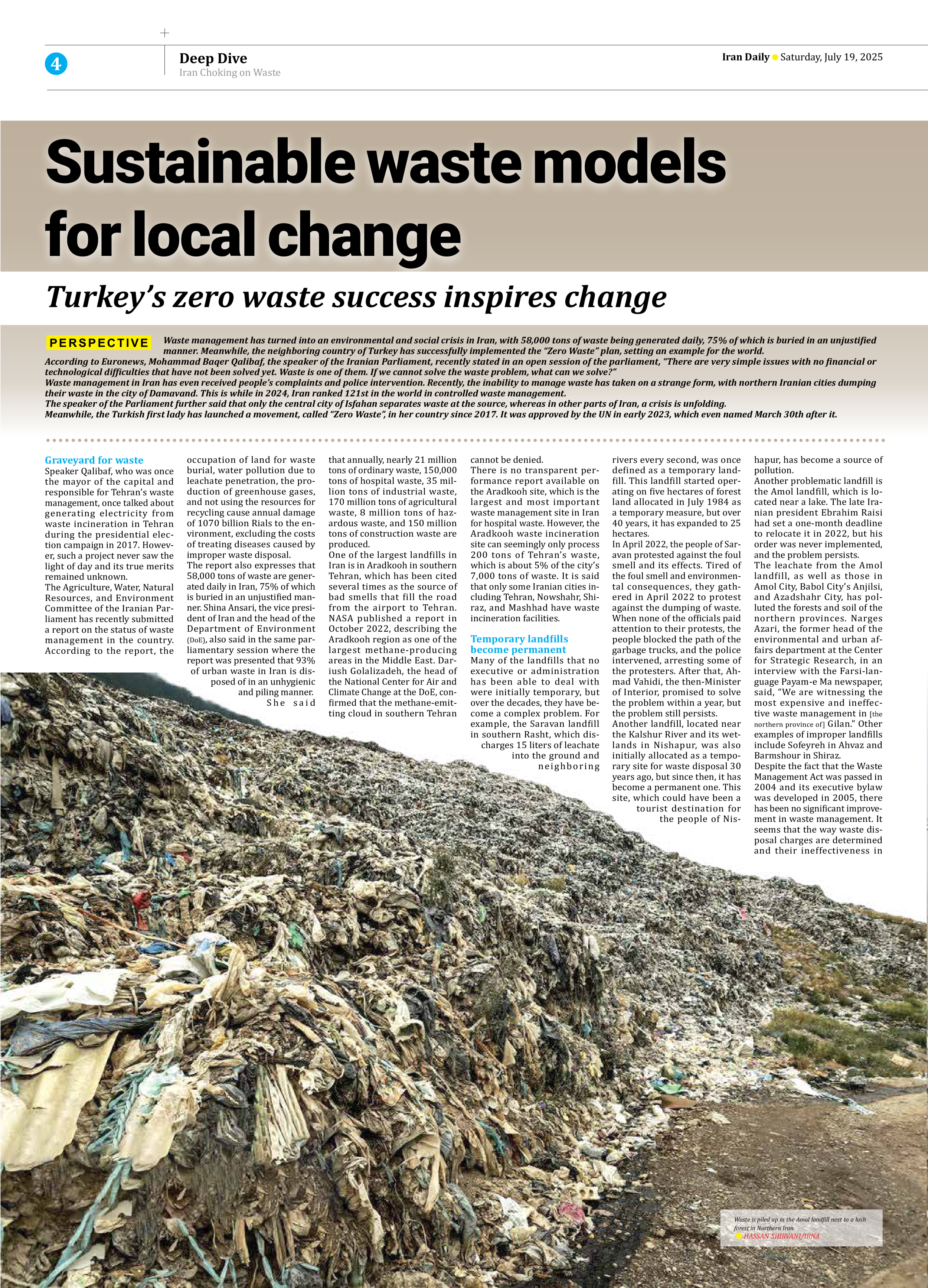
Many of the landfills that no executive or administration has been able to deal with were initially temporary, but over the decades, they have become a complex problem. For example, the Saravan landfill in southern Rasht, which discharges 15 liters of leachate into the ground and neighboring rivers every second, was once defined as a temporary landfill. This landfill started operating on five hectares of forest land allocated in July 1984 as a temporary measure, but over 40 years, it has expanded to 25 hectares.
In April 2022, the people of Saravan protested against the foul smell and its effects. Tired of the foul smell and environmental consequences, they gathered in April 2022 to protest against the dumping of waste. When none of the officials paid attention to their protests, the people blocked the path of the garbage trucks, and the police intervened, arresting some of the protesters. After that, Ahmad Vahidi, the then-Minister of Interior, promised to solve the problem within a year, but the problem still persists.
Another landfill, located near the Kalshur River and its wetlands in Nishapur, was also initially allocated as a temporary site for waste disposal 30 years ago, but since then, it has become a permanent one. This site, which could have been a tourist destination for the people of Nishapur, has become a source of pollution.
Another problematic landfill is the Amol landfill, which is located near a lake. The late Iranian president Ebrahim Raisi had set a one-month deadline to relocate it in 2022, but his order was never implemented, and the problem persists.
The leachate from the Amol landfill, as well as those in Amol City, Babol City’s Anjilsi, and Azadshahr City, has polluted the forests and soil of the northern provinces. Narges Azari, the former head of the environmental and urban affairs department at the Center for Strategic Research, in an interview with the Farsi-language Payam-e Ma newspaper, said, “We are witnessing the most expensive and ineffective waste management in [the northern province of] Gilan.” Other examples of improper landfills include Sofeyreh in Ahvaz and Barmshour in Shiraz.
Despite the fact that the Waste Management Act was passed in 2004 and its executive bylaw was developed in 2005, there has been no significant improvement in waste management. It seems that the way waste disposal charges are determined and their ineffectiveness in changing people’s behavior prevents the source separation of waste.
In the meantime, municipalities and city council members often refer to the “waste mafia” and waste pickers as the cause of chaos in this field. According to a recent parliamentary report, there are an estimated 14,000 waste pickers in Tehran alone, 4,700 of whom are children, and many of them are Afghan migrants.
Secret dumping,
landfill accidents
Before the recent parliamentary session and the reading of the waste report, Damavand city’s Environment Department announced the discovery of waste that had been dumped by six trucks from northern cities and left on the outskirts of Damavand.
This approach to waste management has caused accidents, too. For example, in June 2013, a landslide at the Barmshour landfill in Shiraz killed seven people. The incident occurred when firefighters were trying to put out a fire at the landfill, and the garbage mound suddenly collapsed, burying 12 firefighters and municipality employees under it. Rescuers managed to save five people, but seven others died.
Turkey’s zero-waste experience
Although Iran has had some positive experiences in waste recycling and management, it still lags far behind its neighbor, Turkey. For example, Hayedeh Shirzadi, an Iranian environmental entrepreneur, started a waste recycling company in Kermanshah in 1996, but due to obstruction by the Kermanshah municipality, she was unable to launch it until 1998. Her story shows the extent of the waste management problem in Iran.
In neighboring Turkey, Emine Erdogan, the wife of the president, has been promoting the “Zero Waste” idea since 2017, which has not only improved waste management in Turkey but also prompted the UN to mark March 30th as “Zero Waste Day”. The plan was first implemented among the military and presidential staff. It eventually found its way among the people of Turkey and became a cultural phenomenon.
Interestingly, Turkey, with its global greenhouse gas emissions of 1 percent, was one of the few countries that did not join the Paris Agreement until 2021, along with Iran, Eritrea, Iraq, Libya, and Yemen. However, in 2021, the Turkish Parliament approved the agreement. Now, by successfully implementing its “Zero Waste” plan, Turkey has shown a different side of itself to the world.
In Iran, however, not only are city and government officials unable to manage waste, but there is also no social movement among the people to address the issue. Perhaps Turkey’s “Zero Waste” experience can be a lesson, as it has prompted cashiers to ask customers whether they want a plastic bag, instead of assuming that they do. The same phenomenon has already happened in European chain stores as well.
Moreover, advertisements on plastic bags in Europe and Turkey promote waste reduction, whereas in Iran, chain stores give away plastic bags for free, and the bags only advertise the store’s logo, with no mention of waste management or reduction.
On the other hand, a look at civil activities in Iran shows that not only has no similar movement emerged to improve waste management in Iranian cities, but even campaigns that have been launched to pressure city management to change its waste management policies have been ineffective. For example, a campaign was launched in Ahvaz in 2021 and 2022 to force the municipality to pay attention to waste management, but it yielded no results.
The mayor of Ahvaz, who took office in 2021, removed all waste collection contractors under the pretext of fighting corruption, despite the fact that the city lacks sufficient waste bins. Although the people of Ahvaz protested against the lack of waste bins from January 2022 to June 2022, there was no change in the city’s waste management or an increase in the number of waste bins.
The article first appeared in
Persian on Salamat News.