







From sanctioning of Francesca Albanese to US’s violations of int’l law
Is it time to move UN headquarters?
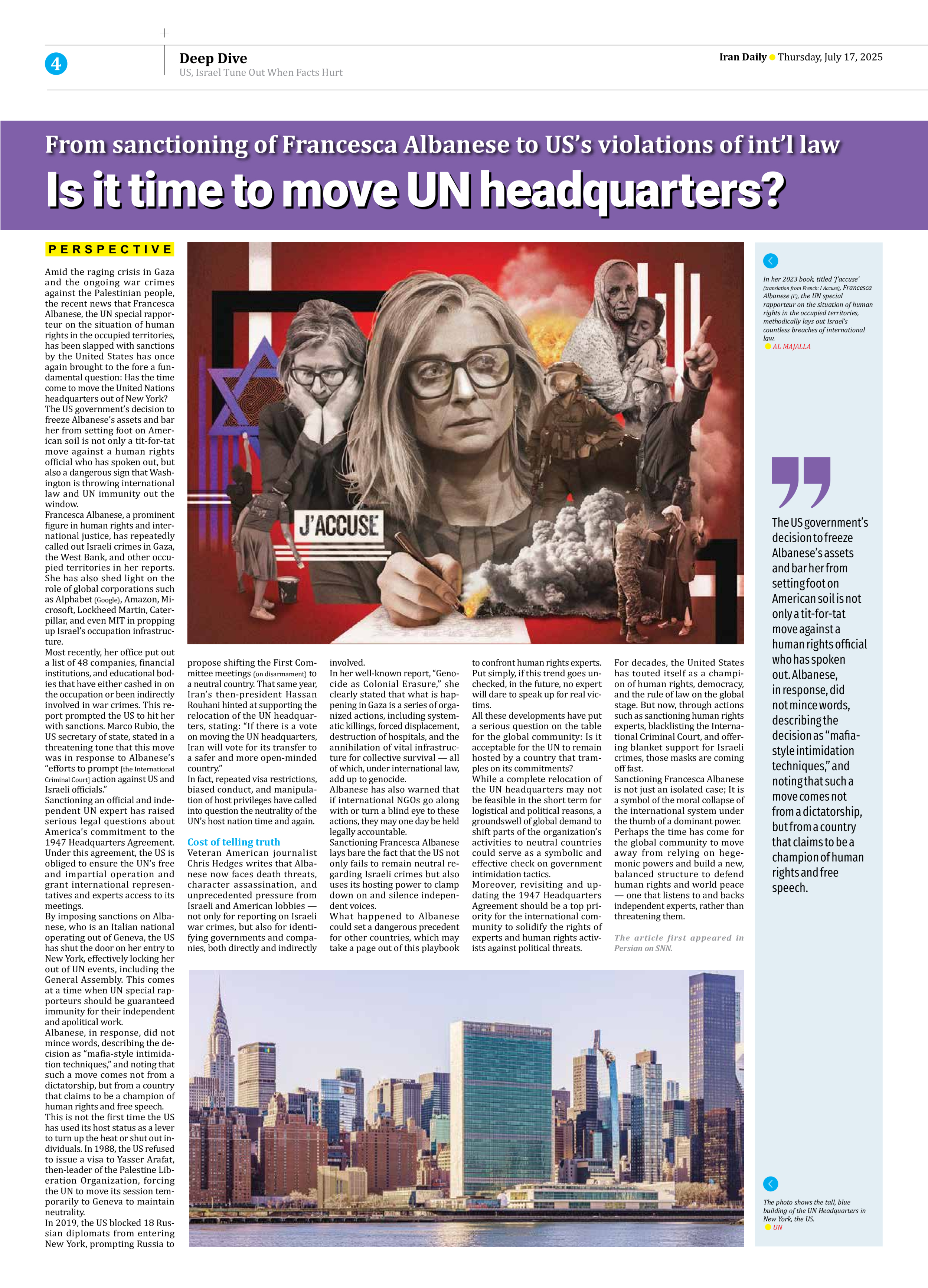
Amid the raging crisis in Gaza and the ongoing war crimes against the Palestinian people, the recent news that Francesca Albanese, the UN special rapporteur on the situation of human rights in the occupied territories, has been slapped with sanctions by the United States has once again brought to the fore a fundamental question: Has the time come to move the United Nations headquarters out of New York?
The US government’s decision to freeze Albanese’s assets and bar her from setting foot on American soil is not only a tit-for-tat move against a human rights official who has spoken out, but also a dangerous sign that Washington is throwing international law and UN immunity out the window.
Francesca Albanese, a prominent figure in human rights and international justice, has repeatedly called out Israeli crimes in Gaza, the West Bank, and other occupied territories in her reports. She has also shed light on the role of global corporations such as Alphabet (Google), Amazon, Microsoft, Lockheed Martin, Caterpillar, and even MIT in propping up Israel’s occupation infrastructure.
Most recently, her office put out a list of 48 companies, financial institutions, and educational bodies that have either cashed in on the occupation or been indirectly involved in war crimes. This report prompted the US to hit her with sanctions. Marco Rubio, the US secretary of state, stated in a threatening tone that this move was in response to Albanese’s “efforts to prompt [the International Criminal Court] action against US and Israeli officials.”
Sanctioning an official and independent UN expert has raised serious legal questions about America’s commitment to the 1947 Headquarters Agreement. Under this agreement, the US is obliged to ensure the UN’s free and impartial operation and grant international representatives and experts access to its meetings.
By imposing sanctions on Albanese, who is an Italian national operating out of Geneva, the US has shut the door on her entry to New York, effectively locking her out of UN events, including the General Assembly. This comes at a time when UN special rapporteurs should be guaranteed immunity for their independent and apolitical work.
Albanese, in response, did not mince words, describing the decision as “mafia-style intimidation techniques,” and noting that such a move comes not from a dictatorship, but from a country that claims to be a champion of human rights and free speech.
This is not the first time the US has used its host status as a lever to turn up the heat or shut out individuals. In 1988, the US refused to issue a visa to Yasser Arafat, then-leader of the Palestine Liberation Organization, forcing the UN to move its session temporarily to Geneva to maintain neutrality.
In 2019, the US blocked 18 Russian diplomats from entering New York, prompting Russia to propose shifting the First Committee meetings (on disarmament) to a neutral country. That same year, Iran’s then-president Hassan Rouhani hinted at supporting the relocation of the UN headquarters, stating: “If there is a vote on moving the UN headquarters, Iran will vote for its transfer to a safer and more open-minded country.”
In fact, repeated visa restrictions, biased conduct, and manipulation of host privileges have called into question the neutrality of the UN’s host nation time and again.
Cost of telling truth
Veteran American journalist Chris Hedges writes that Albanese now faces death threats, character assassination, and unprecedented pressure from Israeli and American lobbies — not only for reporting on Israeli war crimes, but also for identifying governments and companies, both directly and indirectly involved.
In her well-known report, “Genocide as Colonial Erasure,” she clearly stated that what is happening in Gaza is a series of organized actions, including systematic killings, forced displacement, destruction of hospitals, and the annihilation of vital infrastructure for collective survival — all of which, under international law, add up to genocide.
Albanese has also warned that if international NGOs go along with or turn a blind eye to these actions, they may one day be held legally accountable.
Sanctioning Francesca Albanese lays bare the fact that the US not only fails to remain neutral regarding Israeli crimes but also uses its hosting power to clamp down on and silence independent voices.
What happened to Albanese could set a dangerous precedent for other countries, which may take a page out of this playbook to confront human rights experts. Put simply, if this trend goes unchecked, in the future, no expert will dare to speak up for real victims.
All these developments have put a serious question on the table for the global community: Is it acceptable for the UN to remain hosted by a country that tramples on its commitments?
While a complete relocation of the UN headquarters may not be feasible in the short term for logistical and political reasons, a groundswell of global demand to shift parts of the organization’s activities to neutral countries could serve as a symbolic and effective check on government intimidation tactics.
Moreover, revisiting and updating the 1947 Headquarters Agreement should be a top priority for the international community to solidify the rights of experts and human rights activists against political threats.
For decades, the United States has touted itself as a champion of human rights, democracy, and the rule of law on the global stage. But now, through actions such as sanctioning human rights experts, blacklisting the International Criminal Court, and offering blanket support for Israeli crimes, those masks are coming off fast.
Sanctioning Francesca Albanese is not just an isolated case; It is a symbol of the moral collapse of the international system under the thumb of a dominant power.
Perhaps the time has come for the global community to move away from relying on hegemonic powers and build a new, balanced structure to defend human rights and world peace — one that listens to and backs independent experts, rather than threatening them.
The article first appeared in
Persian on SNN.