







Three wastewater treatment projects launched in Tehran
Dams in capital plunge to 14% amid worst drought in 60 years
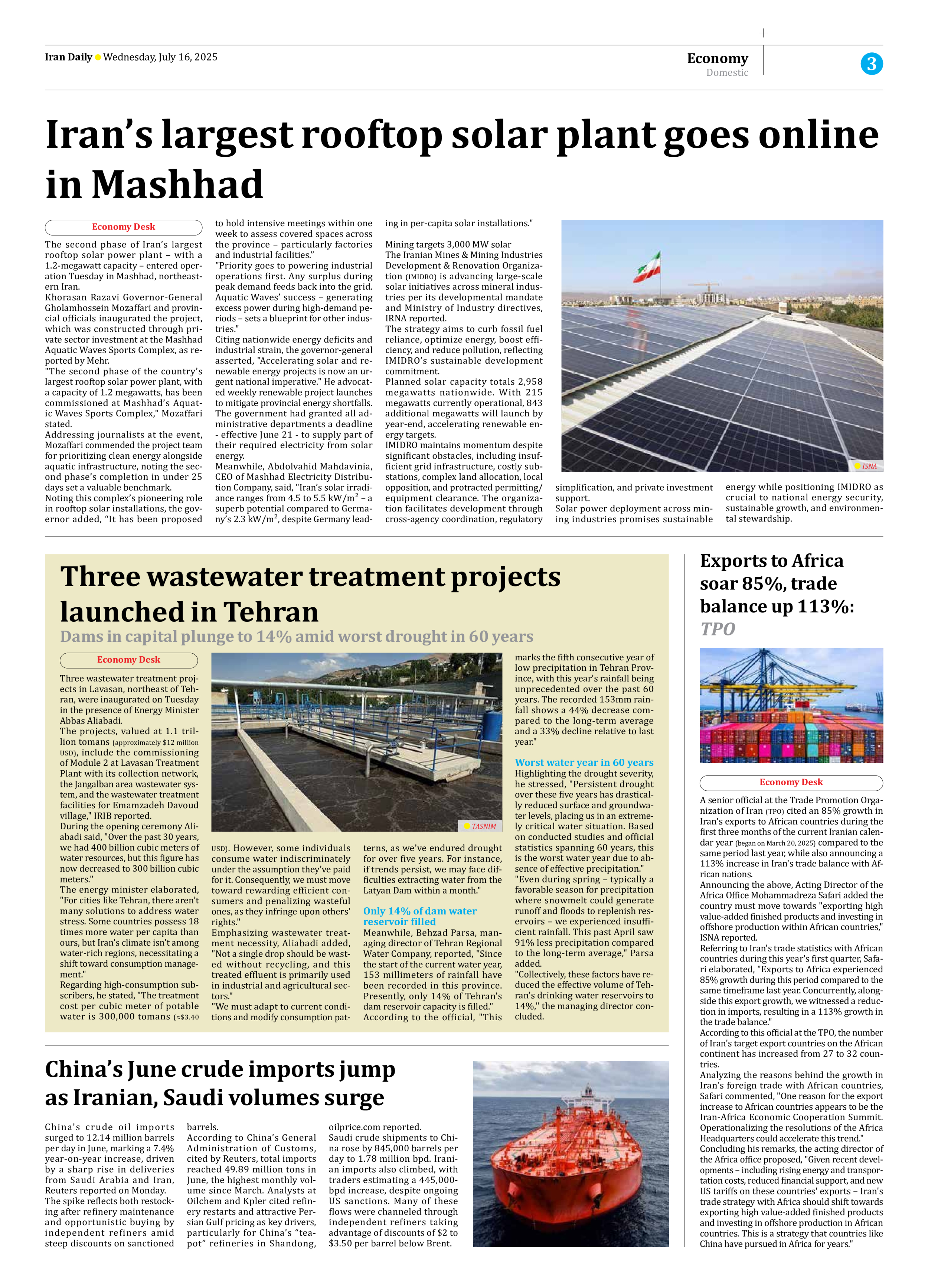
Three wastewater treatment projects in Lavasan, northeast of Tehran, were inaugurated on Tuesday in the presence of Energy Minister Abbas Aliabadi.
The projects, valued at 1.1 trillion tomans (approximately $12 million USD), include the commissioning of Module 2 at Lavasan Treatment Plant with its collection network, the Jangalban area wastewater system, and the wastewater treatment facilities for Emamzadeh Davoud village," IRIB reported.
During the opening ceremony Aliabadi said, "Over the past 30 years, we had 400 billion cubic meters of water resources, but this figure has now decreased to 300 billion cubic meters."
The energy minister elaborated, "For cities like Tehran, there aren’t many solutions to address water stress. Some countries possess 18 times more water per capita than ours, but Iran’s climate isn’t among water-rich regions, necessitating a shift toward consumption management."
Regarding high-consumption subscribers, he stated, "The treatment cost per cubic meter of potable water is 300,000 tomans (≈$3.40 USD). However, some individuals consume water indiscriminately under the assumption they’ve paid for it. Consequently, we must move toward rewarding efficient consumers and penalizing wasteful ones, as they infringe upon others' rights."
Emphasizing wastewater treatment necessity, Aliabadi added, "Not a single drop should be wasted without recycling, and this treated effluent is primarily used in industrial and agricultural sectors."
"We must adapt to current conditions and modify consumption patterns, as we’ve endured drought for over five years. For instance, if trends persist, we may face difficulties extracting water from the Latyan Dam within a month."
Only 14% of dam water reservoir filled
Meanwhile, Behzad Parsa, managing director of Tehran Regional Water Company, reported, "Since the start of the current water year, 153 millimeters of rainfall have been recorded in this province. Presently, only 14% of Tehran’s dam reservoir capacity is filled."
According to the official, "This marks the fifth consecutive year of low precipitation in Tehran Province, with this year’s rainfall being unprecedented over the past 60 years. The recorded 153mm rainfall shows a 44% decrease compared to the long-term average and a 33% decline relative to last year."
Worst water year in 60 years
Highlighting the drought severity, he stressed, "Persistent drought over these five years has drastically reduced surface and groundwater levels, placing us in an extremely critical water situation. Based on conducted studies and official statistics spanning 60 years, this is the worst water year due to absence of effective precipitation."
"Even during spring – typically a favorable season for precipitation where snowmelt could generate runoff and floods to replenish reservoirs – we experienced insufficient rainfall. This past April saw 91% less precipitation compared to the long-term average," Parsa added.
"Collectively, these factors have reduced the effective volume of Tehran’s drinking water reservoirs to 14%," the managing director concluded.