







Iran’s doctrine rules out nuclear weapons: MP
Negotiation marks ‘endgame of any conflict’
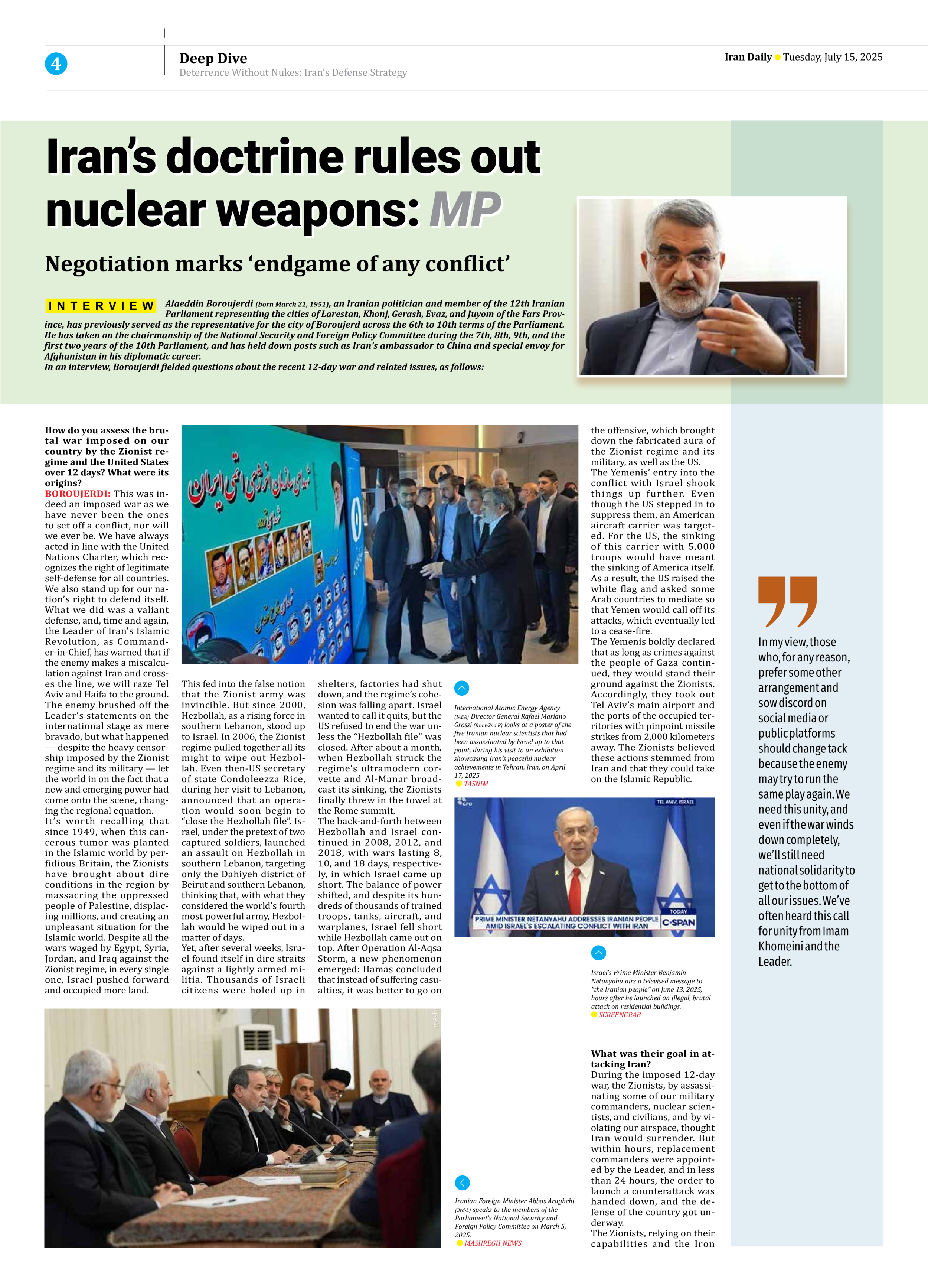
Alaeddin Boroujerdi (born March 21, 1951), an Iranian politician and member of the 12th Iranian Parliament representing the cities of Larestan, Khonj, Gerash, Evaz, and Juyom of the Fars Province, has previously served as the representative for the city of Boroujerd across the 6th to 10th terms of the Parliament. He has taken on the chairmanship of the National Security and Foreign Policy Committee during the 7th, 8th, 9th, and the first two years of the 10th Parliament, and has held down posts such as Iran’s ambassador to China and special envoy for Afghanistan in his diplomatic career. In an interview, Boroujerdi fielded questions about the recent 12-day war and related issues, as follows:
How do you assess the brutal war imposed on our country by the Zionist regime and the United States over 12 days? What were its origins?
BOROUJERDI: This was indeed an imposed war as we have never been the ones to set off a conflict, nor will we ever be. We have always acted in line with the United Nations Charter, which recognizes the right of legitimate self-defense for all countries. We also stand up for our nation’s right to defend itself. What we did was a valiant defense, and, time and again, the Leader of Iran’s Islamic Revolution, as Commander-in-Chief, has warned that if the enemy makes a miscalculation against Iran and crosses the line, we will raze Tel Aviv and Haifa to the ground. The enemy brushed off the Leader’s statements on the international stage as mere bravado, but what happened — despite the heavy censorship imposed by the Zionist regime and its military — let the world in on the fact that a new and emerging power had come onto the scene, changing the regional equation.
It’s worth recalling that since 1949, when this cancerous tumor was planted in the Islamic world by perfidious Britain, the Zionists have brought about dire conditions in the region by massacring the oppressed people of Palestine, displacing millions, and creating an unpleasant situation for the Islamic world. Despite all the wars waged by Egypt, Syria, Jordan, and Iraq against the Zionist regime, in every single one, Israel pushed forward and occupied more land.
This fed into the false notion that the Zionist army was invincible. But since 2000, Hezbollah, as a rising force in southern Lebanon, stood up to Israel. In 2006, the Zionist regime pulled together all its might to wipe out Hezbollah. Even then-US secretary of state Condoleezza Rice, during her visit to Lebanon, announced that an operation would soon begin to “close the Hezbollah file”. Israel, under the pretext of two captured soldiers, launched an assault on Hezbollah in southern Lebanon, targeting only the Dahiyeh district of Beirut and southern Lebanon, thinking that, with what they considered the world’s fourth most powerful army, Hezbollah would be wiped out in a matter of days.
Yet, after several weeks, Israel found itself in dire straits against a lightly armed militia. Thousands of Israeli citizens were holed up in shelters, factories had shut down, and the regime’s cohesion was falling apart. Israel wanted to call it quits, but the US refused to end the war unless the “Hezbollah file” was closed. After about a month, when Hezbollah struck the regime’s ultramodern corvette and Al-Manar broadcast its sinking, the Zionists finally threw in the towel at the Rome summit.
The back-and-forth between Hezbollah and Israel continued in 2008, 2012, and 2018, with wars lasting 8, 10, and 18 days, respectively, in which Israel came up short. The balance of power shifted, and despite its hundreds of thousands of trained troops, tanks, aircraft, and warplanes, Israel fell short while Hezbollah came out on top. After Operation Al-Aqsa Storm, a new phenomenon emerged: Hamas concluded that instead of suffering casualties, it was better to go on the offensive, which brought down the fabricated aura of the Zionist regime and its military, as well as the US.
The Yemenis’ entry into the conflict with Israel shook things up further. Even though the US stepped in to suppress them, an American aircraft carrier was targeted. For the US, the sinking of this carrier with 5,000 troops would have meant the sinking of America itself. As a result, the US raised the white flag and asked some Arab countries to mediate so that Yemen would call off its attacks, which eventually led to a cease-fire.
The Yemenis boldly declared that as long as crimes against the people of Gaza continued, they would stand their ground against the Zionists. Accordingly, they took out Tel Aviv’s main airport and the ports of the occupied territories with pinpoint missile strikes from 2,000 kilometers away. The Zionists believed these actions stemmed from Iran and that they could take on the Islamic Republic.
What was their goal in attacking Iran?
During the imposed 12-day war, the Zionists, by assassinating some of our military commanders, nuclear scientists, and civilians, and by violating our airspace, thought Iran would surrender. But within hours, replacement commanders were appointed by the Leader, and in less than 24 hours, the order to launch a counterattack was handed down, and the defense of the country got underway.
The Zionists, relying on their capabilities and the Iron Dome — on par with NATO’s assets — expected victory. But by the eighth day, Israel saw the writing on the wall and called on the US to weigh in. The US targeted three of Iran’s nuclear facilities. In response, Iran, with remarkable courage, struck back at America’s base in Qatar, launching six 400-ton missiles at al-Udeid, the largest US airbase in the region. This forced Trump’s hand to use Qatar as a go-between to broker a cease-fire. In other words, it was they who pushed for a cease-fire and an end to the war. Since Iran’s policy has never been warmongering, it was decided to halt the conflict. However, the aftershocks of Iran’s military operations, despite the Zionist regime’s tight censorship, are starting to make headlines.
It must be noted that, unlike their adversaries, who zeroed in on blind spots like Gaza, Iran’s missiles, with pinpoint accuracy and after breaking through several layers of enemy defense, hit military targets directly — a major point of pride for Iran that brought down the aura of the Zionist regime. Of course, this war also brought to light some of our own weaknesses. Unlike during the eight-year war, when we had nothing to fall back on against Saddam’s missiles, today we stand among the world’s top five producers of missiles and drones. On this basis, beefing up defensive systems, plugging intelligence gaps to keep out enemy infiltration, and acquiring advanced fighter jets will put our armed forces in a position to tip the balance of power in the region, so the enemy won’t even dare entertain the idea of attacking Iran.
During the 12-day war, even the overseas opposition rallied around the nation and the Islamic Establishment, shooting down the enemy’s hopes of stirring up unrest. What’s your take on this?
I believe a crucial link in the chain of miscalculations came into play through the Zionist regime. Netanyahu himself even uttered a few sentences in Persian, saying, “We’ve done our part, now it’s your turn, people of Iran.” But the Iranian people are truly courageous, honorable, and astute; At critical junctures, they set aside all political and social differences and, both inside and outside the country — even those who were imprisoned for various reasons — banded together in a unified front to defend the nation. This unity crossed out the enemy’s calculations, and one must truly commend this nation; The government and other officials should appreciate the people.
While some economic and livelihood challenges remain, as the Leader has pointed out, the Iranian people are composed, brave, and discerning, which has raised our national standing in the world’s eyes. The enemy thought that by targeting some of our military commanders, the fabric of the Islamic Establishment would come apart at the seams, and something major would break out for them. But thanks to the Leader’s foresight, the command vacuum was filled in no time, the people stepped up, and something monumental happened — unity and cohesion will remain a key deterrent in the future.
What do you suggest for preserving and strengthening this national cohesion?
In my view, those who, for any reason, prefer some other arrangement and sow discord on social media or public platforms should change tack because the enemy may try to run the same play again. We need this unity, and even if the war winds down completely, we’ll still need national solidarity to get to the bottom of all our issues. We’ve often heard this call for unity from Imam Khomeini and the Leader.
How can the link between negotiation and action in the field pave the way for Iran’s success in potentially upcoming talks?
The 12-day imposed war turned the tables politically worldwide. For the first time, the Arab League, in a joint decision and statement, strongly condemned the Zionist regime’s actions and declared support for Iran. Similarly, foreign ministers of Islamic countries, major parties like the Muslim Brotherhood, Al-Azhar University, and public opinion in Europe and America came out against Israel’s actions toward Iran and Gaza, which is highly significant.
Naturally, the endgame of any military conflict is negotiation. Iran, after the eight-year war with Saddam’s regime — backed by about 80 countries — sat down at the table for two years. At the time, there was pressure that the Arvand River should go to Iraq. Some inside the country believed Saddam was crazy and would attack again, but in the end, peace had to be accepted. Dr. Velayati (then foreign minister) said he would not sign a treacherous document that would compromise our territorial integrity, and ultimately, Imam Khomeini signed off on Velayati’s approach.
Today, we are undoubtedly in a position of strength, and the other side knows only a fraction of our capabilities was brought to bear in the 12-day war. Even the German foreign minister, during a visit to Tel Aviv, admitted that the casualty figures announced by Israel do not match the scale of destruction in Tel Aviv and Haifa — since one-third of the fake capital of the regime was destroyed, making them feel the pain of Gaza and Lebanon.
If negotiations are to happen, they must be conducted with authority; the Supreme National Security Council calls the shots, and the foreign minister is the executor. Criticism of Dr. Araghchi, the foreign minister, on social media is misplaced; These decisions are made at the highest level, with top military and intelligence officials present. In negotiations, we must set the terms, not the other way around — otherwise, talks will be pointless.
Recently, Trump claimed that if Iran falls in line like Syria, he would lift sanctions. In my view, Trump needs a team of top psychologists and psychiatrists to sort him out. During Trump’s first term, we met with the martyred Sayyed Hassan Nasrallah, who said he hoped Trump would win, because “Trump’s presidency would speed up America’s downfall.” For example, these days, we see Elon Musk — once Trump’s close ally and a big reason for his election — falling out with him and seeking a new party, showing deep cracks in America’s own ranks.
How was the response of international bodies to Israel’s attack on Iran, and how might the Iranian Parliament’s plan to suspend cooperation with the IAEA shake up international approaches?
One of the UN Security Council’s official duties is to safeguard global security, but when a country is attacked, the UN looks the other way. Even when our nuclear facilities were hit, the IAEA, whose clear duty is to condemn such actions quickly, kept mum, showing that Grossi, the IAEA chief, is merely a puppet.
Over the past two decades, under both ElBaradei and Amano, multiple inspection teams came over to Iran and reported to the Board of Governors on our peaceful nuclear activities. Yet, Grossi put out a completely false report, leading the Board to issue a resolution that gave Israel a pretext to kick off military operations against Iran.
In my view, Grossi also betrayed the Agency severely, and the IAEA’s credibility and reputation went down the drain with this false report. However, we moved quickly in the Parliament to call off all cooperation with the International Atomic Energy Agency. As a result, IAEA inspectors were shown the door, and all of the country’s nuclear activities now carry on out of sight of the Agency’s inspectors.
Of course, Iran’s commitment to forgoing nuclear weapons is serious, and, according to the military doctrine of the Islamic Republic and the Leader’s fatwa, building a nuclear bomb has no place. The global experience — especially the bitter memory in public opinion of the criminal America’s use of atomic bombs against Japan in World War II — serves as a lesson. Nevertheless, we will certainly press ahead with peaceful nuclear activities.
How do you assess the government’s performance during the 12-day war?
Despite the criticisms leveled, the Pezeshkian government did what it took. Some people may not sign off on certain government actions as they expect officials to stand their ground firmly against their counterparts. Still, Iran today holds all the cards, and our strength should be visible in every dialogue and negotiation with other countries.
Iran’s policy and the Islamic Establishment’s approach are to build up strong relations with its neighbors, and the government is pushing ahead with this policy in earnest. In my view, during the 12-day war, the government pulled out all the stops. For the enemy, it makes no difference who is in charge; Their only aim is to target Iranian officials. The reason the Zionists have assassinated our nuclear scientists is that they want to keep knowledge under wraps. But since we have renounced nuclear weapons, we must ramp up our conventional military capabilities for deterrence — and we will. The Iranian people can rest assured that the armed forces will showcase this power, just as they did in the 12-day war.
The interview first appeared in Persian on IRNA.