







Copy in clipboard...
German pres. blames US JCPOA withdrawal for current tensions on Iran’s nuclear issue
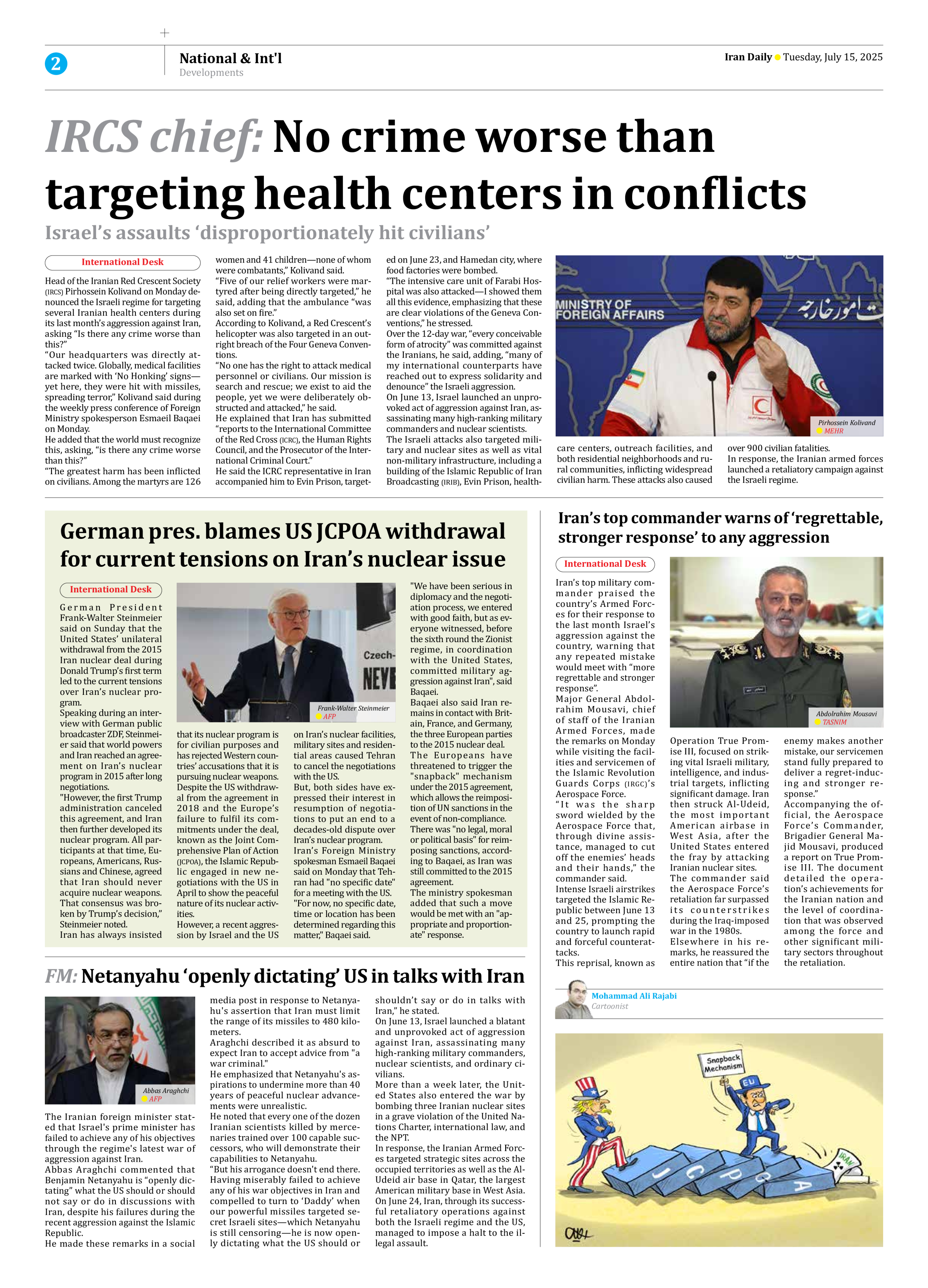
German President Frank-Walter Steinmeier said on Sunday that the United States’ unilateral withdrawal from the 2015 Iran nuclear deal during Donald Trump’s first term led to the current tensions over Iran’s nuclear program.
Speaking during an interview with German public broadcaster ZDF, Steinmeier said that world powers and Iran reached an agreement on Iran’s nuclear program in 2015 after long negotiations.
"However, the first Trump administration canceled this agreement, and Iran then further developed its nuclear program. All participants at that time, Europeans, Americans, Russians and Chinese, agreed that Iran should never acquire nuclear weapons. That consensus was broken by Trump’s decision,” Steinmeier noted.
Iran has always insisted that its nuclear program is for civilian purposes and has rejected Western countries’ accusations that it is pursuing nuclear weapons.
Despite the US withdrawal from the agreement in 2018 and the Europe’s failure to fulfil its commitments under the deal, known as the Joint Comprehensive Plan of Action (JCPOA), the Islamic Republic engaged in new negotiations with the US in April to show the peaceful nature of its nuclear activities.
However, a recent aggression by Israel and the US on Iran’s nuclear facilities, military sites and residential areas caused Tehran to cancel the negotiations with the US.
But, both sides have expressed their interest in resumption of negotiations to put an end to a decades-old dispute over Iran’s nuclear program.
Iran’s Foreign Ministry spokesman Esmaeil Baqaei said on Monday that Tehran had "no specific date" for a meeting with the US.
"For now, no specific date, time or location has been determined regarding this matter," Baqaei said.
"We have been serious in diplomacy and the negotiation process, we entered with good faith, but as everyone witnessed, before the sixth round the Zionist regime, in coordination with the United States, committed military aggression against Iran", said Baqaei.
Baqaei also said Iran remains in contact with Britain, France, and Germany, the three European parties to the 2015 nuclear deal.
The Europeans have threatened to trigger the "snapback" mechanism under the 2015 agreement, which allows the reimposition of UN sanctions in the event of non-compliance.
There was "no legal, moral or political basis" for reimposing sanctions, according to Baqaei, as Iran was still committed to the 2015 agreement.
The ministry spokesman added that such a move would be met with an "appropriate and proportionate" response.