







Copy in clipboard...
Tehran faces worst drought in six decades, minister warns
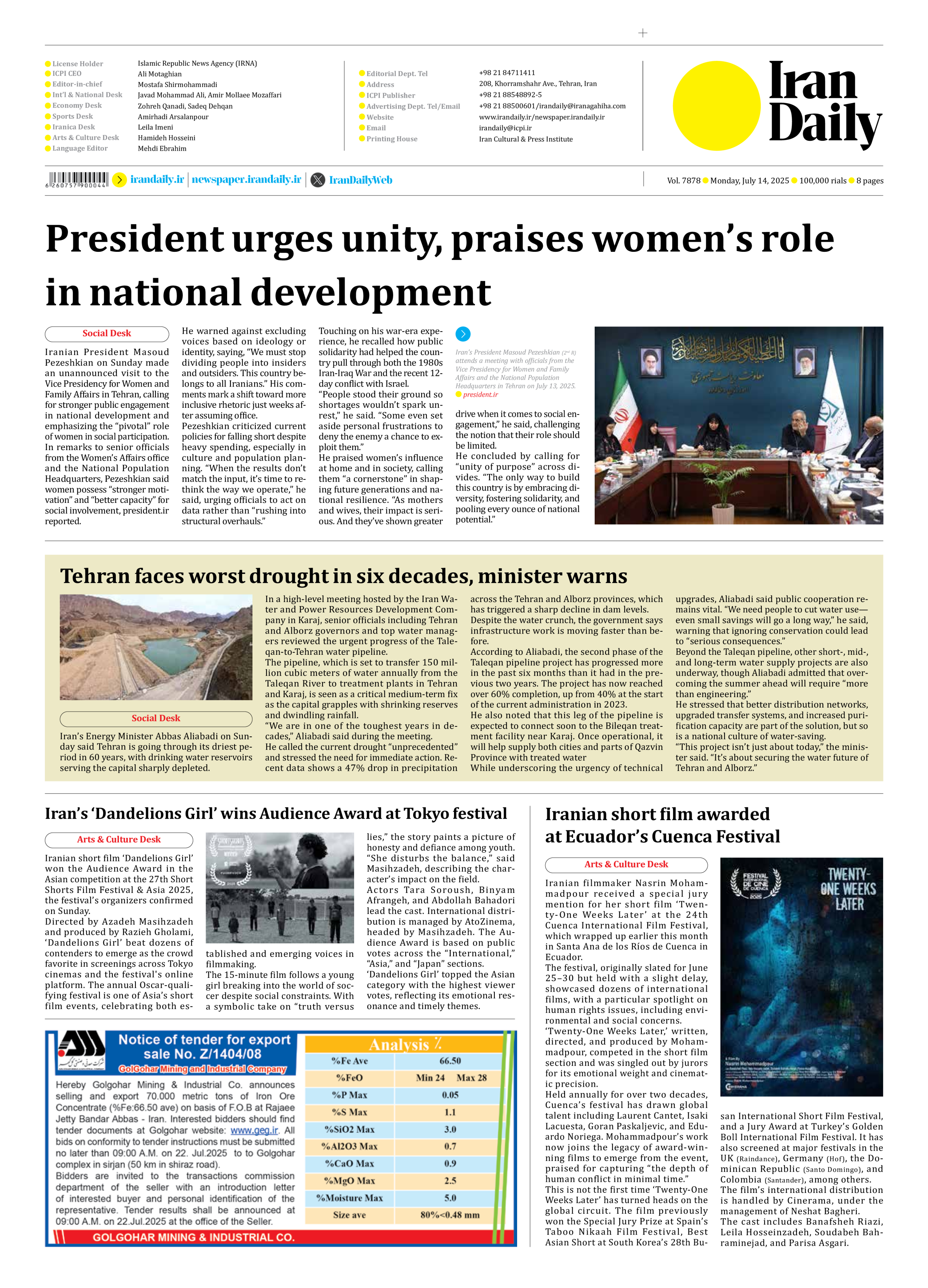
Iran’s Energy Minister Abbas Aliabadi on Sunday said Tehran is going through its driest period in 60 years, with drinking water reservoirs serving the capital sharply depleted.
In a high-level meeting hosted by the Iran Water and Power Resources Development Company in Karaj, senior officials including Tehran and Alborz governors and top water managers reviewed the urgent progress of the Taleqan-to-Tehran water pipeline.
The pipeline, which is set to transfer 150 million cubic meters of water annually from the Taleqan River to treatment plants in Tehran and Karaj, is seen as a critical medium-term fix as the capital grapples with shrinking reserves and dwindling rainfall.
“We are in one of the toughest years in decades,” Aliabadi said during the meeting.
He called the current drought “unprecedented” and stressed the need for immediate action. Recent data shows a 47% drop in precipitation across the Tehran and Alborz provinces, which has triggered a sharp decline in dam levels.
Despite the water crunch, the government says infrastructure work is moving faster than before.
According to Aliabadi, the second phase of the Taleqan pipeline project has progressed more in the past six months than it had in the previous two years. The project has now reached over 60% completion, up from 40% at the start of the current administration in 2023.
He also noted that this leg of the pipeline is expected to connect soon to the Bileqan treatment facility near Karaj. Once operational, it will help supply both cities and parts of Qazvin Province with treated water
While underscoring the urgency of technical upgrades, Aliabadi said public cooperation remains vital. “We need people to cut water use—even small savings will go a long way,” he said, warning that ignoring conservation could lead to “serious consequences.”
Beyond the Taleqan pipeline, other short-, mid-, and long-term water supply projects are also underway, though Aliabadi admitted that overcoming the summer ahead will require “more than engineering.”
He stressed that better distribution networks, upgraded transfer systems, and increased purification capacity are part of the solution, but so is a national culture of water-saving.
“This project isn’t just about today,” the minister said. “It’s about securing the water future of Tehran and Alborz.”