







Significance of Khorramabad Valley’s UNESCO registration for Iran’s heritage, tourism
The international registration of the Khorramabad Valley will play a significant role in boosting tourism in Lorestan Province, said Saeed Pourali, a faculty member of the Institute for Humanities and Cultural Studies at the Iranian Academic Center for Education, Culture and Research (ACECR).
In a detailed note published by ISNA, he highlighted the importance of this achievement for both national and regional development:
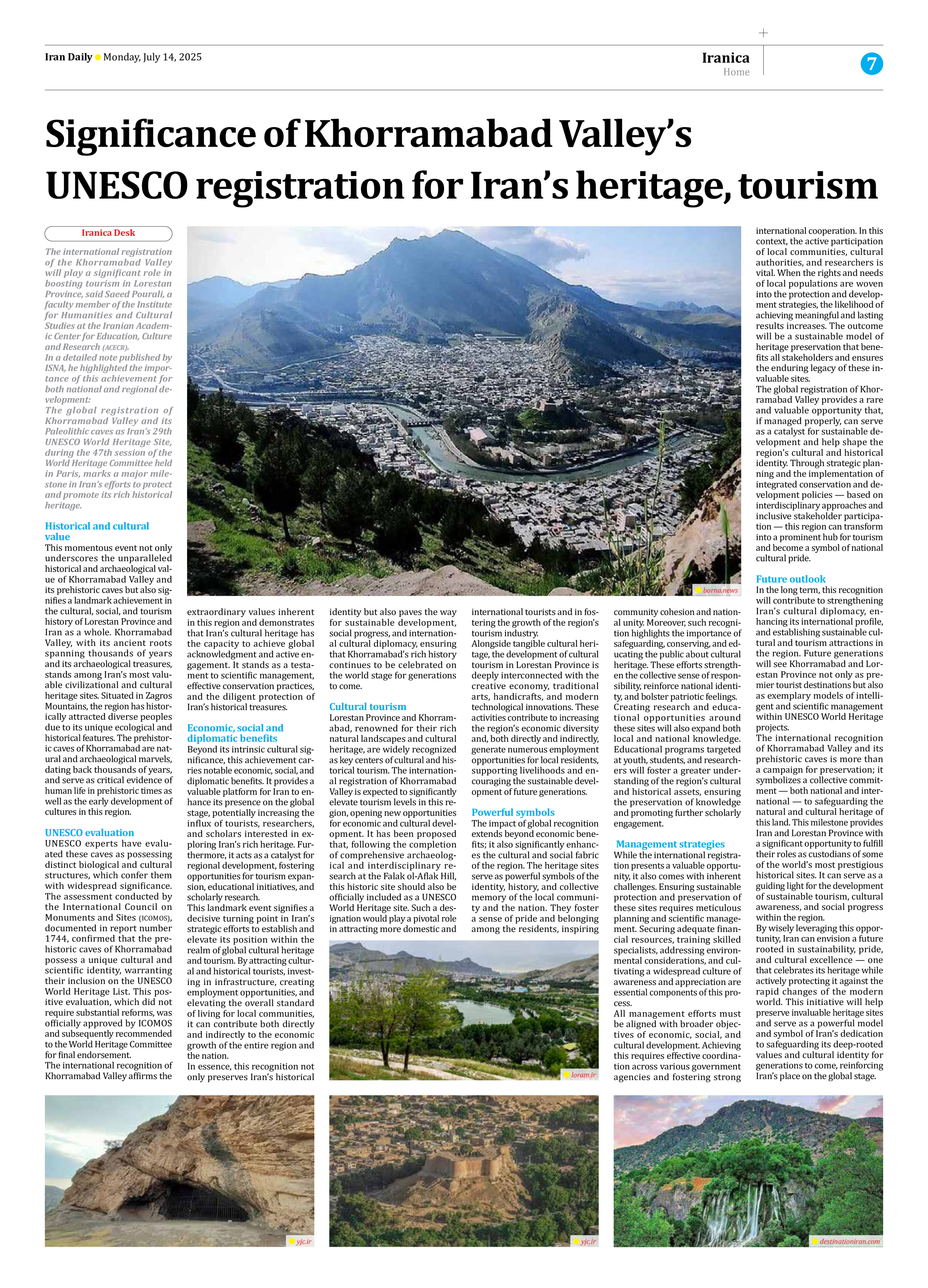
The global registration of Khorramabad Valley and its Paleolithic caves as Iran’s 29th UNESCO World Heritage Site, during the 47th session of the World Heritage Committee held in Paris, marks a major milestone in Iran’s efforts to protect and promote its rich historical heritage.
Historical and cultural value
This momentous event not only underscores the unparalleled historical and archaeological value of Khorramabad Valley and its prehistoric caves but also signifies a landmark achievement in the cultural, social, and tourism history of Lorestan Province and Iran as a whole. Khorramabad Valley, with its ancient roots spanning thousands of years and its archaeological treasures, stands among Iran’s most valuable civilizational and cultural heritage sites. Situated in Zagros Mountains, the region has historically attracted diverse peoples due to its unique ecological and historical features. The prehistoric caves of Khorramabad are natural and archaeological marvels, dating back thousands of years, and serve as critical evidence of human life in prehistoric times as well as the early development of cultures in this region.
UNESCO evaluation
UNESCO experts have evaluated these caves as possessing distinct biological and cultural structures, which confer them with widespread significance. The assessment conducted by the International Council on Monuments and Sites (ICOMOS), documented in report number 1744, confirmed that the prehistoric caves of Khorramabad possess a unique cultural and scientific identity, warranting their inclusion on the UNESCO World Heritage List. This positive evaluation, which did not require substantial reforms, was officially approved by ICOMOS and subsequently recommended to the World Heritage Committee for final endorsement.
The international recognition of Khorramabad Valley affirms the extraordinary values inherent in this region and demonstrates that Iran’s cultural heritage has the capacity to achieve global acknowledgment and active engagement. It stands as a testament to scientific management, effective conservation practices, and the diligent protection of Iran’s historical treasures.
Economic, social and diplomatic benefits
Beyond its intrinsic cultural significance, this achievement carries notable economic, social, and diplomatic benefits. It provides a valuable platform for Iran to enhance its presence on the global stage, potentially increasing the influx of tourists, researchers, and scholars interested in exploring Iran’s rich heritage. Furthermore, it acts as a catalyst for regional development, fostering opportunities for tourism expansion, educational initiatives, and scholarly research.
This landmark event signifies a decisive turning point in Iran’s strategic efforts to establish and elevate its position within the realm of global cultural heritage and tourism. By attracting cultural and historical tourists, investing in infrastructure, creating employment opportunities, and elevating the overall standard of living for local communities, it can contribute both directly and indirectly to the economic growth of the entire region and the nation.
In essence, this recognition not only preserves Iran’s historical identity but also paves the way for sustainable development, social progress, and international cultural diplomacy, ensuring that Khorramabad’s rich history continues to be celebrated on the world stage for generations to come.
Cultural tourism
Lorestan Province and Khorramabad, renowned for their rich natural landscapes and cultural heritage, are widely recognized as key centers of cultural and historical tourism. The international registration of Khorramabad Valley is expected to significantly elevate tourism levels in this region, opening new opportunities for economic and cultural development. It has been proposed that, following the completion of comprehensive archaeological and interdisciplinary research at the Falak ol-Aflak Hill, this historic site should also be officially included as a UNESCO World Heritage site. Such a designation would play a pivotal role in attracting more domestic and international tourists and in fostering the growth of the region’s tourism industry.
Alongside tangible cultural heritage, the development of cultural tourism in Lorestan Province is deeply interconnected with the creative economy, traditional arts, handicrafts, and modern technological innovations. These activities contribute to increasing the region’s economic diversity and, both directly and indirectly, generate numerous employment opportunities for local residents, supporting livelihoods and encouraging the sustainable development of future generations.
Powerful symbols
The impact of global recognition extends beyond economic benefits; it also significantly enhances the cultural and social fabric of the region. The heritage sites serve as powerful symbols of the identity, history, and collective memory of the local community and the nation. They foster a sense of pride and belonging among the residents, inspiring community cohesion and national unity. Moreover, such recognition highlights the importance of safeguarding, conserving, and educating the public about cultural heritage. These efforts strengthen the collective sense of responsibility, reinforce national identity, and bolster patriotic feelings.
Creating research and educational opportunities around these sites will also expand both local and national knowledge. Educational programs targeted at youth, students, and researchers will foster a greater understanding of the region’s cultural and historical assets, ensuring the preservation of knowledge and promoting further scholarly engagement.
Management strategies
While the international registration presents a valuable opportunity, it also comes with inherent challenges. Ensuring sustainable protection and preservation of these sites requires meticulous planning and scientific management. Securing adequate financial resources, training skilled specialists, addressing environmental considerations, and cultivating a widespread culture of awareness and appreciation are essential components of this process.
All management efforts must be aligned with broader objectives of economic, social, and cultural development. Achieving this requires effective coordination across various government agencies and fostering strong international cooperation. In this context, the active participation of local communities, cultural authorities, and researchers is vital. When the rights and needs of local populations are woven into the protection and development strategies, the likelihood of achieving meaningful and lasting results increases. The outcome will be a sustainable model of heritage preservation that benefits all stakeholders and ensures the enduring legacy of these invaluable sites.
The global registration of Khorramabad Valley provides a rare and valuable opportunity that, if managed properly, can serve as a catalyst for sustainable development and help shape the region’s cultural and historical identity. Through strategic planning and the implementation of integrated conservation and development policies — based on interdisciplinary approaches and inclusive stakeholder participation — this region can transform into a prominent hub for tourism and become a symbol of national cultural pride.
Future outlook
In the long term, this recognition will contribute to strengthening Iran’s cultural diplomacy, enhancing its international profile, and establishing sustainable cultural and tourism attractions in the region. Future generations will see Khorramabad and Lorestan Province not only as premier tourist destinations but also as exemplary models of intelligent and scientific management within UNESCO World Heritage projects.
The international recognition of Khorramabad Valley and its prehistoric caves is more than a campaign for preservation; it symbolizes a collective commitment — both national and international — to safeguarding the natural and cultural heritage of this land. This milestone provides Iran and Lorestan Province with a significant opportunity to fulfill their roles as custodians of some of the world’s most prestigious historical sites. It can serve as a guiding light for the development of sustainable tourism, cultural awareness, and social progress within the region.
By wisely leveraging this opportunity, Iran can envision a future rooted in sustainability, pride, and cultural excellence — one that celebrates its heritage while actively protecting it against the rapid changes of the modern world. This initiative will help preserve invaluable heritage sites and serve as a powerful model and symbol of Iran’s dedication to safeguarding its deep-rooted values and cultural identity for generations to come, reinforcing Iran’s place on the global stage.