





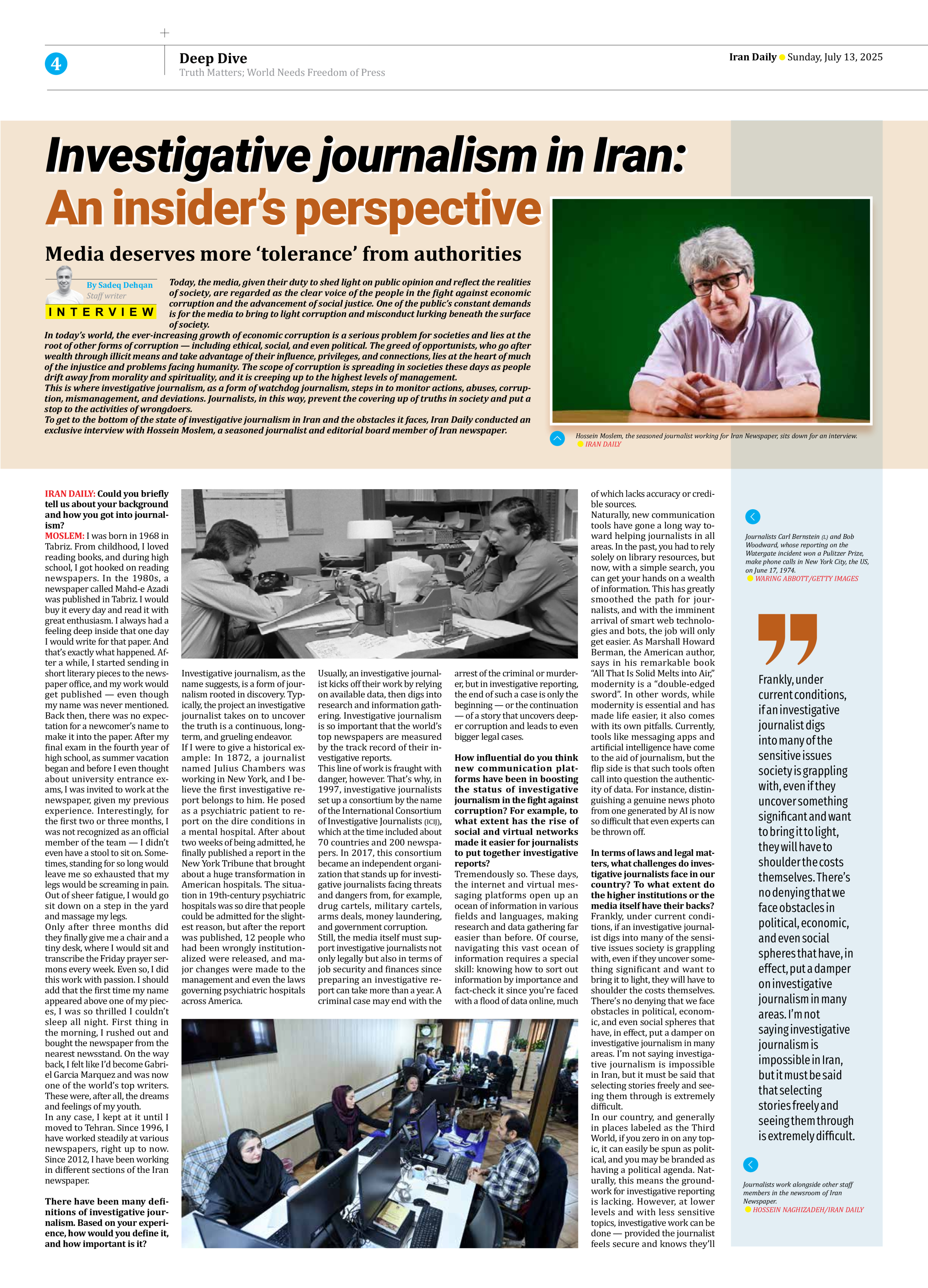


Investigative journalism in Iran: An insider’s perspective
Media deserves more ‘tolerance’ from authorities
Today, the media, given their duty to shed light on public opinion and reflect the realities of society, are regarded as the clear voice of the people in the fight against economic corruption and the advancement of social justice. One of the public’s constant demands is for the media to bring to light corruption and misconduct lurking beneath the surface of society. In today’s world, the ever-increasing growth of economic corruption is a serious problem for societies and lies at the root of other forms of corruption — including ethical, social, and even political. The greed of opportunists, who go after wealth through illicit means and take advantage of their influence, privileges, and connections, lies at the heart of much of the injustice and problems facing humanity. The scope of corruption is spreading in societies these days as people drift away from morality and spirituality, and it is creeping up to the highest levels of management. This is where investigative journalism, as a form of watchdog journalism, steps in to monitor actions, abuses, corruption, mismanagement, and deviations. Journalists, in this way, prevent the covering up of truths in society and put a stop to the activities of wrongdoers. To get to the bottom of the state of investigative journalism in Iran and the obstacles it faces, Iran Daily conducted an exclusive interview with Hossein Moslem, a seasoned journalist and editorial board member of Iran newspaper.
By Sadeq Dehqan
Staff writer
IRAN DAILY: Could you briefly tell us about your background and how you got into journalism?
MOSLEM: I was born in 1968 in Tabriz. From childhood, I loved reading books, and during high school, I got hooked on reading newspapers. In the 1980s, a newspaper called Mahd-e Azadi was published in Tabriz. I would buy it every day and read it with great enthusiasm. I always had a feeling deep inside that one day I would write for that paper. And that’s exactly what happened. After a while, I started sending in short literary pieces to the newspaper office, and my work would get published — even though my name was never mentioned. Back then, there was no expectation for a newcomer’s name to make it into the paper. After my final exam in the fourth year of high school, as summer vacation began and before I even thought about university entrance exams, I was invited to work at the newspaper, given my previous experience. Interestingly, for the first two or three months, I was not recognized as an official member of the team — I didn’t even have a stool to sit on. Sometimes, standing for so long would leave me so exhausted that my legs would be screaming in pain. Out of sheer fatigue, I would go sit down on a step in the yard and massage my legs.
Only after three months did they finally give me a chair and a tiny desk, where I would sit and transcribe the Friday prayer sermons every week. Even so, I did this work with passion. I should add that the first time my name appeared above one of my pieces, I was so thrilled I couldn’t sleep all night. First thing in the morning, I rushed out and bought the newspaper from the nearest newsstand. On the way back, I felt like I’d become Gabriel Garcia Marquez and was now one of the world’s top writers. These were, after all, the dreams and feelings of my youth.
In any case, I kept at it until I moved to Tehran. Since 1996, I have worked steadily at various newspapers, right up to now. Since 2012, I have been working in different sections of the Iran newspaper.
There have been many definitions of investigative journalism. Based on your experience, how would you define it, and how important is it?
Investigative journalism, as the name suggests, is a form of journalism rooted in discovery. Typically, the project an investigative journalist takes on to uncover the truth is a continuous, long-term, and grueling endeavor.
If I were to give a historical example: In 1872, a journalist named Julius Chambers was working in New York, and I believe the first investigative report belongs to him. He posed as a psychiatric patient to report on the dire conditions in a mental hospital. After about two weeks of being admitted, he finally published a report in the New York Tribune that brought about a huge transformation in American hospitals. The situation in 19th-century psychiatric hospitals was so dire that people could be admitted for the slightest reason, but after the report was published, 12 people who had been wrongly institutionalized were released, and major changes were made to the management and even the laws governing psychiatric hospitals across America.
Usually, an investigative journalist kicks off their work by relying on available data, then digs into research and information gathering. Investigative journalism is so important that the world’s top newspapers are measured by the track record of their investigative reports.
This line of work is fraught with danger, however. That’s why, in 1997, investigative journalists set up a consortium by the name of the International Consortium of Investigative Journalists (ICIJ), which at the time included about 70 countries and 200 newspapers. In 2017, this consortium became an independent organization that stands up for investigative journalists facing threats and dangers from, for example, drug cartels, military cartels, arms deals, money laundering, and government corruption.
Still, the media itself must support investigative journalists not only legally but also in terms of job security and finances since preparing an investigative report can take more than a year. A criminal case may end with the arrest of the criminal or murderer, but in investigative reporting, the end of such a case is only the beginning — or the continuation — of a story that uncovers deeper corruption and leads to even bigger legal cases.
How influential do you think new communication platforms have been in boosting the status of investigative journalism in the fight against corruption? For example, to what extent has the rise of social and virtual networks made it easier for journalists to put together investigative reports?
Tremendously so. These days, the internet and virtual messaging platforms open up an ocean of information in various fields and languages, making research and data gathering far easier than before. Of course, navigating this vast ocean of information requires a special skill: knowing how to sort out information by importance and fact-check it since you’re faced with a flood of data online, much of which lacks accuracy or credible sources.
Naturally, new communication tools have gone a long way toward helping journalists in all areas. In the past, you had to rely solely on library resources, but now, with a simple search, you can get your hands on a wealth of information. This has greatly smoothed the path for journalists, and with the imminent arrival of smart web technologies and bots, the job will only get easier. As Marshall Howard Berman, the American author, says in his remarkable book “All That Is Solid Melts into Air,” modernity is a “double-edged sword”. In other words, while modernity is essential and has made life easier, it also comes with its own pitfalls. Currently, tools like messaging apps and artificial intelligence have come to the aid of journalism, but the flip side is that such tools often call into question the authenticity of data. For instance, distinguishing a genuine news photo from one generated by AI is now so difficult that even experts can be thrown off.
In terms of laws and legal matters, what challenges do investigative journalists face in our country? To what extent do the higher institutions or the media itself have their backs?
Frankly, under current conditions, if an investigative journalist digs into many of the sensitive issues society is grappling with, even if they uncover something significant and want to bring it to light, they will have to shoulder the costs themselves. There’s no denying that we face obstacles in political, economic, and even social spheres that have, in effect, put a damper on investigative journalism in many areas. I’m not saying investigative journalism is impossible in Iran, but it must be said that selecting stories freely and seeing them through is extremely difficult.
In our country, and generally in places labeled as the Third World, if you zero in on any topic, it can easily be spun as political, and you may be branded as having a political agenda. Naturally, this means the groundwork for investigative reporting is lacking. However, at lower levels and with less sensitive topics, investigative work can be done — provided the journalist feels secure and knows they’ll be backed by supporting institutions and the media itself, both legally and professionally. This, of course, requires proper legislation. While there are protective laws in the press code and elsewhere, we still need supplementary regulations, since the lack of support remains palpable.
As a result, a journalist who follows up on a story to the fullest and even manages to dig up solid evidence may find their work goes nowhere because of the risks that publishing such material would pose to the media outlet.
All in all, in my view, right now in our country, the conditions are more favorable for analytical journalism than for investigative or exposé journalism. Analytical journalism helps get to the root of issues.
What role do organizational structures play in elevating investigative journalism, and to what extent do media outlets in our country make use of their resources for investigative reporting?
Preparing investigative reports, given their sensitive and complex nature, usually takes up a lot of time. One successful example is the exposure of child abuse in a Catholic church in Massachusetts by a group of journalists, which won them the 2003 Pulitzer Prize for Public Service and was depicted in the acclaimed 2015 film, Spotlight. This report was the result of months of teamwork by the Boston Globe journalists who holed up in a basement and put aside their daily duties to focus solely on this story.
Or take the Watergate scandal, a major political scandal in US history that ultimately brought down president Richard Nixon. Two young Washington Post reporters, Bob Woodward and Carl Bernstein, pieced together the elements of the spying and intelligence-gathering on Nixon’s rivals, eventually revealing that Nixon himself was aware of the break-in and illegal wiretapping at the Democratic headquarters. In the end, Nixon was forced to resign.
These two journalists stepped away from their usual newspaper work for months and poured all their energy into this investigation. Naturally, if our own media managers come around to the idea that investigative reporting can be so impactful, they might be persuaded to set up dedicated teams for such work.
Do current financial conditions in the media — especially print media — allow journalists to step away from their daily routines for extended periods and take on such assignments?
At present, only a handful of our media outlets have the means to take on special projects. That said, these projects don’t necessarily call for massive financial resources. For instance, a four- or five-person team could handle such a task, needing only a dedicated room and workspace. But when some newspapers struggle to fill up their pages due to staff shortages, or when journalists are working on three- or six-month contracts, and outlets can’t even keep up with monthly payroll, it’s clear they’re in no position to take on these kinds of assignments.
On top of that, media managers need to be convinced that when journalists break away from their usual duties, they’ll pour all their energy into the mission and deliver the expected results.
My next question is about the educational groundwork needed to raise the bar for investigative journalism. Do our media outlets put much stock in on-the-job training and boosting the scientific know-how of their journalists?
All in all, a range of factors must come together to set the stage for a healthy journalistic environment, in general, and for investigative journalism, in particular. These include social, political, and economic conditions, as well as both internal and external training.
Of course, recruiting talented individuals should also be on the agenda since investigative journalism, beyond training and resources, calls for a special temperament and behavioral traits. Many skilled journalists may not be cut out for investigative work as it demands persistence, tenacity, courage, willpower, and tirelessness. You might knock on doors dozens of times with no answer, but you can’t lose heart; You must stick with it and even put yourself in harm’s way to get results. Training certainly helps build up the necessary skills, but it’s not enough — journalists themselves must be naturally inclined and possess the right traits.
How familiar do you think our journalists are with investigative journalism? If you asked members of a newsroom to define it and its capabilities, how many could come up with a solid answer?
Naturally, those with an academic background in the field are certainly familiar with investigative journalism and its required steps. But those who have actually rolled up their sleeves and participated in such work are very few. How well others know the field comes down to their personal interest in studying it, but in my view, not many in the newsrooms are truly up to speed.
Does this mean that many of our journalists lack the necessary expertise for their profession?
Yes, this issue has been rearing its head since the late 2000s and early 2010s, with a noticeable drop in the recruitment of capable staff in newsrooms. A newsroom is like a football team: Success depends on a mix of seasoned veterans and energetic newcomers. A newsroom needs an experienced, supportive team so that when a newcomer comes on board, they can draw on the knowledge of the old hands — ensuring that as veterans bow out, their experience is passed down to the next generation.
Unfortunately, in recent years, we’ve gradually seen a drop-off in experienced, capable staff in newsrooms. I’m not saying the entire generation of seasoned professionals has vanished, but many have gradually drifted away from journalism for other careers, while some have simply thrown in the towel due to tough working conditions and left the country altogether. As these experts and veterans move on, the two-way relationship between newcomers and experts breaks down, which inevitably takes a toll on the work.
At the same time, I believe that in recent years, the recruitment of new journalists has become somewhat careless. The reason is clear: When society gets hit by economic and social shocks, every sector feels the impact. One factor is the weakened financial backbone of the media, which hampers their ability to bring in skilled professionals. Another is the rise of favoritism over merit in hiring; In the past, few were hired thanks to personal connections, but now, some are brought in simply because they know the right people. While some of these hires may find their footing and stick around, the odds of a true standout emerging from this group are slim. These are just some of the reasons behind the weakening of our newsrooms.
As a seasoned veteran in the news and media profession, what advice would you give to build up a two-way relationship between the government and the media so that we can see through issues clearly and bring about social and economic justice?
In my view, the government must cut some slack and show more tolerance toward the media because the media are a cornerstone of democracy and justice in society. Every government can lean on them to root out the ills and corruption that can even harm the government itself.
In our country and worldwide — not just recently but always — those in power and wealth, when they have vested interests, will naturally push back against any journalism that tries to poke into their affairs and call out their corruption. Those who hold the reins of power and cash in on illicit gains simply cannot stand losing their position, and they strike back at any perceived threat. So, under such circumstances, few journalists are willing to step into such a dangerous arena. Even if they take on the risks and accept responsibility, the powers that be will stand in their way. Now imagine an investigative journalist who, with stealth and professionalism, unearths the schemes of economic corruptors so well that they cannot shut him down. Even then, which media outlet would be willing to take the plunge and publish such a report without fear of repercussions?
We live in an age where social and virtual networks have carved out a major role in spreading news and events, and citizen journalists have broken into the information scene. To what extent can these citizen journalists pitch in as investigative reporters and help blow the whistle on corruption?
Naturally, with the internet’s expansion and new media tools like social networks available to the public, any ordinary person can now turn themselves into a mobile media outlet and put out photos and news in no time. But how accurate and impactful their work can be is another matter.
If you think, however, that social media and citizen journalists can fill in for official media and professional reporters, I haven’t bought into that yet. I can accept that such individuals can play a part in the news puzzle, but their reports cannot be counted on as official, precise, and credible sources by society. Right now, if you put out a piece of news on social media and simultaneously a widely circulated newspaper prints another story with a different angle and conclusion, which one would you put your trust in? Naturally, official media can tap into social networks and citizen journalism to their advantage and use them as backup for newsroom staff, but they cannot take over the role of professional media and reporters.
What do you think is the ethical boundary for journalists when digging into individuals’ private lives to dig up information on a story or case — how can they stay out of private spheres while still getting to the bottom of necessary facts?
This issue has been brought up since journalism began some 400 years ago, and it took on a more serious shape from the late 19th century when journalism became professionalized. The line journalists can cross into individuals’ private lives for news gathering has always been debated.
To me, privacy means exactly where your pursuit no longer serves the public interest. That’s the key point: Sometimes a person’s behavior can impact millions, and that’s where journalists step in. But where it’s about personal reputation and unrelated to the public good, journalists should back off. Knowing this boundary comes down to the journalist’s own wisdom. Of course, laws now largely spell out these limits.
Overall, it seems there is a connection between investigative journalists and the police. How much can these two team up and lend a hand to each other?
In some cases, the work of police and investigative journalists overlaps. The police, with judicial authority, have much more room to dig into the truth and get involved in matters than investigative journalists do. Our journalists lack broad legal tools to penetrate institutions and scrutinize their performance. So, if the legal framework opens up for journalists, they can certainly collaborate closely with the police in many cases, and both sides’ work will mesh together more effectively.