





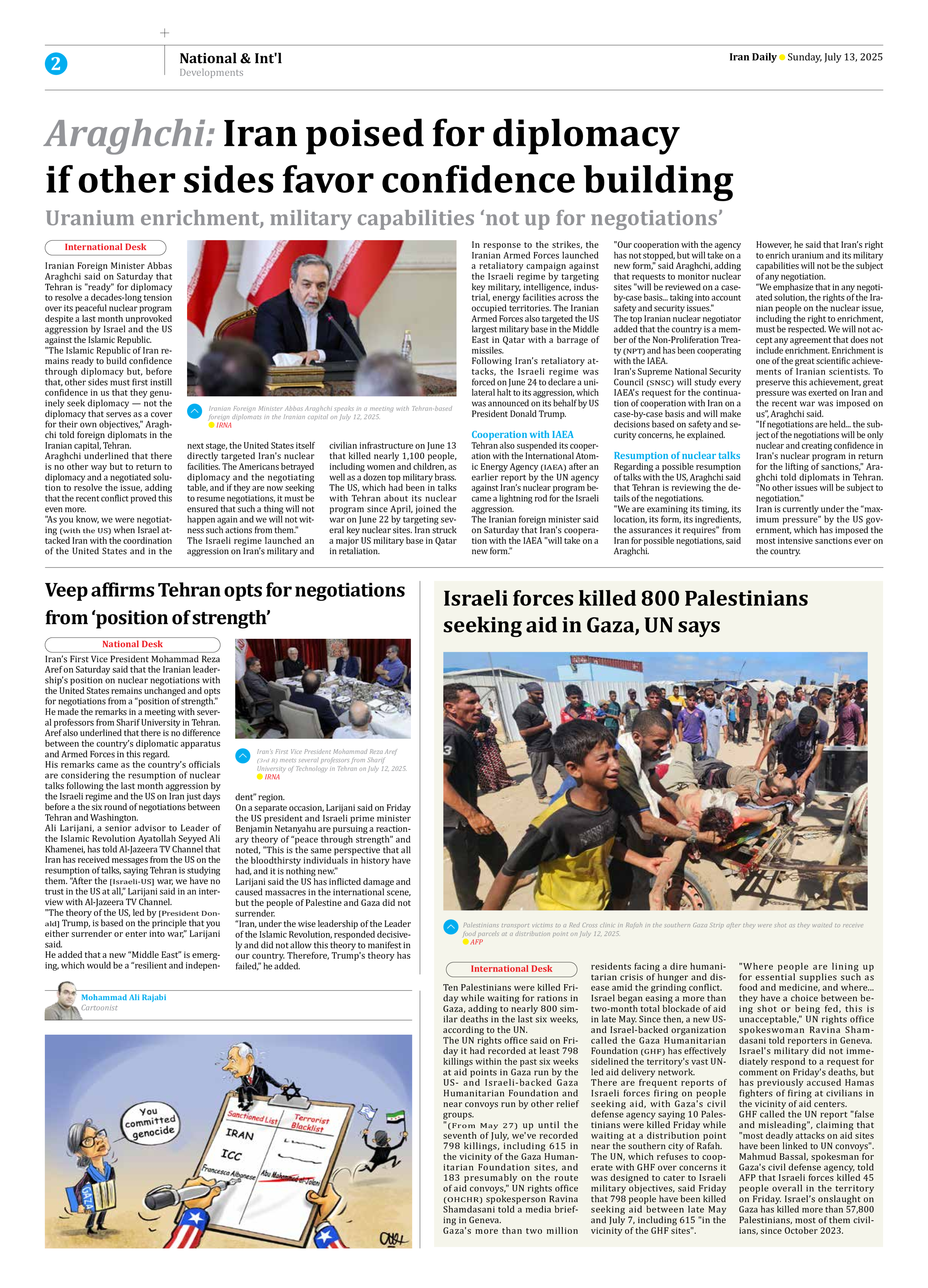


Araghchi: Iran poised for diplomacy if other sides favor confidence building
Uranium enrichment, military capabilities ‘not up for negotiations’
Iranian Foreign Minister Abbas Araghchi said on Saturday that Tehran is "ready" for diplomacy to resolve a decades-long tension over its peaceful nuclear program despite a last month unprovoked aggression by Israel and the US against the Islamic Republic.
"The Islamic Republic of Iran remains ready to build confidence through diplomacy but, before that, other sides must first instill confidence in us that they genuinely seek diplomacy — not the diplomacy that serves as a cover for their own objectives," Araghchi told foreign diplomats in the Iranian capital, Tehran.
Araghchi underlined that there is no other way but to return to diplomacy and a negotiated solution to resolve the issue, adding that the recent conflict proved this even more.
"As you know, we were negotiating (with the US) when Israel attacked Iran with the coordination of the United States and in the next stage, the United States itself directly targeted Iran's nuclear facilities. The Americans betrayed diplomacy and the negotiating table, and if they are now seeking to resume negotiations, it must be ensured that such a thing will not happen again and we will not witness such actions from them."
The Israeli regime launched an aggression on Iran’s military and civilian infrastructure on June 13 that killed nearly 1,100 people, including women and children, as well as a dozen top military brass.
The US, which had been in talks with Tehran about its nuclear program since April, joined the war on June 22 by targeting several key nuclear sites. Iran struck a major US military base in Qatar in retaliation.
In response to the strikes, the Iranian Armed Forces launched a retaliatory campaign against the Israeli regime by targeting key military, intelligence, industrial, energy facilities across the occupied territories. The Iranian Armed Forces also targeted the US largest military base in the Middle East in Qatar with a barrage of missiles.
Following Iran’s retaliatory attacks, the Israeli regime was forced on June 24 to declare a unilateral halt to its aggression, which was announced on its behalf by US President Donald Trump.
Cooperation with IAEA
Tehran also suspended its cooperation with the International Atomic Energy Agency (IAEA) after an earlier report by the UN agency against Iran’s nuclear program became a lightning rod for the Israeli aggression.
The Iranian foreign minister said on Saturday that Iran's cooperation with the IAEA "will take on a new form.”
"Our cooperation with the agency has not stopped, but will take on a new form," said Araghchi, adding that requests to monitor nuclear sites "will be reviewed on a case-by-case basis... taking into account safety and security issues."
The top Iranian nuclear negotiator added that the country is a member of the Non-Proliferation Treaty (NPT) and has been cooperating with the IAEA.
Iran's Supreme National Security Council (SNSC) will study every IAEA’s request for the continuation of cooperation with Iran on a case-by-case basis and will make decisions based on safety and security concerns, he explained.
Resumption of nuclear talks
Regarding a possible resumption of talks with the US, Araghchi said that Tehran is reviewing the details of the negotiations.
"We are examining its timing, its location, its form, its ingredients, the assurances it requires" from Iran for possible negotiations, said Araghchi.
However, he said that Iran’s right to enrich uranium and its military capabilities will not be the subject of any negotiation.
“We emphasize that in any negotiated solution, the rights of the Iranian people on the nuclear issue, including the right to enrichment, must be respected. We will not accept any agreement that does not include enrichment. Enrichment is one of the great scientific achievements of Iranian scientists. To preserve this achievement, great pressure was exerted on Iran and the recent war was imposed on us”, Araghchi said.
"If negotiations are held... the subject of the negotiations will be only nuclear and creating confidence in Iran's nuclear program in return for the lifting of sanctions," Araghchi told diplomats in Tehran. "No other issues will be subject to negotiation."
Iran is currently under the “maximum pressure” by the US government, which has imposed the most intensive sanctions ever on the country.