







Pezeshkian: Tehran to resume cooperation if IAEA redresses double standards
Iranian President Masoud Pezeshkian said on Thursday that Tehran will resume its cooperation with the UN nuclear agency if the agency abandons its “double standards” policies regarding Tehran’s nuclear program.
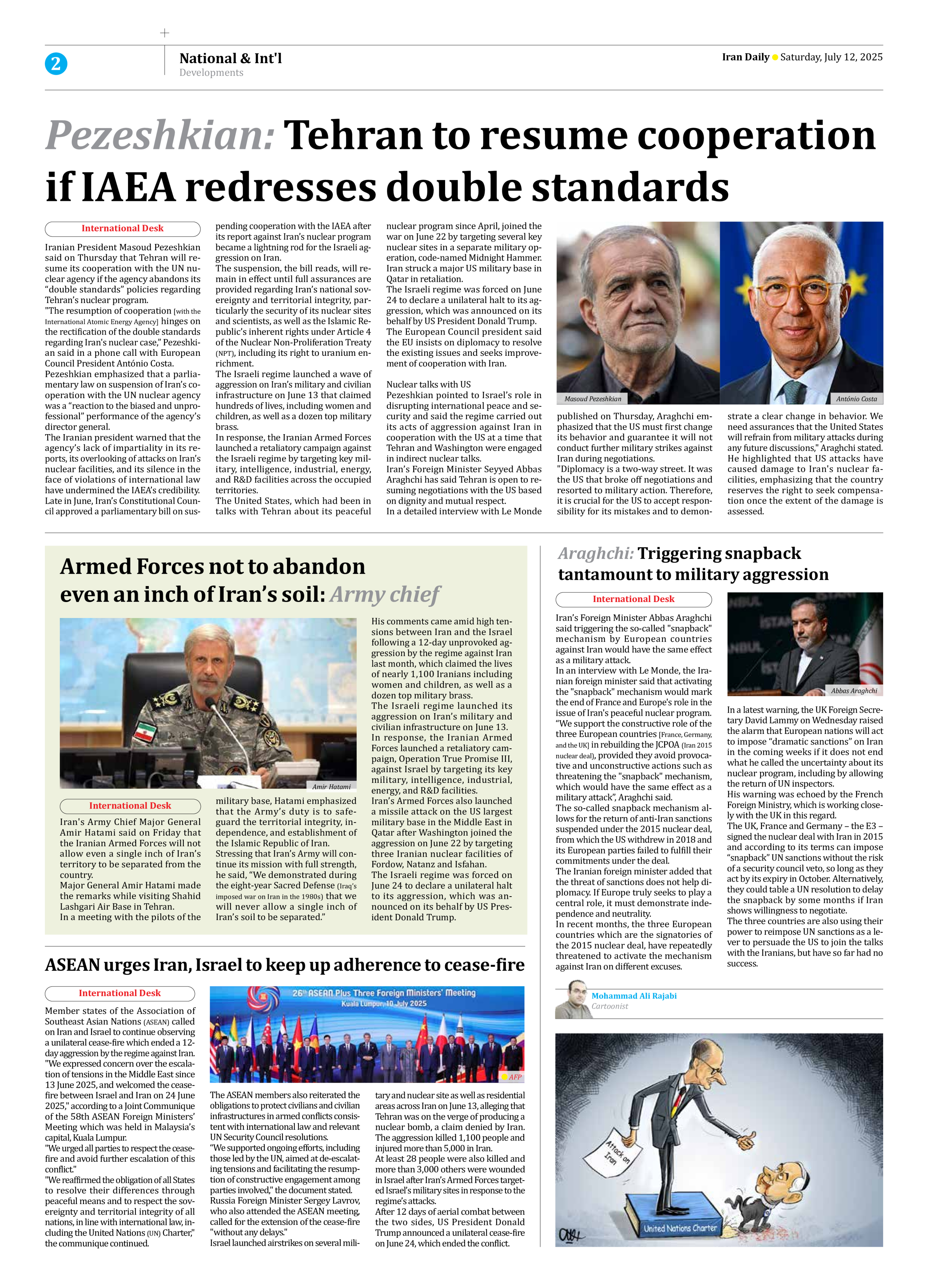
"The resumption of cooperation [with the International Atomic Energy Agency] hinges on the rectification of the double standards regarding Iran's nuclear case,” Pezeshkian said in a phone call with European Council President António Costa.
Pezeshkian emphasized that a parliamentary law on suspension of Iran’s cooperation with the UN nuclear agency was a “reaction to the biased and unprofessional” performance of the agency’s director general.
The Iranian president warned that the agency’s lack of impartiality in its reports, its overlooking of attacks on Iran’s nuclear facilities, and its silence in the face of violations of international law have undermined the IAEA’s credibility.
Late in June, Iran’s Constitutional Council approved a parliamentary bill on suspending cooperation with the IAEA after its report against Iran’s nuclear program became a lightning rod for the Israeli aggression on Iran.
The suspension, the bill reads, will remain in effect until full assurances are provided regarding Iran’s national sovereignty and territorial integrity, particularly the security of its nuclear sites and scientists, as well as the Islamic Republic’s inherent rights under Article 4 of the Nuclear Non-Proliferation Treaty (NPT), including its right to uranium enrichment.
The Israeli regime launched a wave of aggression on Iran’s military and civilian infrastructure on June 13 that claimed hundreds of lives, including women and children, as well as a dozen top military brass.
In response, the Iranian Armed Forces launched a retaliatory campaign against the Israeli regime by targeting key military, intelligence, industrial, energy, and R&D facilities across the occupied territories.
The United States, which had been in talks with Tehran about its peaceful nuclear program since April, joined the war on June 22 by targeting several key nuclear sites in a separate military operation, code-named Midnight Hammer. Iran struck a major US military base in Qatar in retaliation.
The Israeli regime was forced on June 24 to declare a unilateral halt to its aggression, which was announced on its behalf by US President Donald Trump.
The European Council president said the EU insists on diplomacy to resolve the existing issues and seeks improvement of cooperation with Iran.
Nuclear talks with US
Pezeshkian pointed to Israel’s role in disrupting international peace and security and said the regime carried out its acts of aggression against Iran in cooperation with the US at a time that Tehran and Washington were engaged in indirect nuclear talks.
Iran’s Foreign Minister Seyyed Abbas Araghchi has said Tehran is open to resuming negotiations with the US based on dignity and mutual respect.
In a detailed interview with Le Monde published on Thursday, Araghchi emphasized that the US must first change its behavior and guarantee it will not conduct further military strikes against Iran during negotiations.
"Diplomacy is a two-way street. It was the US that broke off negotiations and resorted to military action. Therefore, it is crucial for the US to accept responsibility for its mistakes and to demonstrate a clear change in behavior. We need assurances that the United States will refrain from military attacks during any future discussions," Araghchi stated.
He highlighted that US attacks have caused damage to Iran's nuclear facilities, emphasizing that the country reserves the right to seek compensation once the extent of the damage is assessed.