







US public opinion could tie Trump’s hands in war with Iran
By Charli Carpenter
Professor of political science and legal studies
More than two weeks after the United States unleashed 75 precision-guided munitions against three key Iranian nuclear sites, debate still rages over how much damage was caused by Operation Midnight Hammer, as the attack was called. Regardless of their material outcome, however, the strikes were significant in political terms, raising the stakes between Washington and Tehran in their standoff over Iran’s nuclear program.
Any further escalation between the two sides was headed off after Iran launched a volley of missiles at a US military base in Qatar, while taking care to minimize casualties. For now, too, the cease-fire that US President Donald Trump brokered between Iran and Israel, whose campaign of air attacks a week before had initiated the conflict, appears to be holding.
Nevertheless, the skirmish raises questions about how Americans would react to a more protracted conflict with Iran in the future. One question in particular presents itself: How tolerant would US citizens be of large-scale attacks against Iranian cities and their civilian inhabitants should the US engage in a whole-scale conventional war against Iran?
The answer is: not very.
The first reason to believe so comes from the basic information on public attitudes toward even the initial US strikes themselves, all carried out against military targets. In breaking down an Economist/YouGov poll on the possibility of a US attack against Iran, half of which was conducted before and half after the bombings took place, political scientist Paul Whiteley found limited support among Americans for the military operation. Even among Trump supporters, only half agreed the strikes were a good idea, with that proportion even lower among Democrats, women, and younger people. Although an Axios poll found that these numbers shifted a bit after Americans understood the rationale for the strikes, Whiteley’s analysis also echoes the findings of a CNN poll and a Quinnipiac University poll, and tracks with a TRIP poll of foreign policy experts.
Another reason to believe Americans would be concerned about widescale harm to civilian inhabitants of Iranian cities in a full-scale war comes from a survey Alex Montgomery and I conducted five years ago, as part of a replication of a previous survey conducted by our colleagues Scott Sagan and Benjamin Valentino. Sagan and Valentino asked Americans to imagine a bloody ground war with Iran that might be ended by either a conventional WWII-era saturation strike or a nuclear strike on an Iranian city. While they found a majority of respondents willing to go along with such an act, our study found that the number dropped dramatically when the format of the question was changed even slightly, and especially when respondents were primed to think about the ethics or legality of targeting civilians — something Americans care about deeply and which would certainly be an issue in a real-world scenario.
Last July, a research team at UMass Amherst’s Human Security Lab, which I direct, asked both US citizens and members of the US military a variant of the same question, this time regarding the use of nuclear weapons on an Iranian city. The question was part of a survey about attitudes toward the use of nuclear weapons more broadly, meant to help us measure the shifting strength of the nuclear taboo. Once again, we were heartened to find a majority of Americans would oppose the indiscriminate bombing of Iranians, especially with a nuclear weapon.
Moreover, only approximately half of military-trained Americans who participated in that survey said they would obey a hypothetical order to launch a nuclear strike against an Iranian city. Over a third stated they would refuse outright. Another 15 percent chose the “other / explain” option, and the majority of those stated in their own words that they would disobey, demand answers, desert, or resign in such a scenario. Those who stated they might obey such an order would do so only under very limited conditions, such as retaliation for an equivalent strike against a US city. Meanwhile, nearly half of military-trained Americans want significantly greater limitations placed on the use of US nuclear weapons. And 21 percent of them believe nuclear weapons should “never be used at all”.
This is heartening, considering that the hypothetical questions both the original researchers and our team asked were designed to simulate a situation in which ordinary people, especially US troops, might be predisposed to support a “last resort” strike: a grueling ground war against a traditional enemy of the US, in which ground troops’ lives were at stake, that could be ended through the use of a nuclear weapon — in other words, how many Americans perceive the situation that led to the World War II-era US atomic bombing of Hiroshima. Even so, the majority of both civilian and military respondents were opposed. Many considered the question itself immoral.
Even more hearteningly, three weeks ago, just before the US attack on Iran, our lab was fielding a follow-up to that survey, in which we repeated the question for military-trained Americans about conditions under which they could imagine obeying an order to assist in dropping a nuclear weapon on a civilian-inhabited city. Despite a dramatic shift in the organizational culture of the Defense Department and the US government’s stance on war crimes since our last survey, and an ongoing military crisis that might reasonably have shaped their answers, our newest data shows the number of military-trained Americans who say they would obey such an order has actually decreased by 5 percentage points in the past year since Trump took office.
This finding must be put in context. Social science research generally finds that Americans believe strongly in international law, particularly rules against directly targeting civilians with military force. But it also finds that conservatives are more likely than liberals to accept widespread collateral damage when civilian deaths are unintentional; and that Americans generally are more willing to bend the rules when it comes to their enemies, and even more so when wars become protracted. At the broadest level, Americans also care more about civilian casualties among their allies than among their adversaries. For these reasons, it is possible that a more protracted struggle with Iran would lead to an eventual desensitization among Americans to ratcheted-up violence, particularly if a tit-for-tat dynamic emerged either between the two countries or between Iran and Israel, a long-time US ally.
So why is there such widespread opposition to the recent US attack against Iran, in which the targets were purely military and the conflict short-lived? Gender, age, ethnicity, income level, and especially partisanship predict some of the findings. But Paul Whiteley also argues, based on the Economist/YouGov poll, that Americans overall are experiencing heightened anxiety about the chances of a world war, even possibly a nuclear war, occurring today compared to five years ago. “Around 58% thought the chances [of a world war] were greater, compared with only 11% who thought they were lower,” he wrote. “No less than 52% thought there was a greater chance [of nuclear war] with only 12% thinking that the chances were lower.”
Another reason is predicted by our original study, as well as work by other political scientists: Americans are sensitive to elite cues from international lawyers, human rights organizations, and the United Nations about the appropriate use of force. That includes not just the kinds of operational issues where military personnel are required to disobey unlawful orders, but also questions about the resort to force itself. In this case, as Paul Poast correctly argues, Israel was the aggressor against Iran, launching a military strike that could not be justified under the UN Charter. And when the US joined Israel’s side, it positioned itself on the wrong side of the rules-based international order, regardless of whether one may think that choice was the right call from a tactical and strategic perspective.
On June 26, for example, the UN Office of the High Commissioner of Human Rights released a statement citing numerous UN experts who roundly criticized the Israeli and US strikes. Pointing out the lack of any evidence that Iran intended to imminently attack the US or Israel with a nuclear weapon, the statement underscored that “‘[p]reventive’ or ‘anticipatory’ self-defence against speculative future threats, such as nuclear proliferation or terrorism, has not been permitted by international law since the United Nations Charter was adopted 80 years ago.”
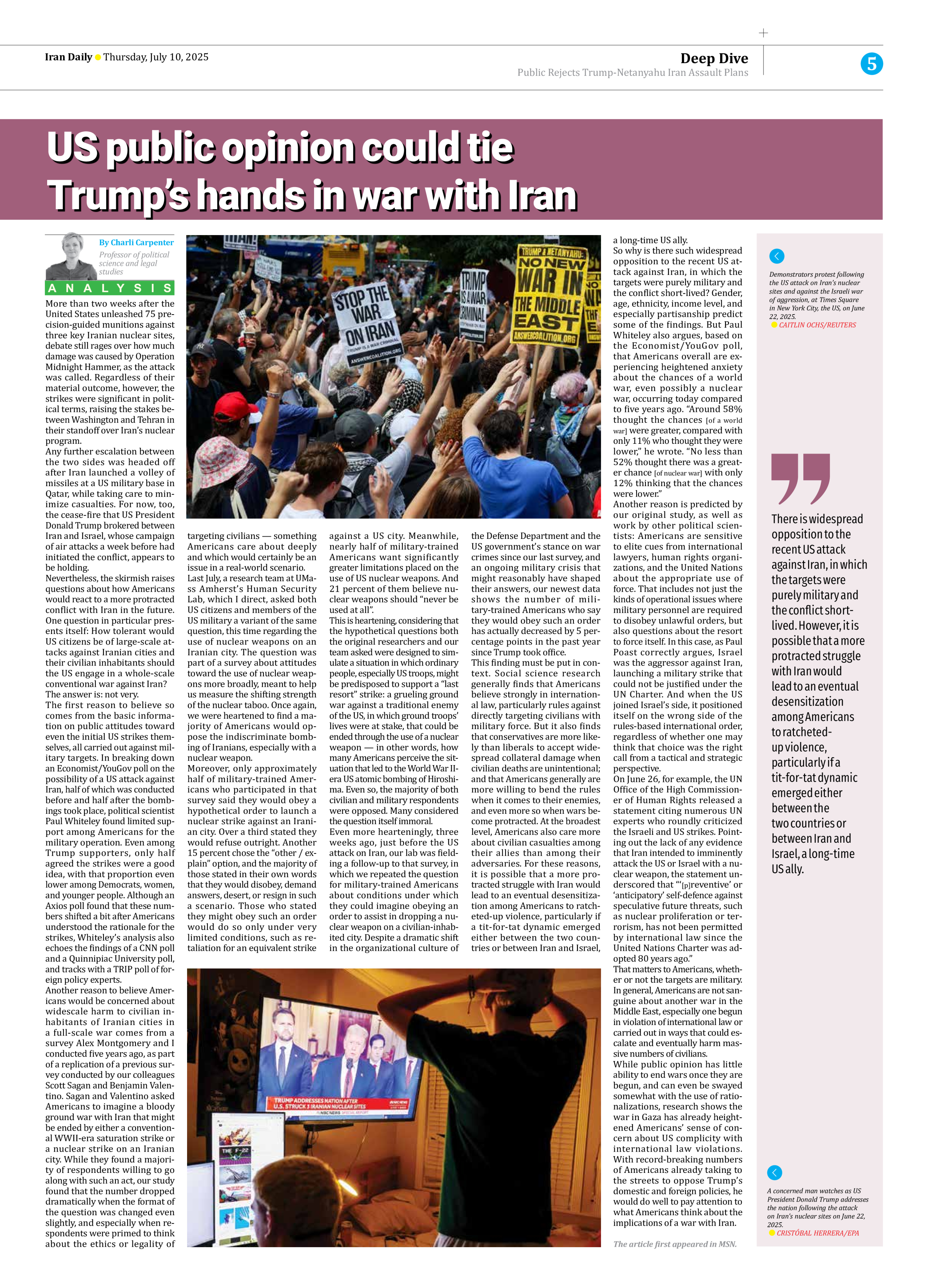
That matters to Americans, whether or not the targets are military. In general, Americans are not sanguine about another war in the Middle East, especially one begun in violation of international law or carried out in ways that could escalate and eventually harm massive numbers of civilians.
While public opinion has little ability to end wars once they are begun, and can even be swayed somewhat with the use of rationalizations, research shows the war in Gaza has already heightened Americans’ sense of concern about US complicity with international law violations. With record-breaking numbers of Americans already taking to the streets to oppose Trump’s domestic and foreign policies, he would do well to pay attention to what Americans think about the implications of a war with Iran.
The article first appeared in MSN.