







Iran’s underground cities as shelters, cultural treasures
Ancient underground hand-carved structures in Iran — alongside similar examples in countries like Turkey — served as settlements that were sometimes excavated to several stories deep within mountains or beneath the ground by ancient inhabitants. These subterranean spaces functioned both as refuges during climate-related floods and as safe havens during critical times such as wars and attacks by neighboring tribes, helping to safeguard the lives of early residents.
Distinctive examples
Iranian underground structures, such as those in the city of Samen and Arzan Fud village in Hamedan, as well as Meymand in Kerman Province and Kandovan in East Azarbaijan Province, stand out as unique examples of architecture that harmonizes with nature while providing secure settlements from ancient times. Today, the question arises: given the current conditions in the country, where the topic of shelters to protect against potential future conflicts has gained renewed importance, is it feasible to utilize these ancient underground cities in Iran in the modern era to ensure safety from emerging risks?
Samen Underground City
Ali Khaksar, an archaeologist and the director of the Samen and Arzan Fud cultural heritage sites in Hamedan Province, told ILNA that the Samen Underground City extends over a large area beneath the city’s houses, streets, and administrative buildings. Over the years, it has experienced disturbances caused by urban development and human interventions — such as activities by water, electricity, and gas departments — that have resulted in some damage. Nevertheless, the main foundation of the site remains well-preserved; despite its long history, the structure is still solid and intact. Natural erosion and deterioration have not been observed, and most of the damage has resulted from human activities.
Historical uses
He stated that this ancient hand-carved complex has been used across different periods and served various functions. He added, “Considering the artifacts and cultural materials discovered in the Samen Underground City, we hypothesize that it was constructed before the Parthian period, and its primary function at that time was likely religious and ritualistic.”
He continued, “When the Samen Underground City was abandoned during the Parthian period, it was repurposed as a tomb for burial purposes. This function persisted for a significant period of time.”
Khaksar further explained that studies of the skeletons discovered during archaeological excavations suggest that this space was used as a burial site from the Parthian period through the early Islamic centuries, spanning roughly 700 years. However, from the medieval Islamic era onward, the underground city was used for about 800 years solely as a shelter, providing emergency housing during times of insecurity and danger.
Stating that during the Islamic period, the inhabitants of the Samen Underground City only used the ground floor temporarily for residences during times of threat, Khaksar said, “Artifacts from the Ilkhanid, Timurid, Safavid, and Qajar periods have been uncovered during excavations at the site.”
Conservation and documentation
He further added, “Extensive restoration and conservation work have been undertaken in this complex, and its 3D documentation has been completed. All objects and cultural materials recovered from the excavations have been thoroughly cataloged, and the findings have been published.”
Potential and challenges
Khaksar said that the Samen Underground City has the potential to be used as a shelter because of its strategic location within the city.
Currently, two sections are open to tourists; therefore, these parts are not suitable for use as shelters at this moment. However, other sections of the site could serve as shelters, as they are structurally very robust. Constructed entirely of granite, these sections are resistant to collapse or destruction and are completely impermeable. Despite this, access is limited due to narrow corridors. Nonetheless, in emergency situations, nearby residents might potentially use these areas as refuges.
Arzan Fud Underground City
He added, “Regarding the Arzan Fud Underground City, which is the second national cultural heritage site in Hamedan Province and was discovered in 2000, four phases of archaeological excavations have been conducted there. This hand-carved complex extends over a vast area carved into black slate rocks. Located outside the city, in Arzan Fud village on the eastern slopes of Alvand Mountain, it is suitable for tourism and nature excursions. Initially, the primary purpose of the Arzan Fud Underground City was religious and ritualistic; however, in later periods, it was entirely used as a shelter.”
He said that despite its potential as a shelter, I do not recommend using it as a refuge for the public due to its remote location far from urban populated centers.
Architectural features
The archaeologist explained that the underground carved area spans approximately seven hectares and contains over 35 interconnected rooms within a single section. On the walls of these spaces, there are stone hooks, which initial studies hypothesized were used for tying animals. However, no remains of animal feces or other evidence of animal keeping have been found during excavations. Another hypothesis suggested that prisoners might have been restrained there, but again, no such evidence was discovered. Interestingly, all the rooms contain numerous hooks — one room, in particular, features about 15 carved into the walls. The mystery surrounding these stone hooks remains unsolved and warrants further, detailed investigation.
Function and historical timeline
Khaksar also discussed the function of the Arzan Fud Underground City, stating, “We found artifacts dating from the late Parthian and early Sassanid periods, and even more artifacts from the intermediate and later Islamic periods. We also recovered numerous cultural objects and pottery from the Ilkhanid era. The site is nearly ready to be opened to tourists within the next year and a half, with high security measures in place.
Khaksar noted the neglect of Iran’s underground cities’ historical and architectural value, adding, “Many of the country’s hand-carved structures are now abandoned and have suffered significant damage as a result of urban development and the expansion of towns and villages.”
Archaeological research
He referenced the archaeological activities carried out in the Samen and Arzan Fud Underground Cities, which have been ongoing since 2005. He mentioned that there have been six phases of excavation in Samen and four in Arzan Fud. Khaksar explained, “These hand-carved structures are primarily carved into rock and are located underground. Rock-cut tombs, most of which belonged to ancient kings, are quite common, along with tombs from the Sassanid era that have been found in Hamedan.”
Since 2016, the Samen and Arzan Fud cultural heritage sites have been established. Over the past two years, both locations have been prepared to welcome tourists.
Other rock-cut structures
Khaksar continued, “Other rock-cut structures, such as Kandovan and Meymand, also exist. Despite being thousands of years old, these structures are still inhabited and used today.”
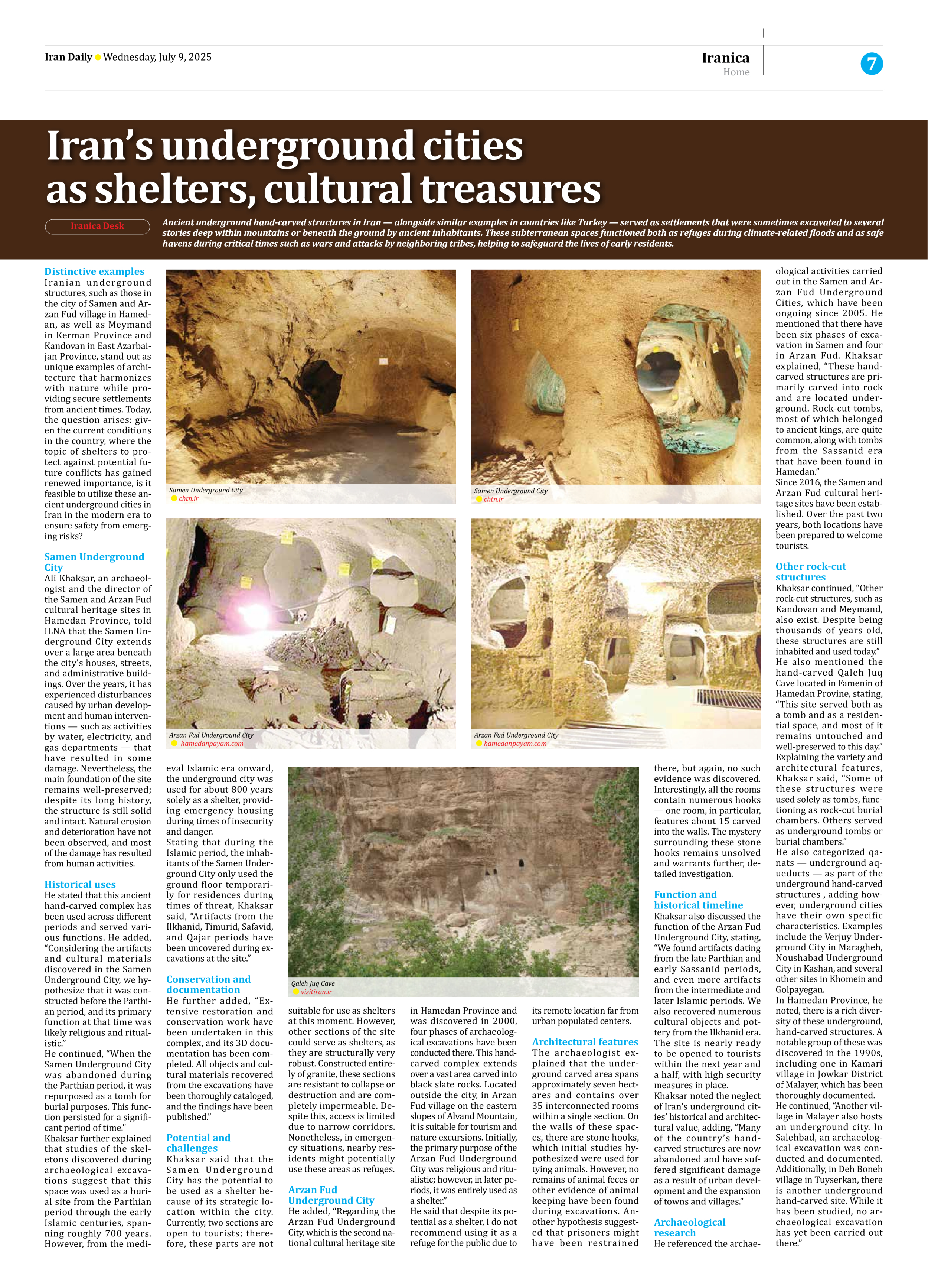
He also mentioned the hand-carved Qaleh Juq Cave located in Famenin of Hamedan Provine, stating, “This site served both as a tomb and as a residential space, and most of it remains untouched and well-preserved to this day.”
Explaining the variety and architectural features, Khaksar said, “Some of these structures were used solely as tombs, functioning as rock-cut burial chambers. Others served as underground tombs or burial chambers.”
He also categorized qanats — underground aqueducts — as part of the underground hand-carved structures , adding however, underground cities have their own specific characteristics. Examples include the Verjuy Underground City in Maragheh, Noushabad Underground City in Kashan, and several other sites in Khomein and Golpayegan.
In Hamedan Province, he noted, there is a rich diversity of these underground, hand-carved structures. A notable group of these was discovered in the 1990s, including one in Kamari village in Jowkar District of Malayer, which has been thoroughly documented.
He continued, “Another village in Malayer also hosts an underground city. In Salehbad, an archaeological excavation was conducted and documented. Additionally, in Deh Boneh village in Tuyserkan, there is another underground hand-carved site. While it has been studied, no archaeological excavation has yet been carried out there.”